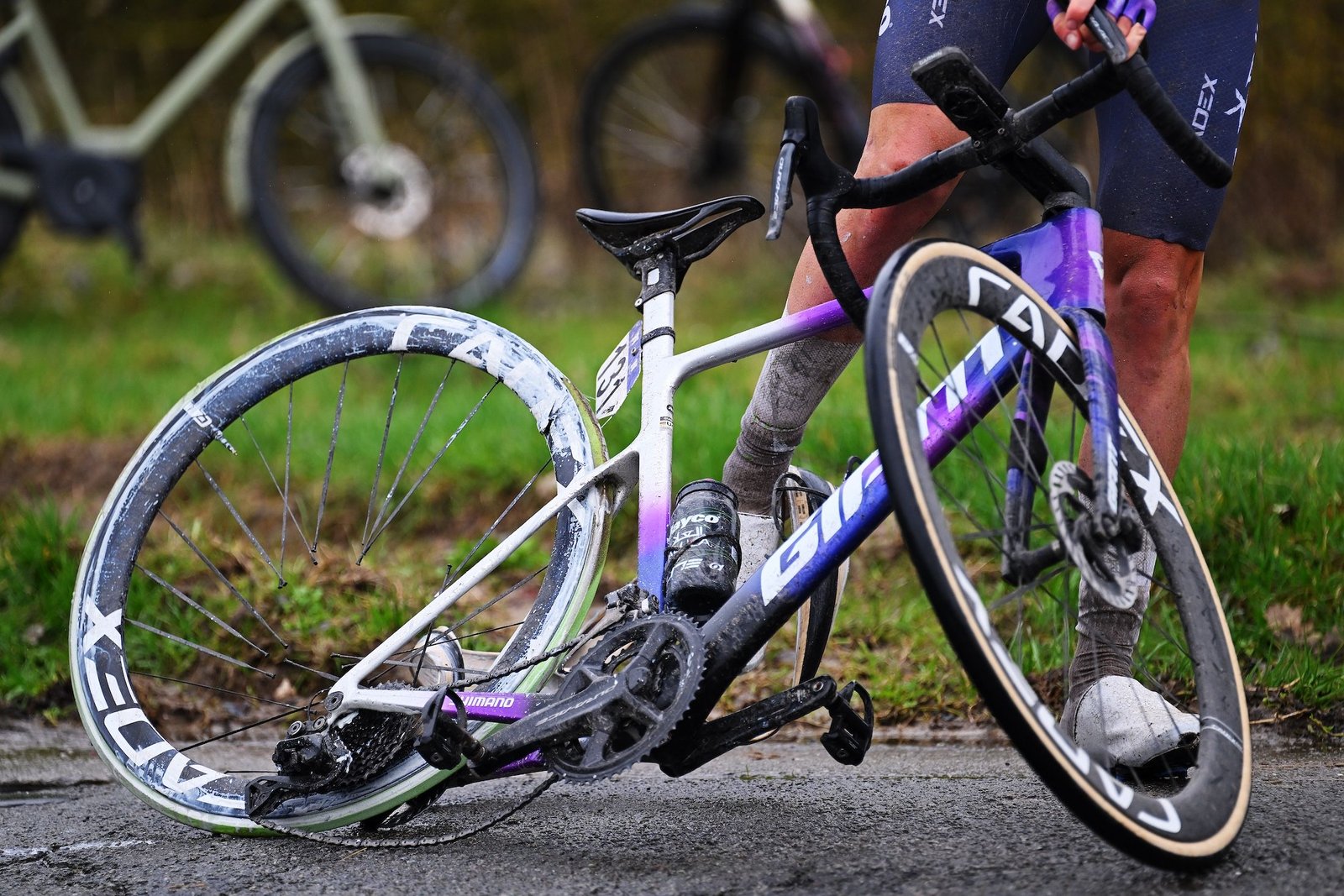
When this image and others from Omloop Nieuwsblad appeared on social media and online over the weekend, fans and commentators were quick to speculate as to what had happened, with some keen to blame hookless rims, tubeless tyres or carbon wheel construction.
The real cause however wasn’t so scandalous.
Amaury Capiot (Jayco AlUla) was forced to walk on while waiting for his team car
(Image credit: Getty Images)
So why did we see the spokes separate from the hub, and the rim retain it’s shape?
Carbon spokes and reinforced rims transfer more load into the hub and flanges, which likely explains why we saw hub flanges or spokes failing at the centre of the wheel in this case.
The enormous amount of energy transferred into the hyper-rigid system, without the tyre to manage it, is transferred in and out of the rim, into the spokes, then hub. That energy has to come out somewhere. Add pedalling force in a wheel that’s already damaged, and your wheel is not going to last long.
Regardless, the truth remains, that whilst some wheels can and no doubt have survived this kind of incident, no wheel, hookless, hooked, carbon or even alloy is meant to survive being ridden directly on cobbles without a tyre.
Without a tyre, cobblestones likely send some 30-50 times more force into the wheel than it was designed to withstand. So when tens of thousands of newtons strike a rim in milliseconds, failure is just physics.
Opinion – Why you should never ride on a flat

Founder of Spoon Customs that designed and built some of the world’s most coveted custom bikes, Andy has also been an Alpine ride guide, thus spending most of his life on two wheels
Now, I’m not a hookless fan. And the hooks clearly have a role in retaining the tyre in some circumstances, but my lengthy investigations last year, concluded that whilst the system works perfectly well when set-up correctly – and I have never experienced a problem with it myself – there’s a fairly narrow window in which it’s safe.
And for me, and almost every industry insider I asked, the Hookless window is decidedly tight. Especially for a system joe public is asked to set up and manage themselves, in a huge variety of variable settings.
A modern road tyre is not cosmetic. It is the bicycle’s primary suspension system. As chassis expert Tony Foale explains, in his many excellent books on the subject, a pneumatic tyre stretches the impact over time, reducing vertical wheel velocity, and spreading force around the rim.
Remove it, and the wheel system itself is incomplete, and the rim, spokes and hub is then forced to absorb the full blow of an impact almost instantaneously.
With a 30mm tyre in place, a sharp 25mm cobble hit at race speed transmits forces in the range of 3-6kN, the tyre physically deforms to absorb it and spreads the load around the rim. Modern wheels are designed to handle that. Not always without flatting of course, but they’re designed to handle it.
Remove the air from the tyre, or lose it completely and keep riding – as appears to have happened here – and that same impact can spike toward 150-250kN – a huge order higher. At that point, even a single stone (let alone a course made of cobbles) becomes a death sentence for what’s left of the wheel.

