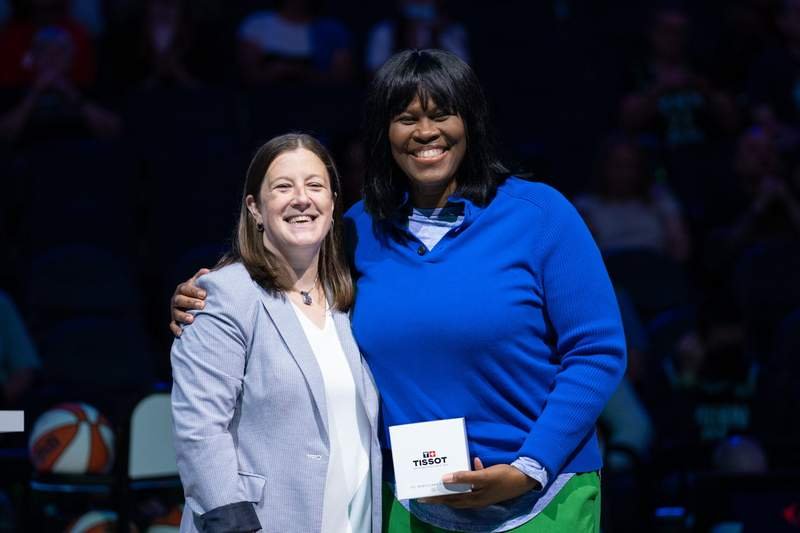
Minnesota Lynx president Carley Knox offered a strange injury theory, but there is a real workload argument hiding underneath it.
The WNBA has opened their 2026 season with several injury concerns across the league, which has turned availability into an early talking point.
Advertisement
Knox’s answer stood out because she connected that problem to CBA negotiations, rather than only bad luck, contact plays or normal early-season rust.
Photo by Ben Brewer/Getty Images
Carley Knox links WNBA injuries to CBA negotiations
Colin Salao shared the exchange in which Knox was asked about the early run of WNBA injuries and immediately pointed to the league’s labor talks.
“CBA negotiations, I’m serious. …We didn’t have players that were in great shape. … I think that had a little something to do with it.”
That is a bold explanation because CBA negotiations do not directly pull a hamstring, twist a knee or cause a concussion.
Advertisement
Still, her broader point was about preparation. Knox suggested some players had uneven offseason schedules because of negotiations, Unrivaled, overseas gaps and the sudden ramp into WNBA training camp.
Why the Lynx injury claim sounds odd but not random
The reason the comment sounded bizarre is that it blamed a business process for physical injuries.
But the WNBA’s offseason was not normal. The league and players’ union spent months working through a new CBA after players opted out of the previous deal, and the agreement brought major salary-cap and player-benefit changes before the 2026 season.
That kind of uncertainty can affect routines, travel, offseason leagues and when players fully lock into team-specific conditioning. It still does not prove causation, and Knox was careful to say it did not explain every injury.
Advertisement
Her argument works better as a workload concern than a blame assignment. The issue is not that negotiations injured players, but that a disrupted offseason may have made the ramp-up harder.
Early WNBA injuries made Knox’s comments louder
The comment spread because the league already has a visible injury list.
Recent reports have included Rickea Jackson’s season-ending knee injury, Sabrina Ionescu managing early-season availability and multiple teams carrying day-to-day or long-term injury concerns.
That context made Knox’s answer feel both provocative and timely. Fans can reject the framing and still understand why team executives are thinking about preparation.
The safer read is simple. Knox probably overstated the CBA angle, but she was really asking whether players had enough consistent runway to get game-ready before the season arrived.

