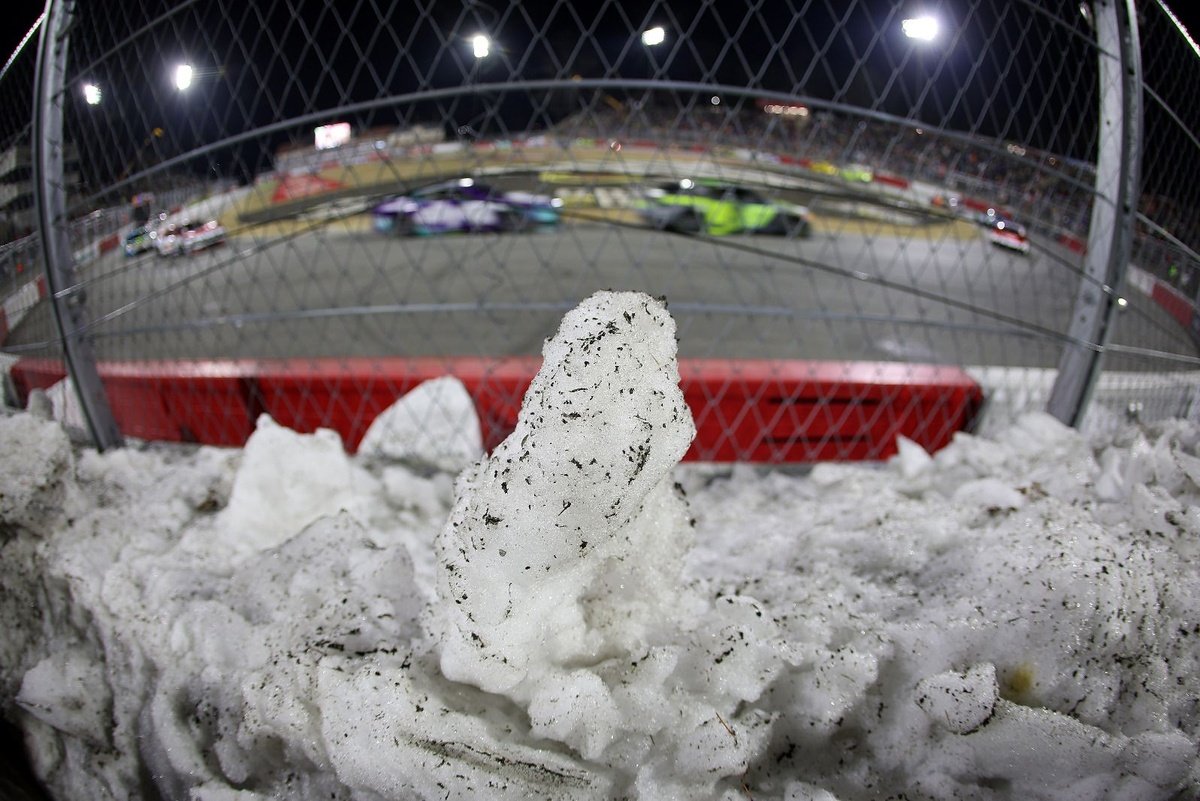
NASCAR’s senior competition leadership says there were ‘multiple layers’ to the decision to let teams refuel without penalty on Wednesday in the middle of a sleet-affected and caution-riddled Cookout Clash at Bowman Gray Stadium.
The decision drew the ire of several crew chiefs, those who filled their tank before the start of the race or those who took fuel at the expense of their track position and those who ran out leading NASCAR to make the call.
Advertisement
Kyle Larson ran out of fuel
Chase Elliott ran out of fuel
Kyle Busch topped off before NASCAR made the call
Tyler Reddick topped off before NASCAR made the call
This was in addition to general confusion surrounding which tires teams could bolt on their cars, and when, as a soaked track gradually begin to dry but with race control never officially deeming it dry enough to get off the Goodyear wet weather package.
Read Also:
Officiating for the NASCAR Cup Clash was a bit of a mess
Advertisement
Scott Miller, NASCAR Senior VP of Competition, cited the following reasons to let the field take fuel without penalty on Lap 165 when discussing the matter during the annual media Research & Development roundtable on Thursday afternoon:
This was the first race with the 750 horsepower package and fuel mileage was an inexact estimate There is no true pit road at Bowman Gray Maybe Larson and Elliott were mechanical failures and not fuel shortage issues Caution laps were not counting
“It’s the first time we’ve run that engine in an actual race with the higher horsepower, for one,” Miller said. “So was our data totally accurate that we went into the race with? We believe it is. We’re still going to go through all of that.
Advertisement
“The teams should have had full tanks when they went out for the Last Chance or The Clash, which obviously leads us to think they didn’t have enough fuel in the cars when they started.”
So, then it was a fair question to ask if it was required for them to have full tanks, and it was not which begs the question why not leave it up to the teams to choose when to give up their track position to refuel.
Crew chief notes only recommended full tanks, but that’s also added weight.
Advertisement
“So what we were managing from our side is that we had way more cautions than we’ve ever had,” Miller said. “We don’t have a pit road that you could just allow fueling at any time. We don’t have fire protection at every station, so just multiple layers.
“We were getting reports, where we obviously saw some of them run out of fuel, starting with (Larson) and we weren’t sure if there was a pickup issue; we didn’t have that information at the time so we allowed them to fuel.”
Miller thought not allowing them to take fuel, and having more cars run out, that would just create more problems for the show and race quality.
Advertisement
“We had 35 green flag laps to go with all the no count cautions that we could have had,” Miller said. “And we were trending pretty high at that point. So at that point, the decision was made that we didn’t want that to be the entire story of how the race ended.”
Miller said not counting cautions was ‘not our friends’ on Wednesday night.
Read Also:

Josh Berry and Austin Cindric advance into Clash after full-contact LCQ
The McDowell penalty
The first officiating topic of conversation came on the opening lap of the Cookout Clash Last Chance Race when race control deemed that Michael McDowell jumped the initial start on pole sitter Josh Berry from the front row.
Advertisement
McDowell was sent to the rear of the field and did not make it back to a transfer position and was eliminated before the main event. At the time, McDowell said he was aggressive but that he was also snookered by Berry, who fired off first.
That topic was tackled by senior Vice President of competition of NASCAR, Elton Sawyer.
“Once they get in the zone, then at that point, you’re looking at (Berry) to make sure he does that … and we don’t know wheel spin and all that,” Sawyer said. “But this one was pretty straightforward because (McDowell) launched … and he’s not even the control car and he fired before we got in the zone.
Advertisement
“I think Brad Moran had a nice conversation with him this morning and he says he was really aggressive, and we’re watching all the radio communication transcripts, and he said ‘I need to be aggressive,’ and he was.”
To read more Motorsport.com articles visit our website.

