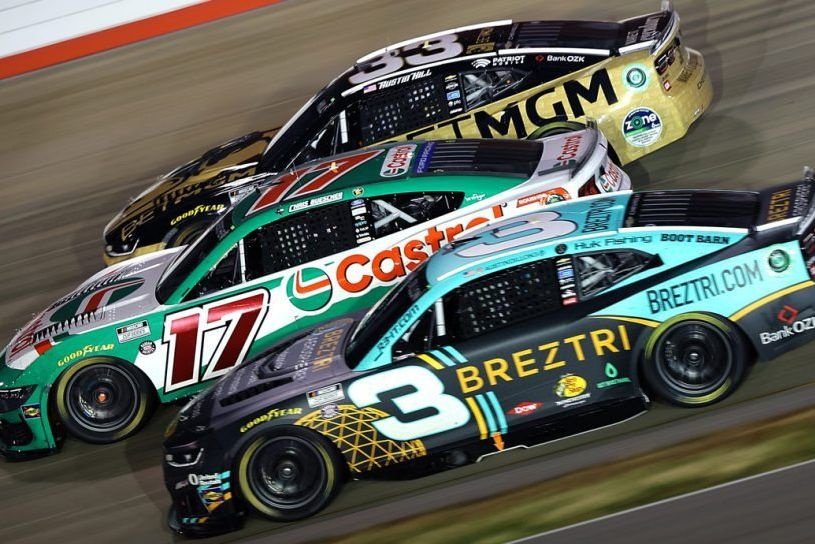
On the official NASCAR Hauler Talk Podcast, Senior Director of Racing Communications Amanda Ellis detailed the decision from the Sanctioning Body to not penalize Austin Dillon for what Brad Keselowski and spotter TJ Majors felt was intentional retaliation on Sunday at Nashville Superspeedway.
The entire ordeal began on Lap 145 when Dillon was spun off a chain reaction of events. There was a bottleneck on pit entry and coming down the frontstretch, Keselowski shaded low and stalled Dillon, who spun off the nose of Keselowski.
Advertisement
Dillon blamed Keselowski in real time.
Then, 47 laps later, there was a stack-up on a restart and Dillon followed Keselowski down the apron. Dillon connected with Keselowski, and crashed him as a result. In real time, Majors told Keselowski that he felt it was intentional payback and Keselowski himself indicated the same conviction
“You know, I felt like we had just made the adjustments on the car we needed to be competitive … and it’s pretty clear he wrecked me intentionally after seeing that replay,” Keselowski said on the Prime Video broadcast. “So, turnabout is fair play.”
Advertisement
For their part, NASCAR officials did take a look at it, but didn’t see anything that drew their suspicions. Ellis said that NASCAR competition strategist Scott Miller looked at all the SMT data and radio transmissions.
“When that incident occurred, you do kind of take notice what happened on the track,” Ellis said. “We actually have the ability …
“Scott Miller pulled all the data from that incident, and we knew pretty quickly that Austin was out of the throttle and they both were at the time of the incident. They obviously tangled on the track, and then the incident happened, right? … But we were able to tell pretty quickly that it wasn’t a situation where Austin was in the gas or anything related to that.
Advertisement
“To your point, TV also kind of made that judgment call that they didn’t think it was on purpose event though they had a difference of opinion about the race. We think it was more of a racing incident in NASCAR’s opinion.”
Ellis referred to the broadcast analysts of Dale Earnhardt Jr. and Steve Letarte who didn’t see anything that looked intentional.
On Tuesday, Majors was still adamant that it was on purpose, and said as much to Dale Jr. Download co-host Dale Earnhardt Jr.
Advertisement
“Just watching it, to me, he’s just tracking him. Out of the corner, he’s like, ‘Oh, I’m going where he goes.’ He’s looking for him,” Majors said.
And Earnhardt still buying it either.
“My opinion is that, did he try to wreck you on purpose? I don’t think he did. Did he give a shit that you wrecked? No, but I don’t think, considering everything that they’ve had to go through the last couple of weeks, that they want to be out there wrecking people,” Earnhardt Jr. said.
Advertisement
What did Majors want Dillon to do?
“I would’ve lifted. To me, he’s just tracking Brad right there the entire time,” Majors said.
They were both off the throttle. Dillon lifted from 100 percent throttle out of Turn 4 to 17 percent throttle at the time of contact.
“I think everybody was checking up. I don’t think he drove into you on purpose,” Earnhardt said. “He sees (Noah Gragson) slide up the track, he’s getting down the track just like you are.”
To read more Motorsport.com articles visit our website.

