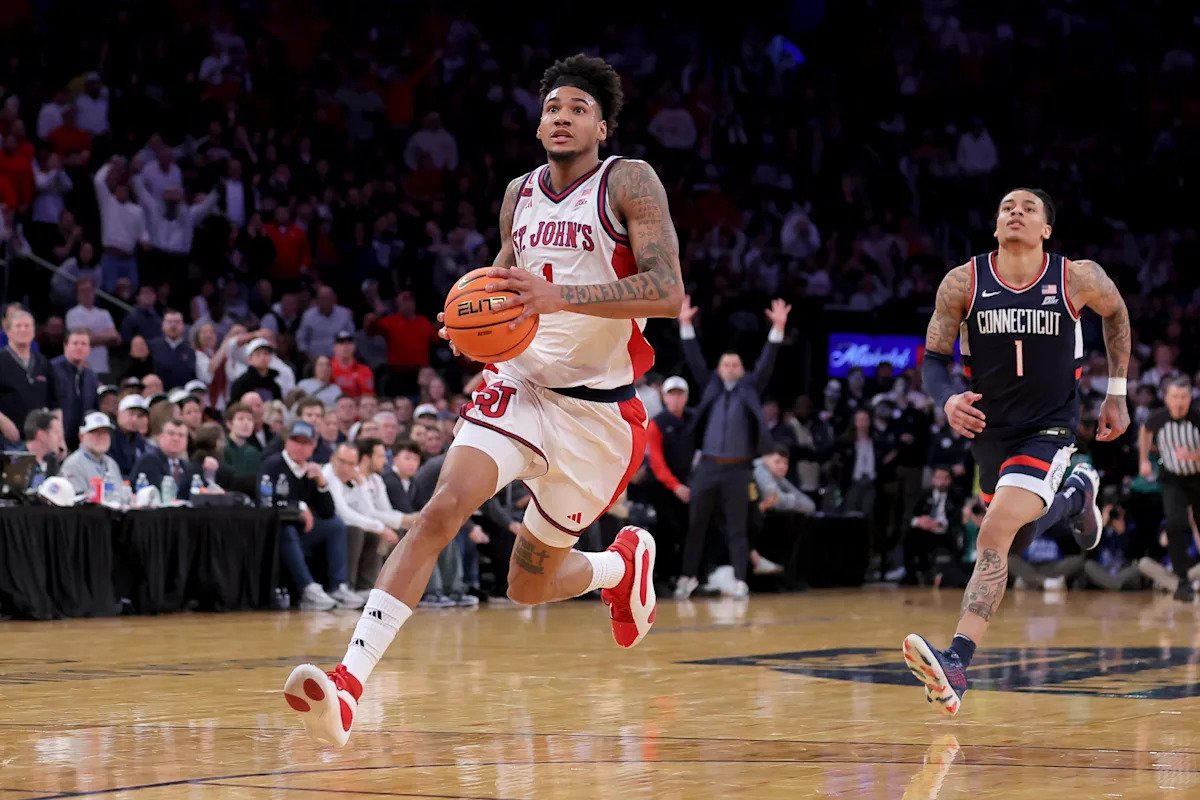
To say the Red Storm received a brutal draw in March Madness would be an understatement. Fresh off obliterating UConn to win its second consecutive Big East Tournament title, St. John’s could only muster a 5-seed in this year’s NCAA Tournament. Awaiting them in the East Region is the number-one overall seed Duke, multiple future NBA lottery picks, and a murderer’s row of elite head coaches who either are, or will be, in the Basketball Hall of Fame. Making matters worse, they have to travel across the country to begin the tournament.
Despite the many cards stacked against them, Rick Pitino’s squad has what it takes to not only return to the second weekend of the NCAA Tournament for the first time since 1999, but also go even deeper into March and even emerge from this region of death.
Advertisement
In the NCAA Tournament, a team needs an ace that can execute in critical moments and elevate their performance. Zuby Ejiofor fits that bill and is enjoying the best basketball in his college career this month. Through five games in March, the Big East Player of the Year is averaging 20.6 points, 6.6 rebounds, 3.0 assists, and 3.4 blocks on 65.6% shooting. Last week, the big man became the first player since Kemba Walker in 2011 to score 20 or more points in four consecutive Big East Tournament games, and the first player in Big East championship game history to record seven blocks.
His frontcourt partners are also hitting their stride. After an inconsistent regular season, Bryce Hopkins looked like his old self in the Big East Tournament, showing more aggression on offense and punishing opposing defenses at all three levels. He accrued 15.0 points and 8.3 rebounds per game on 69.6% shooting in three contests. Dillon Mitchell is the perfect glue guy for this physical, high-tempo Red Storm team. The 6-foot-8 forward acts like a Swiss army knife, as he can guard multiple positions, handle and distribute the ball like a seasoned point guard, and out-leap everyone else on the floor when attacking the rim or hunting for rebounds.
Many are quick to point out that St. John’s could struggle going from competing in a weaker Big East to facing opponents they aren’t familiar with because they did not have any impressive wins in non-conference play. The Johnnies went 2-4 against power-conference squads on a loaded non-conference slate, with those two wins coming against Baylor and Ole Miss, teams already out of tournament contention.
However, this is a very different Red Storm team than the one that started the season 9-5. Following a humbling defeat to Providence on January 3, St. John’s won 19 of their next 20 games after Dillon Mitchell was re-inserted into the starting lineup to form a three-man frontcourt. Although their league only sent three teams to the Big Dance, the Johnnies still swept 8-seed Villanova (and beat them by 32 in their second meeting), then won two of three against 2-seed UConn.
Advertisement
The numbers back up their incredible turnaround. Dating back to January 4, St. John’s is the 10th-best team in the country in BartTorvik’s aggregate rating, ahead of higher-seeded teams in the East Region, such as the aforementioned 2-seed Connecticut (14th), 3-seed Michigan State (12th), and their potential second-round opponents, 4-seed Kansas (23rd).
St. John’s’ path to reach their first Sweet Sixteen in more than a quarter-century is open. While Northern Iowa is back to full strength and is a popular upset pick that brings back memories of Ali Farokhmanesh and Paul Jesperson, their glaring weaknesses are defining strengths for the Red Storm. The Panthers hold the sixth-worst offensive rebound percentage and fifth-lowest free-throw rate in the country, limiting their ability to create second-chance opportunities and get to the line against a Johnnies team that is elite at both. Couple that with Northern Iowa’s 153rd-ranked KenPom offense facing the Red Storm’s 12th-ranked KenPom defense, and it is quickly apparent that this is a favorable matchup for Pitino’s posse.
Their likely second-round opponent in Kansas has sputtered to the NCAA Tournament, having lost five of their last eight games by double digits. Two of the Jayhawks’ best players are riding the struggle bus over their last six outings. Potential top-three draft pick Darryn Peterson is only shooting 35.4% overall and 29.7% from three in this stretch, while sophomore big man Flory Bidunga is averaging 8.5 points and 8.5 rebounds on 52.5% shooting. In his 27 previous games, Bidunga averaged 14.6 points and 9.3 rebounds while shooting 66.4% from the field.
If Cal Baptist pulls off the improbable and knocks off Kansas, they would also suffer the same issues Northern Iowa will likely run into against St. John’s. The Lancers rank 191st in KenPom adjusted offense, 302nd in effective field goal percentage at 48.6%, and 278th in the country in turnover rate at 18.1%.
Advertisement
The Red Storm’s outlook grows murkier in a possible Sweet Sixteen matchup against the vaunted Duke Blue Devils, whose only two defeats were decided by one possession, and no matter their opponent, they will have the best player on the floor in Cameron Boozer. The super freshman is a runaway favorite for National Player of the Year and a double-double machine, but the Blue Devils will be entering the tournament at less than one hundred percent. Starters Patrick Ngongba and Caleb Foster are on the shelf, as each player missed the ACC Tournament due to foot injuries. Ngongba is considered day-to-day, but Foster is dealing with a fracture and may not return until the Final Four if Duke advances that far. Losing the production of even one of those players could be the difference in a Sweet Sixteen matchup between the Blue Devils and the Johnnies.
If they advance to the Elite Eight, everything is on the table for St. John’s, and what better coach to have in their foxhole than one who’s been there and done that. In twelve trips to the Regional Finals, Rick Pitino led his teams to Final Fours in seven of them, reached the National Championship game thrice, and won a pair of national titles. At Louisville, Pitino reached the Final Four with a team that played in the 4/5-seed sub-region twice, in 2005 and 2012. His team has the talent and make-up to do it a third time this season.

