I recall being told as a joke in my student days by people in Northern Germany that as a Scot, I should feel very much at home in Stuttgart because of the alleged Geiz (frugality) of the residents of Schwabenland (Swabia)!
It’s an old cliche that never quite measures up to reality, and I think — I hope — that most of a fair mind would say the same of my compatriots. In fact, I’m quite confident that fans of Celtic and VfB Stuttgart will enjoy and appreciate each other’s generosity of football spirit when the pair meet in one of the most eye-catching two-legged UEFA Europa League confrontations in the next few days.
What should Celtic supporters know in advance?
– Meet Noahkai Banks: The outside pick to make USMNT’s World Cup squad
– Harry Kane scores 500th goal: Explaining stats behind red-hot form
– Amid more Bundesliga success, Bayern’s Pokal drought weighs heavily
To me, VfB Stuttgart represent an underrated footballing and cultural force outside Germany and a few eyes will be opened as to their power and appeal.
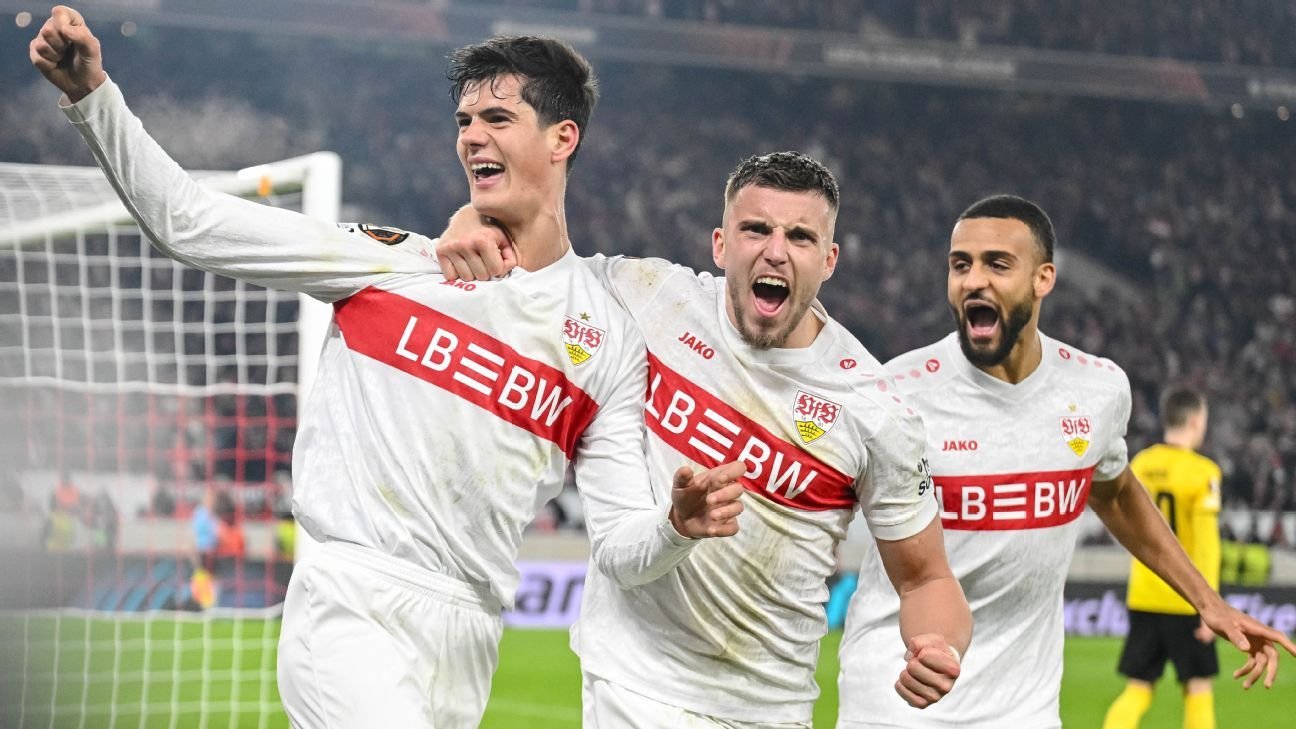
It all starts with the distinctive Brustring (the red ring or hoop around the team’s white shirt). Last August, the club celebrated 100 years of the Brustring, and the accompanying organic choreography from the always passionate Cannstatter Kurve left you with that hair on the back of your neck feeling on that day against Borussia Mönchengladbach.
For some odd reason, Stuttgart is rarely mentioned as one of the bucket list places to watch a football match, but it really should be. Just under 60,000 fans pack into the MHP Arena at every home game through good times and bad, and it’s akin to a rite of passage. The team has a large catchment area in the South West and for many fans in the area, it would be simply incongruous to support anyone else.
Even as three-time Bundesliga champions and four-time Pokalsieger (German Cup winners), including last May, Stuttgart and its fans have nevertheless felt the full gamut of emotional highs and lows in recent years. They suffered the dreaded Abstieg (demotion) in 2016 and 2019, although luckily in both cases bounced back to secure the Klassenerhalt (ascending back to the top) at the first time of asking.
Still, in both 2022 and 2023, this colossal club started the 2. Bundesliga in the face again and stayed up by the skin of their teeth. In the first instance, salvation arrived only through a dramatic 92nd-minute goal on the final day against Köln from Wataru Endo. A year later, they had to navigate the always twitchy relegation playoff against Hamburger SV.
By then, the urbane Sebastian Hoeneß had taken over their reins. It’s hard to believe his appointment came less than three years ago because in a very short space of time, the nephew of Uli and son of Dieter has guided VfB — Verein für Bewegungsspiele (literally, “club for movement games”) — to one of the most fruitful periods in its history. That he has taken Stuttgart to a runners-up finish in the Bundesliga (ahead of Bayern Munich no less) in 2024 and a Pokalsieg in 2025, while saying goodbye to key players seemingly every summer, speaks to the coach’s competence and that of Sportchef Fabian Wohlgemuth in finding adequate replacements.
Just consider the list of departures. In 2023, Endo, Konstantinos Mavropanos and Borna Sosa went. In 2024, it was captain Waldemar Anton and prolific striker Serhou Guirassy, both to Dortmund, as well as Hiroki Ito to Bayern. Then last summer, it was Nick Woltemade and Enzo Millot.
But Stuttgart, in their present guise, are getting on with the job of booking a UEFA Champions League place next season and find themselves in the top four after winning five of their last seven Bundesliga games in 2026 so far. They have the demanding but desirable Dreifachbelastung (burden of competing in three competitions) and a Pokal semifinal to look forward to in late April as they try to retain the title.
Hoeneß mostly likes his team to keep the ball and it’s that rotation of attacking players, rather in the manner of a revolving door, that keeps opponents off balance. You never quite know what they’re going to throw at you. Still, arguably their best performance of the year to date came in Leverkusen when it was all about intense Gegenpressing, smothering the opponents at the source and finishing the contest before halftime.
The player who most makes them tick is the redoubtable Deniz Undav, who, while preferring a Döner kebab to their more traditional local dishes of Maultaschen (dumplings) and Spätzle (a pasta derivative), nevertheless personifies the club’s football more than anyone.
Really a forward with Spielmacher (playmaker) qualities, the 29-year-old is generally used underneath pure striker Ermedin Demirovic. The fact remains, though, that since 2023, only Harry Kane and Undav’s former teammate Guirassy have netted more goals.
Jamie Leweling is also a force to be reckoned with, and the difficulty is knowing how to stop him, whether he lines up on the right, the left, or cuts into the centre. Leweling has made huge strides since his Union Berlin and Greuther Fürth days. The heartbeat is provided by twin central midfielders, captain Atakan Karazor and ball playing left footer Angelo Stiller, a favourite of Hoeneß, also from their time together at Bayern II and TSG Hoffenheim. If Stiller scores, it’s usually with a long-range pile- driver.
The left-hand side can be a problem for adversaries with competent fullback Maximilian Mittelstädt, combining with Dribbelkönig (dribbling king) Chris Führich, who is back on song after enduring a difficult time of it last term. It would be churlish to call the right-hand side a weakness defensively, but I always feel there is Luft nach oben (room for improvement) when it comes to the two right back occupants, Josha Vagnoman and Lorenz Assignon.
Jeff Chabot is the defensive chief. Left-footed, dominating and rightly being assessed as a national team candidate for the World Cup, the former Köln man partners well with precocious and good on the ball 19-year-old Finn Jeltsch.
Between the posts, Alexander Nübel — a long-term Bayern loanee — rarely lets anyone down. I can’t imagine Hoeneß in Glasgow will attempt to press as high as Stuttgart did in Leverkusen. But it’s something to watch for, especially the positioning of Karazor.
Whatever happens in the next week in this intriguing Europa League tie, the Wertschätzung (appreciation) factor for the men wearing the Brustring and their fans is bound to grow.

