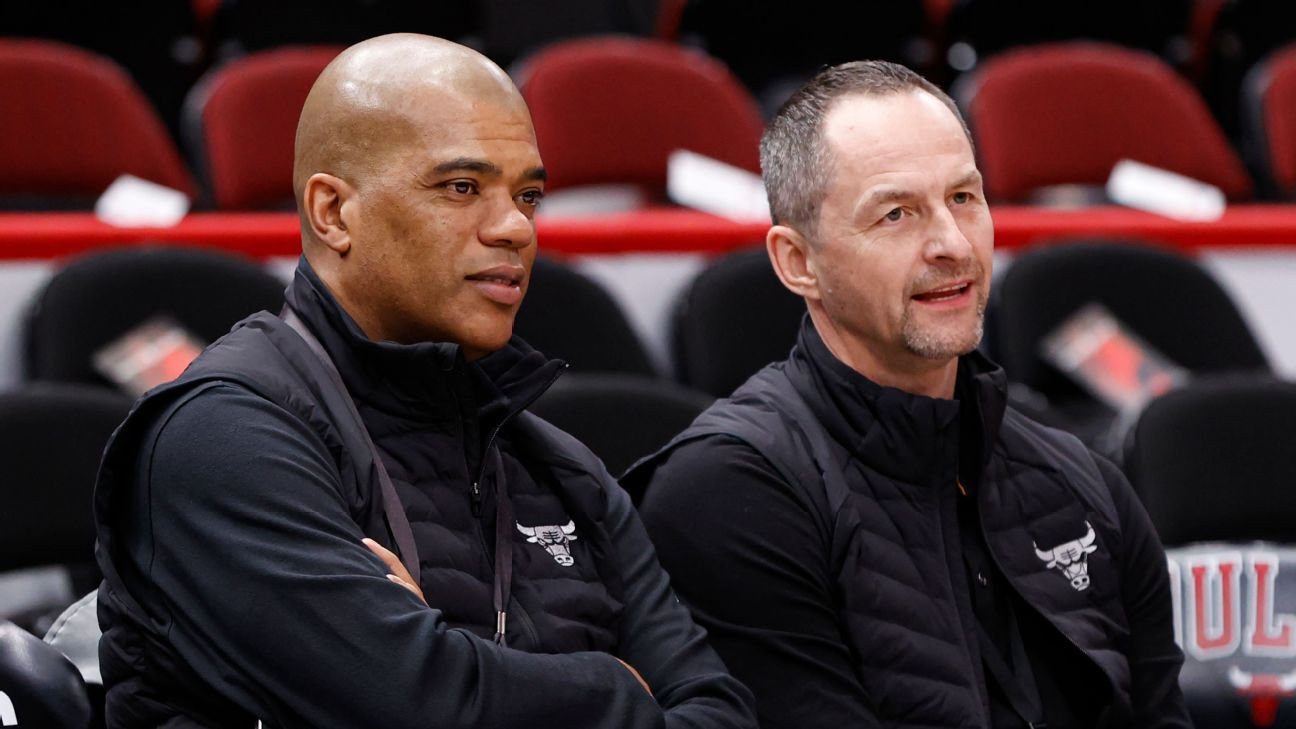
The Chicago Bulls don’t make changes to their front office often. So, Monday’s news that the Bulls were firing president of basketball operations Arturas Karnisovas and general manager Marc Eversley was surprising — no matter how futile the past six years of Bulls basketball have been.
Since they took over the Bulls at the start of the 2020-21 season, the number of roster errors the duo has committed has only grown. They made transactions that baffled the league, such as trading Alex Caruso for Josh Giddey; misjudged the value of their own players, such as Patrick Williams and his five-year, $90 million contract; and frequently waited too long to trade players who were coveted around the league — most recently, Coby White and Ayo Dosunmu at this season’s trade deadline.
All the while, the Bulls weren’t winning. They went 224-254 across six seasons under Karnisovas’ leadership. Their lone winning season came in 2021-22, and the Bulls were quickly dispatched in a five-game, first-round exit to the Milwaukee Bucks. They currently sit at 29-49 and 12th in the Eastern Conference.
So, although the change was swift with a week remaining in the regular season, team sources said ownership had been mulling the change for weeks, especially in the aftermath of the team’s dismissal of Jaden Ivey and questions about whether the Bulls did enough homework before acquiring him last February, team sources told ESPN.
The front office defended its approach in acquiring Ivey, but one source described the Bulls as having a “credibility” problem around the league and with their own fans.
Bulls team owner Michael Reinsdorf acknowledged fans’ frustrations in a statement released by the team, announcing the news and a commitment to getting it right.
Now Chicago is about to conduct a search for a new head of basketball operations for only the third time since the start of the millennium.
Here’s why the team decided to fire its front office with just days left in the regular season, what these moves might mean for coach Billy Donovan and what Bulls ownership should look for in its next front office. — Jamal Collier
Why did the Bulls decide to make this change now?
Team sources described a “growing disconnect” between the front office and the rest of the franchise, with several people across the organization unsure about the direction of the team after a surprising trade deadline.
“People didn’t know the plan,” one team source told ESPN on Monday. “They didn’t know the process. We needed to move on — with a clean slate and start this thing over.”
The list of puzzling roster moves also began to stack up over the years. The same team source described the team’s initial trade for Nikola Vucevic in 2021 — the team traded Wendell Carter Jr., Otto Porter Jr. and two first-round picks for Vucevic and Al-Farouq Aminu — as the team’s “original sin.”
Team sources said recently Karnisovas has expressed remorse for the move, saying a deal like that to give away two first-round picks should have been the team’s final move toward contention instead of an initial one.
When Chicago did select players in the first round, the results were inconsistent. The Bulls’ highest draft pick was No. 4 in 2020, which they used to select Williams, and they re-signed him to a five-year extension in July 2024 after middling performances.
The Bulls began the 2021-22 season with promise — they were No. 2 in the Eastern Conference by the All-Star break — but clung to their nucleus of Vucevic, DeMar DeRozan and Zach LaVine for years after, even as the trio became a perennial play-in contender following injuries to Lonzo Ball.
Karnisovas’ failure to pivot from that core quickly enough, and the paltry returns from trading those players, did not leave the team in position to contend. Karnisovas finally made moves at the deadline, attempting to avoid another play-in tournament appearance, but the team’s meandering direction, the embarrassment of the Ivey situation and Karnisovas’ lack of definitive direction left the Bulls looking for new leadership to take the reins. — Collier
Why did it take so long for the Bulls to decide on a direction for their roster?
Karnisovas and Eversley maintained throughout the past few years that they were working under the constraints of ownership, team sources told ESPN. The team’s ownership and coach Billy Donovan were hesitant to “tank” in order to prioritize a high draft pick, which, they said, limited the team’s options.
Karnisovas and Eversley were also victims of their own initial success, however. Chicago was 38-21 before the All-Star break during the 2021-22 season, but Ball’s injuries that season derailed the team’s trajectory and took more than 1,000 days off his NBA career. Ball did not play in another NBA game until the start of the 2024 season, but the front office kept the core of that team intact for two more full seasons without Ball ever appearing in a game. Eventually, the Bulls traded away the top six players (LaVine, DeRozan, Vucevic, Ball, White and Caruso) from their February 2022 team. The only first-round pick they received in return? A return of their own first-round selection in 2025.
“We took too long to pick a lane,” the team source told ESPN. “The Lonzo thing just really messed them up. We saw that success early on and didn’t have the foresight to pivot early.”
Chicago slowly began making changes to its roster, trading away LaVine at the deadline last year; Ball this summer; and then Vucevic, White and Ayo Dosunmu this past February to pivot toward a new core featuring Josh Giddey, Matas Buzelis and Noa Essengue, who was drafted in the first round last season.
But the Bulls currently have a record of 29-49, the ninth-best odds in the league in the upcoming NBA draft lottery and more than $60 million in projected cap space this upcoming offseason. With cap space, draft picks and without much money tied up long term going forward, team sources said, the Bulls thought it was the right time for a new direction. — Collier
What is Billy Donovan’s future with the franchise?
Chicago remains high on coach Billy Donovan and plans to meet with him in the offseason to see how the team can retain him, sources told ESPN on Monday. Donovan has been with the team since 2020, and despite a 224-254 record (.469 winning percentage), he is well respected by players and staff alike within the organization.
The Bulls have struggled mightily on the court this season, including four separate losing streaks of at least five games and a roster overhaul at the deadline that had Bulls coaches scrambling with so many new faces.
Donovan had a rough season personally as well. His father, Billy Sr., passed away earlier this year and then his mother-in-law, Patricia, died eight days later. Donovan missed only one game, on Feb. 19, and a few practices around the funerals, and team sources have in recent weeks wondered whether Donovan would decide to take a step back after the season, especially faced with a Bulls roster almost certain to require a rebuild.
The team has made it clear, though, that it wants him back in the organization as coach or in some capacity going forward, sources told ESPN. — Collier
What characteristics should Bulls ownership look for in a new front office?
Someone who can offer a true vision. Ever since the franchise traded Jimmy Butler III in 2017, Chicago has vacillated between short-circuited rebuilds and a misguided attempt to move into contention. The Bulls’ series of moves in 2021 — notably adding veterans DeMar DeRozan and Nikola Vucevic — left them hovering in the middle with no path to relevancy, which is why the team won 39 or 40 games in three consecutive seasons before the 2025-26 campaign.
There are actually reasons for optimism for whoever takes over. The Bulls have a fairly clean cap sheet, potentially two first-round picks this year (if the Portland Trail Blazers reach the playoffs) and an attractive market for free agents. — Tim Bontemps
What is the Bulls’ draft outlook?
After losing their past seven games, the Bulls will likely finish with the ninth-best odds in May’s draft lottery — a 4.5% chance at the No. 1 pick and a 20.3% chance at selecting in the top four.
That’s gives them a fair, if unlikely, shot at moving up for one of the top-tier prospects in what NBA executives view as an excellent draft class. Chicago still has a chance to add a quality player if it stays put at No. 9, but the options at that spot aren’t necessarily franchise-changing.
Matas Buzelis and Josh Giddey had been considered the Bulls’ cornerstone players, but the roster is still far from taking shape. How a new decision-maker views them long term could impact what direction Chicago goes positionally with its selection.
The Bulls also own the Trail Blazers’ lottery-protected first-round pick. If Portland (8-2 in its past 10) makes it out of the play-in and into the playoffs, Chicago would get another first-round selection in the mid-teens. Beyond that Portland pick, which has rolling lottery protection through 2028, the Bulls are light on extra draft capital and have only their own first-round picks.
Landing a stroke of luck on lottery night would be a massive coup for whomever Chicago hires to run the organization next. Drafting well is imperative regardless, but without a friendly bounce, picking a direction will be more of a challenge: A protracted nosedive in 2027 and 2028, two draft classes NBA execs are presently less excited about, will not be the most direct path to a playoff return. — Jeremy Woo
What roster and financial decisions will the new Bulls’ front office inherit?
The Bulls wiped their cap ledger clean at the deadline, making seven trades that netted them eight second-round picks and former lottery pick Rob Dillingham, as well as Anfernee Simons and Jaden Ivey, who was waived on March 30.
As a result of the trades, Chicago is projected to have nearly $60 million in cap space to use in free agency.
The new front office will inherit a roster that includes Josh Giddey, Tre Jones, Matas Buzelis and Noa Essengue. The Bulls picked Essengue in last year’s draft, but he played only two games this season before season-ending shoulder surgery in December.
The free agency path is more unclear and requires a methodical roster-building approach. The Bulls have the spending power to sign players, but they are not at a stage to commit long term, which ultimately takes away flexibility in the future.
Chicago will need a checklist for free agents and trade candidates who fit its identity on the court both now and moving forward. — Bobby Marks

