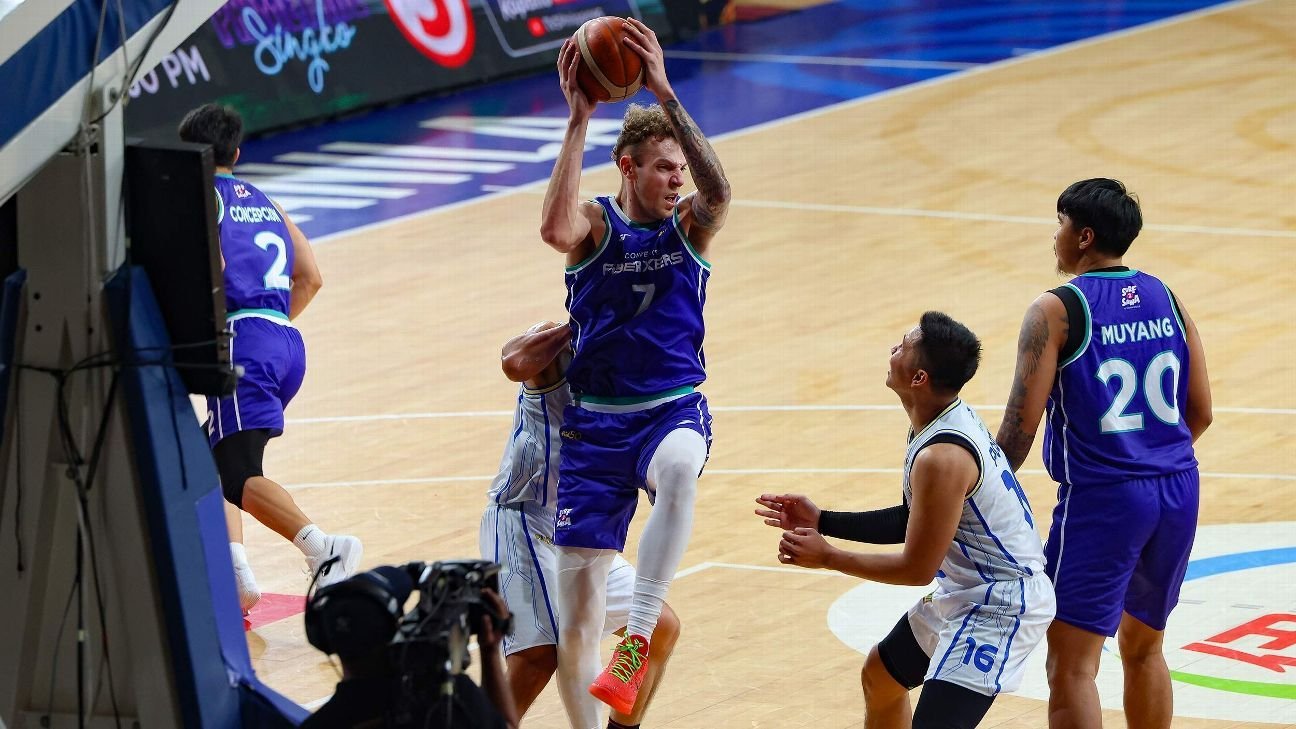
Converge FiberXers may have kept their PBA Season 50 Commissioner’s Cup campaign alive with a much-needed win over the TNT Tropang 5G, but even in victory, a familiar concern refused to fade into the background.
Kylor Kelley once again turned in a quiet outing with just four points and nine rebounds — continuing a trend that has slowly shifted the narrative around Converge’s import situation.
What was initially seen as a calculated move by bringing in a defense-first anchor to complement a supposedly potent local core has instead begun to highlight deeper issues in roster balance and identity.
As sources confirmed to ESPN Philippines that Donovan Smith is set to debut for the team, it prompts an assessment on why Kelley did not prosper as Converge’s import.
Kelley’s offensive limitations
Within the offensive ecosystem of the Converge, Kelley operates almost exclusively as a vertical spacer — someone whose primary value is tied to gravity as a lob threat rather than actual shot creation.
These touches are largely dictated by pick-and-roll actions, where he dives hard to the rim hoping to finish alley-oops or drop-offs from guards like Juan Gómez de Liaño and Mikey Williams.
But even within that limited role, there are inconsistencies.
Kelley has had stretches where he struggles to secure clean catches on pocket passes and tight-window feeds in pick-and-roll situations. Whether it’s traffic in the lane or timing with his guards, his hands haven’t always been reliable, leading to fumbled possessions or missed scoring opportunities at the rim.
For a big whose offense is almost entirely dependent on guards creating for him, that lack of consistency becomes a real issue.
The problem is, that’s where the offensive repertoire both begins and ends. There’s little short-roll playmaking, no reliable push shot or floater in the lane, and minimal back-to-the-basket scoring when switches occur.
In situations where the defense neutralizes the initial action whether by tagging the roller early, switching the screen, or clogging the paint — Kelley doesn’t offer a secondary counter.
He can’t punish mismatches, can’t isolate, and doesn’t stretch the floor, which allows opposing defenses to shrink the court and load up on Converge’s ball handlers – evidenced by his measly average of just 11.5 points, which is lowest among all imports.
Yet, the reality of having the 10th ranked offensive rating of 104 points per 100 possessions is not solely Kelley’s fault. But the inability to improve that has been the misfit between him and Converge.
Was Kelley’s defense enough?
On the defensive end, Kelley’s value is more nuanced.
At his best, he functions as a weakside rim protector — timing rotations, contesting shots at the summit, and deterring drives simply with his presence with three blocks per game. In drop coverage, he can be effective when he’s able to stay near the paint, using his length to challenge floaters and finishes without overcommitting.
Those flashes suggest a player who can anchor a scheme built around protecting the rim first.
But once Kelley is pulled into high pick-and-rolls, the cracks start to show.
His lateral mobility becomes a target, as quicker guards turn the corner or force him into awkward recoveries. If he plays too deep, he concedes open pull-ups, but if he steps up, he risks getting blown by. That in-between space is where opposing offenses consistently find leverage.
There’s also the physicality issue.
Against imports who thrive on contact, players who initiate bumps, carve out space in the post, or attack downhill with force, Kelley’s lean frame limits his ability to absorb and respond.
He gets dislodged from his spots, struggles to hold position on seals, and doesn’t consistently win those physical 50-50 battles inside. So while the shot-blocking and rim deterrence are real, they don’t always translate into full defensive control.
Which brings Converge to a critical evaluation point: if Kelley can’t reliably switch, hedge, or contain in space, and can’t dominate physically inside, then his defensive impact becomes more situational than transformative.

