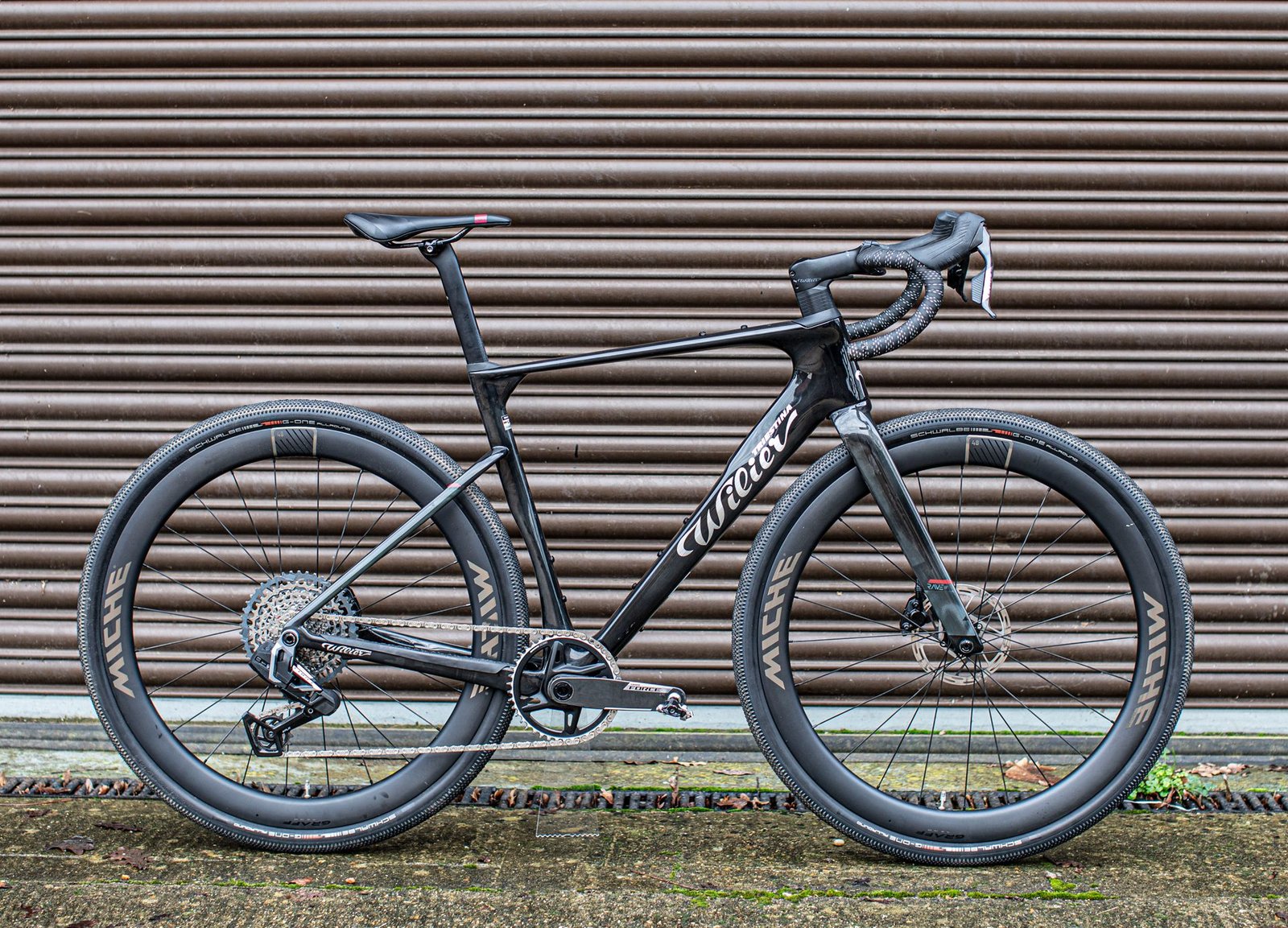
It might share its name with the original Rave SLR, but the Wilier Rave SLR ID2 is designed for all-out racing on gravel roads, not all-roading adventures like its forebear. As expected of a contemporary gravel machine, aerodynamics is a large part of its modus operandi, but Wilier has made it clear that the Rave SLR ID2 is as much about speed as it is off-road capability – attributes that now go hand in hand.
Modern gravel racing has become increasingly technical, and to succeed against its rivals, Wilier needed to create a bike that was not only fast but also able to temper the demands on both the body and the bike.
The result is impressive to say the least, but with so many manufacturers now moving towards suspension forks or at least offering provision for it, does the Wilier Rave SLR ID2 have what it takes to hold its own in a radically shifting gravel bike genre?

The visuals are said to be inspired by the energy of underground culture and the digital icons of the 1990s
(Image credit: Aaron Borrill)
Design details
The Rave SLR ID2 is available in four colourways and two finishes, matte or glossy. The colour naming conventions are pretty complex, but in simple terms, the bike can be optioned in green and cream (matte), and purple and black (glossy). Our test bike came outfitted in the latter, a shade Wilier calls V11 Glitch Black. The visual treatment of the bike, according to Wilier, ‘is inspired by the energy of underground culture and the digital icons of the 1990s’.
It looks spectacular, and the brushed aluminium-look wordmark logos pop nicely against the black frame.
Wilier spent a lot of time shaping and tweaking the frameset you see here – it’s a result of innumerable hours of wind tunnel testing and CFD modelling at Wilier’s Innovation Lab in Rossana, Veneto, Italy. The frame is very much in line with contemporary Italian aero gravel bike design, utilising NACA tube blueprinting and time-trial bike influences to shape it. This is evident in the widened downtube (introduced to hide the water bottles) and the Supersonica time trial bike-like fork profile.
According to Wilier, this results in a 5.3-watt saving at 35km/h compared with the previous Rave SLR model. This may not sound like much, but when ridden in anger, particularly at an average power of 350w over 70km, there’s a saving of over 50 seconds to be had.

The brushed-aluminium-look decals contrast the black frame quite exquisitely
(Image credit: Aaron Borrill)
The rear end, particularly the seat tube cut-out, has also been significantly updated to now house a 52mm tyre (2.1in) – a must given the gnarlier tracks gravel races now traverse. Matched to 423mm chainstays, the 1,031mm wheelbase is shorter than before but in line with racier gravel bikes such as the Cannondale SuperX and Specialized Crux. The geometry overall feels more road bike-like than gravel bike, but this has become the running theme across the racier end of the spectrum. For context, our size large test bike has a 71-degree head angle and a 73.5-degree seat angle, not quite parallel but close enough to suggest predictable, stable handling. The reach and stack are rated at 391 mm and 570mm, respectively, which are again, very racy.
While there’s a fair amount of mounting points on the bike, including a slew of bottle bosses on the downtube (in the main triangle and underneath), and Bento box points on the top tube, there’s a lack of provision for bags, mudguards, and other storage options. This comes as no surprise, given the bike’s racy intentions, but you’d still expect a couple of bosses on the forks to improve utility if you like to go long.

While the Rave SLR ID2 can accommodate rubber of upto 2.1in wide, our test bike came kitted out in rather-tame 45mm Schwalbe G-One tyres
(Image credit: Aaron Borrill)
Specifications
The Rave SLR ID2 is available in a variety of groupset options, including high-end builds from Campagnolo and SRAM. Our bike came fitted with SRAM Force XPLR AXS, complete with a direct-mount rear mech. Sharing much of its architecture with Red XPLR AXS, save for a small weight penalty, there’s not much of a tangible difference between the two groupsets. A 42T chainset, complete with 170mm cranks, drives a 10-46T cassette, providing a good, usable range over a variety of terrain. I’m surprised by the press-fit bottom bracket, given the filthy conditions gravel bikes endure, but during my month-long test term with the Rave SLR ID2, I didn’t experience any creaking coming from the area.

A 42T, 10-46T chainset ensures a decent spread of gearing for most scenarios
(Image credit: Aaron Borrill)
There’s a fair bit of in-house kit, too, including the Ritchey/Wilier Barra S2 alloy bar and Filante seatpost. As expected, Wilier has stuck with Miche to keep it rolling – in this instance, a pair of Graff Aero 48 shod in 45mm Schwalbe G-One R Pro TLR tyres. The build is rounded off by a Prologo Dimension AGX saddle and handy rubber chainstay protector.
The total build comes in at 8.45kg (without pedals), which is not particularly heavy for a gravel race bike, but still notably heavier than some of its sub-8kg rivals. The Rave is 1x-only compatible and comes with a UDH rear dropout.

Speed demon – the Wilier Race SLR ID2 is all about going fast off-road
(Image credit: Richard Butcher)
Performance
Speed is the Rave SLR ID2’s secret weapon. It’s seriously fast on the open road, able to devour mile upon mile without much effort – even on chonkier surfaces. The riding position feels a lot like a road bike, and some may enjoy stitching in sections of tarmac on their training rides as a result, but the bike is best suited to dirt roads.
Despite the stiff bottom bracket and head tube, overall frame compliance is top-notch, as is the front-end response and control, which help absorb trail chatter and high-frequency bumps. This, matched to the Miche Graff Aero 48 wheels and 45mm tyres, allows you to bulldoze your way through washboard with very little discomfort and speed loss – the wheels are excellent. Grip is plentiful, and this supplies confidence in spades, allowing you to manoeuvere through downhill singletrack with ease. Of course, the extra agility afforded by the wheelbase can also be credited here.
As an aside, I did run the Rave with 50mm Vittoria Terreno T50 tyres to test whether this had any bearing on trail purchase and ride quality. The difference was significant enough to suggest wider is better on the Rave, as is comfort – all out speed didn’t feel negatively impacted.

Yeah, some mild mountain bike singletrack and flowing berms can be enjoyed, too
(Image credit: Richard Butcher)
Even on paved surfaces, the Rave SLR ID2 manages to hold speed with little to no struggle. Having recently trained and raced on the Cannondale SuperX Lab71, I was amazed by how much more comfortable the bike was at speed and over bumpier terrain. While difficult to quantify, its stability at speed and ability to glide over uneven surfaces add a sense of assurance that is missing from much of the competition.
Of course, the Rave SLR ID2 is notably heavier than some of its rivals at 8.45kg, and you can feel this on the steeper inclines, but it manages to flatten bumps thanks to the 42T, 10-46T gearing, which is ideal for most gravel settings. While a 44- or even 46T would better suit those who live in flat, rolling areas, not once did a spin out on the 42T – in fact, I think it’s a goldilocks chainring size for lumpy areas where speed is high on the whole.
Like the SuperX, it’s not compatible with a suspension fork, and given where the gravel segment is going, I think this is a missed opportunity on Wilier’s part, but it’s not a deal-breaker. The ability to run tyres as wide as 2.1in makes up for this in part.

Despite the stiff head tube, front-end response, control and compliance is top-notch
(Image credit: Aaron Borrill)
Value
Wilier has done an impressive job with the Rave SLR ID2, delivering a race-honed gravel platform with a wide range of price points and specification levels to meet most riders’ needs. Not only is it one seriously fast machine, but it also dismisses climbs and flats in equal measure; it’s got one of the best ride qualities in the segment, thanks to the large-volume 50mm tyres (upgradable to burlier 2.1in rubber if needed) and frame layup.
At £5,699, the Rave SLR ID2 is one of the most affordable premium-level gravel race bikes on the market, upstaging both the £7,250 Cannondale SuperX 1 and £6,999 Specialized Crux Pro in similar spec. Sure, it’s heavier than both of these models, but based on speed and trail comfort, the Rave SLR ID2 leads the charge here.
In terms of all-out aero, it’s also worth looking at the Cervelo Áspero-5. Not only is it £2,551 dearer than the Rave in Force AXS trim, but it also loses out on the max tyre clearance stakes, too, with a rated 45mm of front/rear clearance. It does, however, feature downtube storage and a threaded bottom bracket, and is widely considered the fastest gravel bike on the market, claiming to be 33 watts faster than its nearest rival at 35km/h.
Having raced Gravel Burn in South Africa and other gravel races here in the UK, having the fastest gravel bike on paper means nothing in the real world – trust me, there’s more to lose when it comes to counting grams and using anything less than 50mm gravel tyres. When the going gets rough, the average rider requires a bike that is able to absorb bumps and corrugations or at least partly mitigate vibration-induced speed loss – and the Rave SLR ID2 delivers all of that in spades. It’s excellent.
Tech spec
- Price: £5,699
- Brand: Wilier
- Frame: Rave ID2, carbon monocoque Hus Mod
- Fork: Rave ID2, carbon monocoque Hus Mod
- Weight: 8.45kg (actual, large)
- Sizes: XS, S, M, L, XL, XXL
- Levers: SRAM Force AXS
- Brakes: SRAM Force AXS
- Rear derailleur: SRAM Force XPLR AXS
- Front derailleur: N/A
- Crankset: SRAM Force XPLR Dub Wide, 42T
- Bottom bracket: SRAM Dub Wide press fit
- Cassette: SRAM Force XPLR 10-46T
- Chain: SRAM Force
- Wheels: Miche Graff Aero 48
- Tyres: 45mm Schwalbe G-One R Pro TLR tyres
- Bar/stem: Ritchey/Wilier Barra S2 alloy
- Seatpost: Wilier Filante
- Saddle: Prologo Dimension AGX

