If the Vancouver Whitecaps do not survive the latest risk to their long-term survival and pack up for Las Vegas, finding the responsible party will turn into a whodunnit.
Is it the provincial government of British Columbia, owners of BC Place, the venue no longer profitable enough to sustain a major professional sports team at revenues necessary to continue spending?
Advertisement
Is it the current owners of the Whitecaps, seeking a larger return on their investment?
Is it the Vancouver business community, perhaps beloved native son Ryan Reynolds himself, unwilling to step up and take over a civic asset?
“It’s a strange one,” Ciarán Nicoll, the president and secretary of supporters’ group Vancouver Southsiders, told USA TODAY Sports. “Even in the city, people who are talking to me are like, ‘What’s going on here?’ You could easily say if nobody was coming to games, if they weren’t successful, well, that’s the reason they’re moving.
“That’s not the case at all. We’re consistently top of the league or close to it for attendance, we’ve got probably the best team in the league, maybe on the continent. It’s difficult to tell who’s at fault here.”
Advertisement
It’s not just biased bluster. The Caps were runners-up in the 2025 Concacaf Champions Cup and 2025 MLS Cup and current sit three points off the Supporters’ Shield table with one fewer game played than the leaders.
So, why would anybody want to kill the Caps?
Like any good murder mystery, many of the suspects are gathering in the same room, with Vancouver the epicenter of the soccer world during this week’s FIFA Congress. Vancouver hosted the 2015 women’s World Cup final and is scheduled to host seven men’s World Cup matches this summer. The city, BC Place and the soccer scene in general seem to be at an acceptable standard for even some of the sport’s most discerning spectators.
Advertisement
Yet, reporting in The Athletic this week indicated a group of MLS owners met to discuss the possibility of moving the franchise, something that would mark the first such shift since 2006, with discussions already taking place with a group that would take the team to Las Vegas.
The Caps have been up for sale since late 2024 with owners citing a gap between the revenue possible to earn from the province-owned BC Place and that earned by most of the Whitecaps’ MLS competitions. While the city of Vancouver and the club signed a Memorandum of Understanding to negotiate for a new stadium, the negotiations are slated to run through 2026 and there is no guarantee of a final agreement being reached.
“Over the past 16 months, we have had serious conversations with more than 100 parties, and to date, no viable offer has emerged that would keep the club here,” a club statement released this week read. “It remains the strong preference of this ownership group to find a solution in Vancouver. If there is a local ownership group with the vision and resources to chart a path forward, we urge them to come forward.”
Advertisement
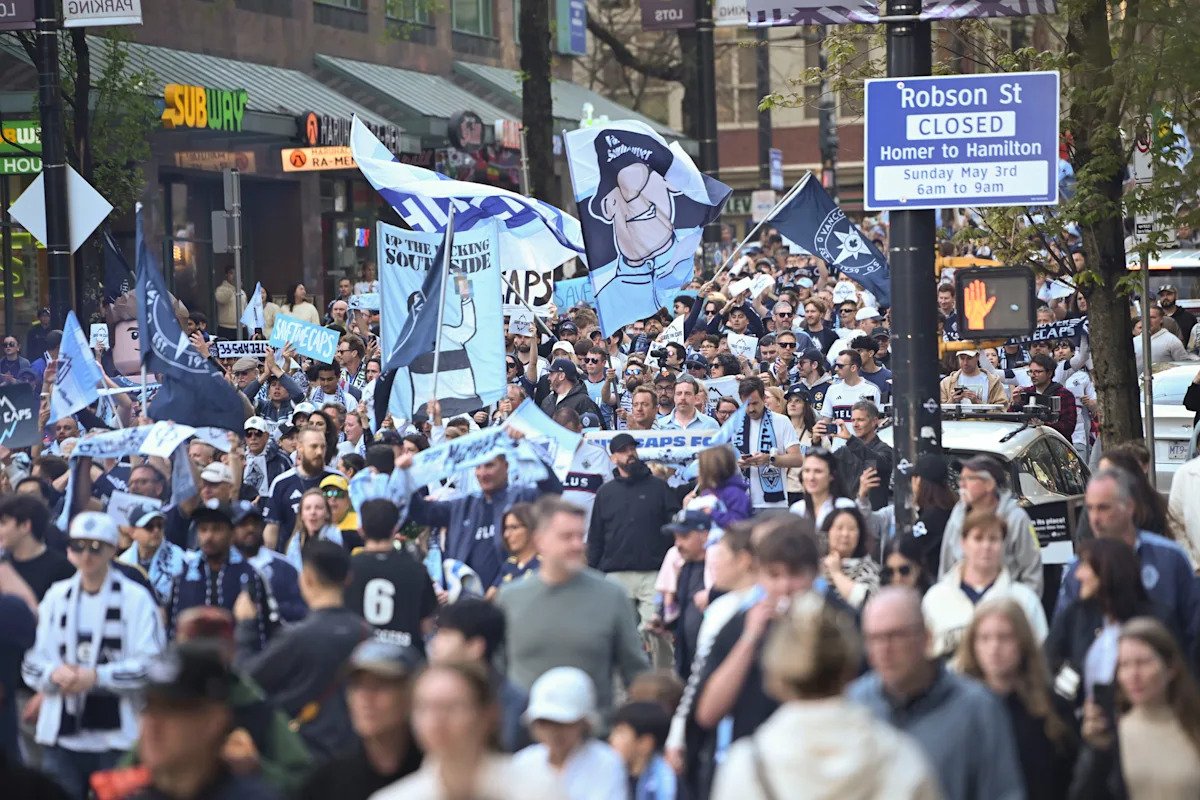
Nicoll and other fans are holding out hope their efforts will succeed. This week, those have included a march through the streets of Vancouver that drew thousands, and an online campaign with logos fans can utilize on social media or use to print signs and banners.
“I don’t think there’s too many cities, especially MLS cities, where the club means as much compared to other teams in the city,” Nicoll said. “Vancouver’s got the Canucks, and they’re obviously big, but the Whitecaps are huge in this city.”
The group’s leaders are speaking daily to the leaders of the successful Save The Crew movement that kept an MLS franchise in Columbus, Ohio and saw Austin, Texas, the planned relocation market, awarded an expansion team instead.
They also have talked to fans from another city that saw a team lured by the lights of Las Vegas, the former Oakland A’s of Major League Baseball. While that fan base’s efforts weren’t successful, Nicoll said there are lessons to be learned there as well – and perhaps a cautionary tale for those ready for relocation as the A’s continue to toil away in a minor league park in West Sacramento.
“Having the most important FIFA [event] on our doorstep is a bit of a blessing,” Nicoll said. “Teams shouldn’t move, and it shows some of the weaknesses. I’m sure (MLS commissioner) Don Garber being in Vancouver will want to be seen as a very professional organization that doesn’t do these sorts of things.”
Advertisement
The Southsdiers, other Vancouver fans and the players on the field clearly have an alibi if the Caps do disappear, but they’ll be the heroes of the story if the team stays.
The swell of support and the team getting a needed new home actually isn’t a story that is new to Vancouver.
The 1979 Whitecaps that played in the North American Soccer League captured the city’s attention, beating a New York Cosmos team led by Giorgio Chinaglia and Franz Beckenbauer in the conference championships to move into the Soccer Bowl. A Trevor Whymark double at Giants Stadium pushed the Caps to a 2-1 win over the Tampa Bay Rowdies, setting off celebrations in the city and a parade that stretched from the airport to downtown and drew a crowd estimated between 30,000-100,000.
“The great victory of the Whitecaps points out the importance of our having a new stadium in Vancouver! You’re going to have a new stadium. I give you that promise!” Mayor Jack Volrich told cheering fans.
Advertisement
Paul Manning had to help deliver on that promise. Already working on a study for the premier of British Columbia, Manning and others were able to secure a stadium for soccer with shovels in the ground in 1981 and the opening game taking place in June 1983 as the structure with the world’s largest air-supported roof.
“We built it for $60 million, guaranteed maximum price and delivered it on time and on budget, which is an amazing thing,” Manning told USA TODAY Sports this week.
Vancouver continued to grow, hosting the Expo 86 World’s Fair that helped the False Creek area continue to develop near downtown. The city increased in density and became linked by a robust rapid transit system.
But while Vancouver grew as a city throughout the 1980s and 90s, soccer didn’t. A triumphant opening game at BC Place drew a capacity crowd of 60,000, but there would be just one more NASL season after the stadium was opened.
Advertisement
Top-division soccer was essentially absent from Vancouver until the Whitecaps became the 17th MLS team, starting play in 2011. The league has lasted much longer than the NASL, but the Whitecaps’ future once agin is at risk.
“I’m sad to hear what’s happening with the Whitecaps,” Manning said. “It’s a real tragedy if a solution isn’t found.”


One of the biggest concerns for Vancouver locals, beyond potentially losing a rallying point for community in the senior team, is what would happen to the Caps expansive youth system.
“The expansion of youth soccer in this city largely due to the Whitecaps has been incredible,” Manning said. “I’m 81 years old, but I’ve got friends and grandkids all playing soccer. There’s no question the Whitecaps have been a big impetus for kid’s soccer in this city.”
Advertisement
MORE: MLS says commissioner’s account was hacked after taunting Vancouver Whitecaps
The Caps have produced Canada national team players for both the men’s and women’s team, with an impressive list of alumni that includes Alphonso Davies, Ali Ahmed and Jordyn Huitema.
“The Whitecaps have so many people that are playing because of them in the province. I think losing that would be a blow not just to football in this province but across Canada,” Nicoll said.
More than a murder mystery, it could turn into a blame game. There is the opportunity, though, for someone to step up and save the patient, for a new owner to emerge and become a hero, and for the whodunnit to turn into “We did it.”
This article originally appeared on USA TODAY: Save The Caps movement draws hope from Vancouver soccer history, Crew’s success

