With Full Focus on Swimming, Liberty Clark Spikes Freshman Season
Liberty Clark’s first NCAA Championships went better than the Indiana freshman could’ve expected at the start of the season.
Considering that it’s her first true scholastic swim season, in an event that didn’t always resonate as her strongest, the results are even more enlightening.
Clark joined the elite sub-1:40 club in the 200 freestyle at NCAAs with a time of 1:39.70 off the front of Indiana’s 800 free relay. She finished second in the 200 free in 1:39.88, she and champion Anna Moesch of Virginia becoming the only two NCAA swimmers ever to twice dip under 1:40, and as a freshman and sophomore, respectively.
Clark finished sixth in the 50 free and fourth in the 100 free, part of a Hoosiers team effort that finished seventh.
Not bad for someone who didn’t swim in high school, preferring scholastic volleyball and high-level club swimming in a timeshare that she and her family agreed was best for her holistically.
“Playing multiple sports helps with overall athleticism and also keeping me happy,” Clark said at NCAAs in Atlanta. “Obviously it lets me focus a little bit more now. I didn’t always focus that hard on swimming, but now I’m really able to commit to that.”
The scholastic sports calendar in California forced a choice from the Chico native. Swimming and volleyball are fall sports in the state. Clark grew up with networks of friends in both, and when it came time to choose a varsity sport at Chico High, the opposite hitter opted for the volleyball court.
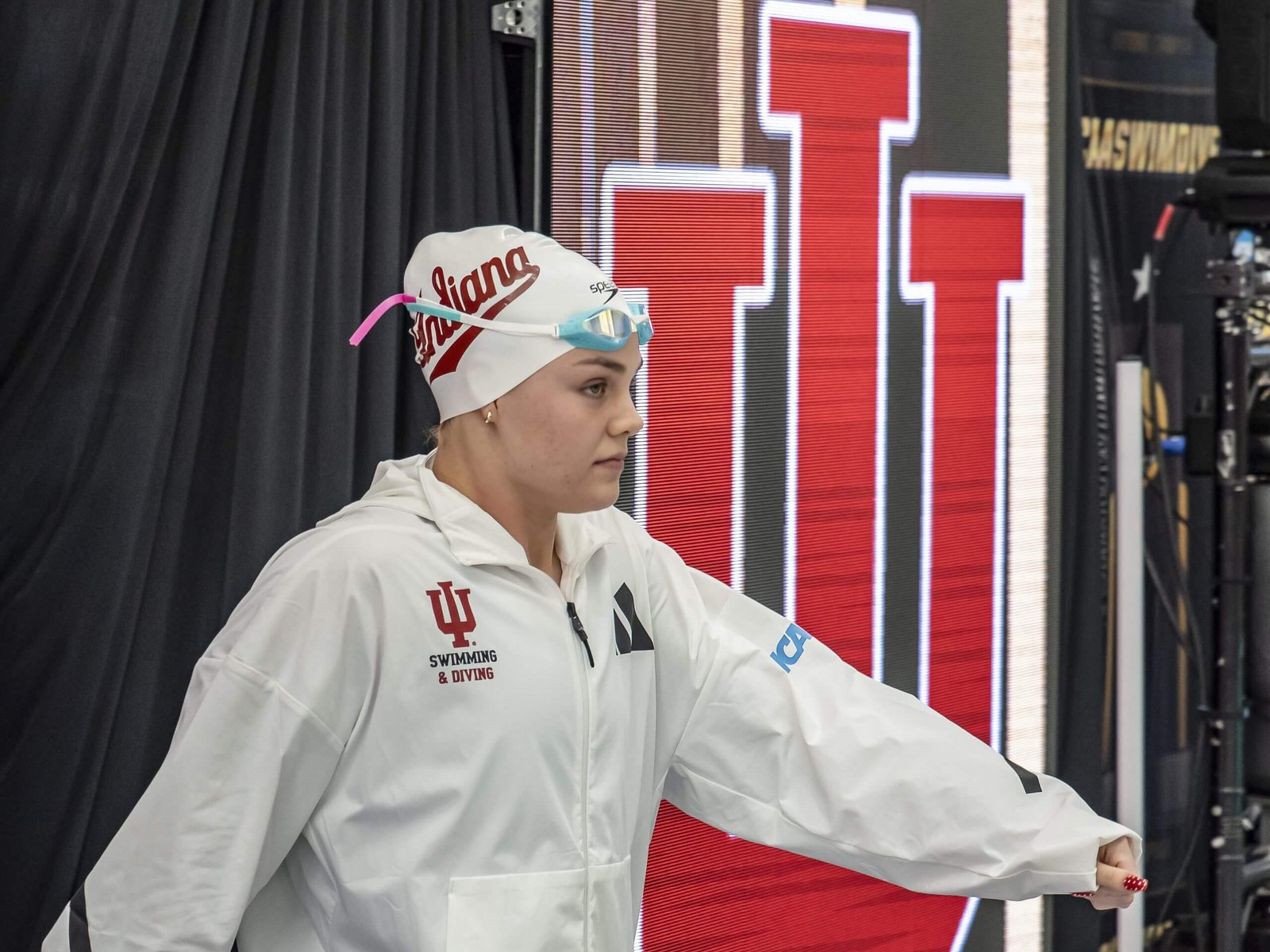
Liberty Clark; Photo Courtesy: Peter H. Bick
Clark comes from a swimming family. Her dad, Brian Clark, is a swim coach. Mom Haley (Cope) Clark won an Olympic silver medal on the U.S.’s 400 medley relay at the Athens Olympics in 2004 and was the 2001 World Champion in the 50-meter backstroke to go with three gold and six total short-course World Championships gold medals. Cope was the Pac-10 Swimmer of the Year in 2000 at Cal.
But Clark said she felt no pressure to specialize. Indeed, her parents’ experience with hyper-specialized swimmers led them to encourage their daughter to diversify if that was what she wanted.
“I think my parents did a great job,” Clark said. “Both my mom and dad have a lot of experience in swimming, and I think that worked to my advantage in that they get to watch a lot of people maybe specialize too early.
“So I was doing just fine in swimming, with volleyball. I didn’t feel the pressure to only do swimming because I was content with where I was in both sports. And my parents never really forced me to commit to one or the other, because my friends played volleyball, and I liked that. And then I had other friends in different areas that swam, and so it was just a good experience. As long as I was happy, they were willing to support me.”
Clark struck a sporting timeshare. Volleyball took precedence in the fall, with a club season winding through April. After varsity ended in the fall, she’d ramp up swimming for a few weeks to compete in December championship meets.
The summer tilted toward swimming. She trained in high-level club environments, first with the Crow Canyon Sharks and then the Pleasanton Seahawks. She never stayed in the pool long enough to build the heavy volume of many of her mid-distance teammates. But that didn’t diminish her results.
She was a relay swimmer for the United States at the 2024 World Junior Championships. At Olympic Trials in 2024, she finished 35th in the 100 free and tied for 38th in the 50 free. She won the 100 free title at Speedo Junior National Championships in 2025.
Volleyball, she says, was never the direction she was leaning toward at the college level. A broken ankle her senior year confirmed that.
Clark’s unusual journey created a certain latent speed in college. The 200 wasn’t the event she thought she’d specialize in. Her best time before college was a 1:45.76 from Speedo Winter Juniors in 2024. With her injury layoff in 2025, she clocked just 1:51.03 at Speedo Sectionals last March.
To be 11 seconds faster than that a year later is beyond what she imagined.
“At the beginning of the season, my goal time was a 1:44,” Clark said. “Obviously, I went past that. And so 1:39 is definitely a thought, just because that’s a time that’s been almost untouched for a while. So coming into this meet, I didn’t really think that I would be there, but to see that time was the most thrill that I’ve had swimming in a while.”
Clark served notice with a 1:41.76 in the invitational season in November that forced a reset of goals. She clicked into another echelon by winning the Big Ten title in a meet record 1:40.84.
Clark believes she benefitted from the years of cross-training, though the ankle injury meant she didn’t carry much directly into college. She’s retained some explosiveness off the blocks or walls, though much of the benefit of volleyball that still follows her is in the balance it created in her adolescence.
Her journey has required adaptation. She didn’t go to Bloomington and assume the training schedule of a normal mid-distance freestyler, which she suspects would’ve been disastrous. She does six to seven practices a week, with one day of doubles. She credits the IU coaching staff with understanding her acclimation phase and not pushing it too hard, willing to dial back when wear showed.
Now that she’s ascended to the third-fastest performer in NCAA history with this workload, she has the possibility of ramping up in her back pocket.
“I’m definitely happy not doing that many practices, and I’ll stick with it as long as I can,” she said. “But I like having something to fall back onto. If I start to hit a plateau, I know I can add in more, and that’s something that a lot of people don’t have.”
There’s also untapped potential in her race plan. She’s technically a sprinter, but she has more speed than the field in the second 100 of a 200.
It’s a unique bled that has generated one special moment at NCAAs, and it has the potential for more.
“During the race, I like to be out in front, and I don’t think that’s a secret,” she said. “And so being behind Nikolett (Padar of Texas) at the 100 was uncomfortable, but I just was like, OK, it’s fine, stick to the race plan. I was feeling really good at the end and I hit the wall and my teammate, Grace Hoeper, says, 1:39. And I was like, No.”

