In the normal WNBA calendar, February is generally a good time to check in on the state of the draft. The college season is about three-fourths complete, allowing for ample scouting of the domestic prospects. The European and Australian seasons are in full swing as well for international prospects.
By this point, WNBA free agency is also underway, and it’s easier to assess team needs once rosters start to fill out. Additionally, many offseason transactions involve trades of draft picks, which shake up the draft order.
Advertisement
Of course, this isn’t a normal WNBA offseason. The college and international seasons have proceeded according to plan, but without a new CBA, there has been no free agency and not a single trade since the Nov. 23 draft lottery, when The Athletic published its first mock draft of this season. As a result, the draft order is the same as it was in November — it actually remains undecided, as we still don’t know where in the 15-team order expansion teams will select.
Nevertheless, enough time has passed and enough has changed in the evaluation of this year’s class to warrant another mock draft. Expect a lot more movement once the WNBA’s offseason begins in earnest.
1. Dallas Wings
Awa Fam | 6-4 center | Valencia (Spain)
Dallas should be the biggest winner of 2026 free agency. With the league’s newest superstar Paige Bueckers under contract and a practice facility scheduled to open in April, the Wings have two enormous carrots to dangle in front of the league’s best players, and as has been repeated ad nauseam, almost every veteran in the WNBA is available to change teams. If all goes according to plan, this is the last time Dallas will be drafting in the lottery in the foreseeable future. As a result, the Wings should take a big swing, and that swing is Awa Fam.
Advertisement
The 19-year-old is a fantastic athlete and already shows veteran instincts on the defensive end. Her upside as a rim protector and play finisher is the highest in the class. It’s worth noting her offense hasn’t exactly popped in EuroLeague, as she’s averaging seven points and less than six rebounds this season. But Fam is still playing more than 20 minutes per game against the highest level of European competition and holding her own as a teenager. That usually bodes well for WNBA prospects.
2. Minnesota Lynx (from Chicago Sky)
Azzi Fudd | 5-11 guard | UConn
WNBA talent evaluators have been waiting five years to see Azzi Fudd healthy and playing consistently. The UConn guard has finally delivered in her super senior season. She has played every game and is averaging career-bests in points (17.4), assists (3.0) and steals (2.4). She is also shooting the absolute leather off the ball. Even after a relative slump during January, Fudd is making 53 percent of her 2s and 45 percent of her 3s. She doesn’t get to the line much but is near automatic when she does, missing only two free throws all season.
Advertisement
Fudd still doesn’t project as a No. 1 scoring option. Her handle is a little limited, and she has used only eight percent of her possessions in isolation or as a pick-and-roll ballhandler, per Synergy. But she is particularly valuable as a spot-up threat in the half court and in transition with her high, steady release, and she is equally excellent coming off screens and handoffs. Fudd has also been a high-impact defender. She is an easy fit on any roster, especially a franchise that has historically valued Huskies products.
3. Seattle Storm (from Los Angeles Sparks)
Olivia Miles | 5-10 guard | TCU
Miles’ drop from my last mock draft has little to do with her own production and more to do with Fudd’s ascent. In her first season at TCU, Miles has been as dominant as ever running the show, even with an entirely new set of teammates. She can make every read and every pass in the halfcourt and in transition, and when defenses play her as a scorer, Miles gets to the rim and scores efficiently. The swing skill with Miles was her 3-point shooting, and though she hasn’t been as productive as she was in 2024-25 at Notre Dame, she is still making 35.2 percent of her triples and 39 percent of her catch-and-shoot attempts. Considering Miles has also improved her free-throw percentage to 85.2 percent, her jumper should be plenty good enough for the pro level and force defenders to stay honest with her on the perimeter.
Advertisement
The main drawback with Miles is her lack of defensive playmaking, but that’s less important at point guard than at any other position. Her turnover rate is also a smidge high; however, that’s the creativity tax for her audacious passing.
4. Washington Mystics
Lauren Betts | 6-7 center | UCLA
The Mystics hope to have their center of the future in Shakira Austin. In his most recent public comments, Washington president Michael Winger said as much while acknowledging the uncertainty of her future as a restricted free agent. “I love Kira, I foresee her being a part of this team for a long time,” he said. “She’ll have the opportunity to explore her options. I hope that we are an attractive option for her.”
Advertisement
If Austin chooses to move on, what a great opportunity to reunite what should have been the latest in a long line of dominant Stanford frontcourt duos. Betts and Kiki Iriafen only played one season together in Palo Alto — and Betts barely saw the floor as a freshman — but their games have grown to complement each other. Iriafen has a smooth face-up game, and Betts thrives without the ball in her hands as a screener and on put-backs. While Iriafen can cover more mobile forwards and even perimeter players, Betts is a dominant paint defender, arguably the best rim protector in college basketball; opponents shoot 13 percent worse at the rim when Betts is in the game, per CBB Analytics.
Sydney Johnson developed the Mystics’ identity as a defensive team in his first season in Washington. With cornerstones already on the wing (Sonia Citron) and at power forward, Betts is another strong defensive piece to add to the young core.
5. Chicago Sky (from Connecticut Sun)
Flau’jae Johnson | 5-10 guard | LSU
The goal of this exercise wasn’t to recreate great college teams of recent memory, but it is a happy accident. Flau’jae Johnson could pair with not one, but two former LSU teammates in Chicago: Angel Reese and Hailey Van Lith. More importantly, the Sky need a perimeter shot creator.
Advertisement
Johnson’s usage has decreased with the Tigers’ increased depth this season, but her efficiency is as good as ever. She gets such good lift on her jumper and excels off screens and as a spot-up shooter. Johnson is a force on the offensive glass, especially for her position. It’s a little concerning that she still isn’t LSU’s No. 1 option as a senior, but her Tigers keep winning, and she finds a way to help them find success no matter the surrounding context. Seeing Johnson under a coach who prioritizes offensive initiation from the wings would be interesting.
6. Portland Fire
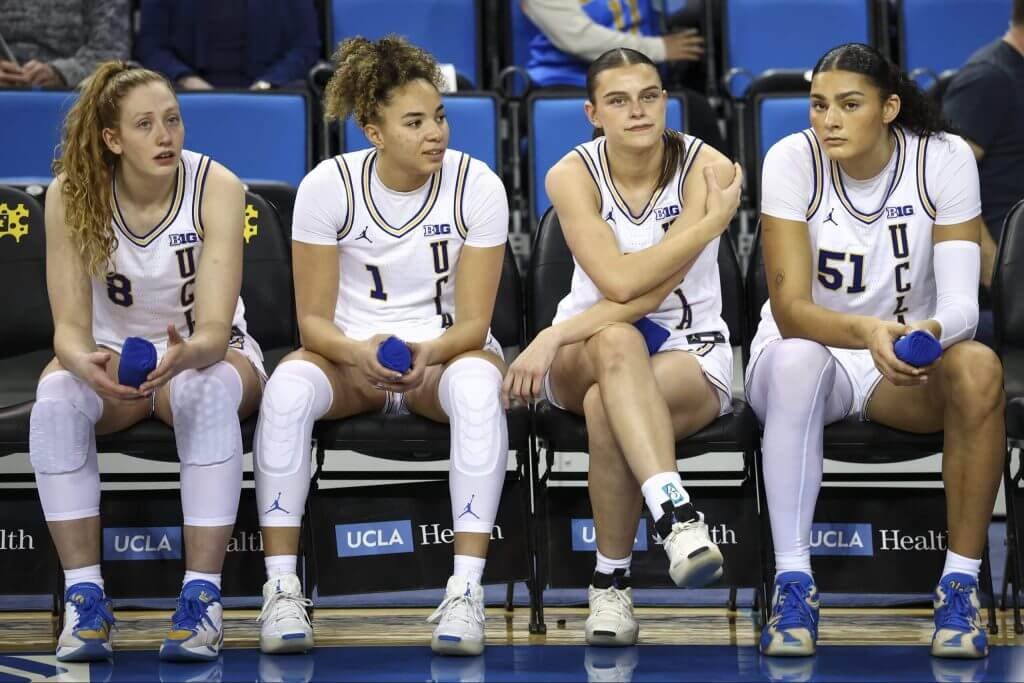
Gabriela Jaquez | 6-0 wing | UCLA
This is probably too high for a role player, even one as highly regarded as Jaquez. At some point, I might have to course correct. But everyone I’ve spoken to in the WNBA loves Jaquez. She can play multiple positions. She shoots well (62.9 percent on 2s, 43.8 percent on 3s and 87.5 percent on free throws), moves off the ball — UCLA scores a ridiculous 1.47 points per possession off of her cuts, per Synergy — and defends.
Advertisement
Every time Jaquez takes the floor, she seems to get a little better. If you’re building a culture from the ground up, you couldn’t do better than opting for the life Jaquez breathes into a program.
7. Toronto Tempo
Iyana Martín | 5-9 guard | Avenida (Spain)
This is another pick that hasn’t changed since November. After winning the EuroLeague’s young player of the year award last season, Martín is averaging 12.5 points and 5.2 assists in EuroCup games in 2025-26. That would have been a top 10 assist mark among qualified players in the WNBA last season. Her team is 9-1 in those contests with a 20-year-old running point. Martín’s 3-point percentage has dropped 10 percent since last season, but her free-throw percentage has gone up by a similar margin to 82.8.
Advertisement
8. Golden State Valkyries
Nell Angloma | 5-11 guard | Lattes Montpellier (France)
The French wave is inevitable. After the rapid success of Dominique Malonga and Leïla Lacan, there’s much less skepticism about French prospects and how they perceive the WNBA. France is developing an incredible generation of talent, and if those players want to come to the U.S., the WNBA is more than happy to have them.
It should come as little surprise that a foreign player is mocked to Golden State after the Valkyries rostered 10 internationals over the course of their debut season. Angloma is on the come-up thanks to a prolific scoring season in France’s top league. Opponents can’t stop Angloma from getting to the basket, even though she doesn’t have much of a jump shot. She’s averaging 16.2 points per game and earning 6.1 free-throw attempts per contest. At 19, she already has the physicality to survive in the league, though her jumper will have to improve to make her a viable shooting guard or small forward.
Advertisement
9. Washington (from Seattle)
Gianna Kneepkens | 6-0 guard | UCLA
Kneepkens led the Big 12 in effective field-goal percentage and free-throw percentage last season, making 57 percent of her 2s, 45 percent of her 3s and 89 percent of her foul shots. Since transferring to UCLA, she has become even more efficient from every area. Kneepkens is simply one of the best shooters college basketball has seen in recent years, no matter her usage. The Bruins improve their effective field-goal percentage by 7.6 percent when Kneepkens is on the floor.
She uses an unorthodox form on her jump shot, but after five seasons in three conferences, there is enough of a track record to believe it will translate to the professional level. The Mystics took and made the fewest 3s in the WNBA in 2025. Bringing in an ace shooter like Kneepkens is a quick way to fix that.
Advertisement
10. Indiana Fever
Charlisse Leger-Walker | 5-10 guard | UCLA
Leger-Walker is the second-best pure point guard in this class behind Miles, though her age (she turns 25 in September) limits her upside relative to Martín. Nevertheless, she knows how to run an offense and makes a mean skip pass. She’s also a bully on drives and has become a surprisingly good screen navigator on defense at UCLA after being a more inattentive defender during her Washington State days.
All of those attributes make her a useful complement to Caitlin Clark. Leger-Walker can give Clark opportunities to play off the ball, letting the Fever star come off screens and function as a movement shooter instead of having to bring the ball up and do all of the shot creation. Leger-Walker’s passing craft rivals Clark’s, allowing her to mimic some of Clark’s sets as a backup point guard.
Advertisement
Indiana is trying to win now, and Leger-Walker has as much experience as possible for a rookie. In addition to her six years of college basketball, she has been playing for the New Zealand national team since age 16.
11. Washington (from New York Liberty via Connecticut)
Kiki Rice | 5-11 guard | UCLA
Kiki Rice has been the starting point guard for UCLA for four seasons, and I’m still uncertain if she can be a point guard in the pros. But the WNBA is trending more positionless; not every team needs a classic floor general if they have playmaking at other positions. And regardless of Rice’s position, she has enough certainties in her game. She defends the point of attack (she has the second-best defensive on-off differential for the Bruins behind Betts), she puts pressure on the rim, and she holds herself accountable. Rice shot 21.7 from 3-point range and 79.1 percent from the foul line as a freshman; those figures are 40 percent and 89.5 percent as a senior. Bring Rice home to D.C. and let her continue to improve through Washington’s rebuild.
12. Connecticut (from Phoenix Mercury)
Ta’Niya Latson | 5-8 guard | South Carolina
The Sun have a ton of defensive talent on the perimeter with Lacan and Saniya Rivers. They don’t have much offensive pop. Let Latson change that. The adjustment to South Carolina has been a bit more uneven than Latson or the Gamecocks might have hoped, but she is still a fearsome scorer and dynamic downhill attacker; 47.4 percent of her shot attempts come within 4.5 feet of the rim, and she earns 5.8 free-throw attempts per game. Connecticut will have to find some stretch bigs to accommodate spacing challenges at other positions, but Latson will insist her way to the basket no matter who else is on the floor. The Sun could desperately use that type of player.
Advertisement
13. Atlanta Dream
Raven Johnson | 5-9 guard | South Carolina
The Dream are building around Rhyne Howard, Allisha Gray and Naz Hillmon, and that trio needs an organizing force at point guard. That’s Raven Johnson. She controls pace, knows how to get all of her teammates involved and is loath to hijack possessions when a better option presents itself. She also has consistently helmed great defenses and makes dribbling difficult for opposing guards for 94 feet. If there were any consistency on her jump shot, she’d be a better prospect. Perhaps playing for Karl Smesko and being forced to launch from 3 will improve her confidence in her jumper.
14. Seattle (from Las Vegas Aces)
Ashlon Jackson | 6-0 guard | Duke
Jackson looks like a 3-and-D player — she has a pro body and takes a high volume of 3-pointers, and she does so confidently. The stats don’t totally support that hypothesis, neither the shooting nor the defense, though her 3-pointer was much better in the two seasons before this one. Yet, Jackson has been heavily relied upon by some excellent Duke teams. She makes her foul shots, a rarity for the Blue Devils in the Kara Lawson era. She’s emerged as a valuable playmaker. She holds up well in one-on-one defense and has improved as a screen-and-roll defender as she learns how to navigate those offensive possessions. She has a lot of tools to like, even if the whole package hasn’t quite come together at Duke.
Advertisement
15. Connecticut (from Minnesota via Washington)
Madina Okot | 6-5 center | South Carolina
This pick could go in many directions. In addition to the three players listed below, Grace VanSlooten, Dariana Littlepage-Buggs and Janiah Barker were all considered here. VanSlooten is a personal favorite, but it’s hard to justify picking her when the Sun already have two young power forwards in Aneesah Morrow and Aaliyah Edwards. Ultimately, the spot goes to Okot. She does exactly what you want from a center: seals her defender, protects the paint and boxes out. Okot has shown massive improvement in just two years of college basketball, and she’s young for this class since she won’t turn 22 until August. There is so much room to grow.
Also considered: Maggie Doogan (Richmond), Tonie Morgan (Kentucky), Laila Phelia (Syracuse)
Advertisement
This article originally appeared in The Athletic.
Minnesota Lynx, New York Liberty, Seattle Storm, Los Angeles Sparks, Washington Mystics, Atlanta Dream, Chicago Sky, Connecticut Sun, Indiana Fever, Dallas Wings, Las Vegas Aces, Phoenix Mercury, Duke Blue Devils, UCLA Bruins, South Carolina Gamecocks, TCU Horned Frogs, Connecticut Huskies, LSU Lady Tigers, Golden State Valkyries, Portland Fire, Toronto Tempo, WNBA, Women’s College Basketball
2026 The Athletic Media Company

