The NCAA women’s basketball tournament is committed to having two sites for its four regionals for at least five more seasons but might return to four sites at some point after that. And if there is expansion for the men’s tournament, the women’s field also will expand.
“To have the same championship participation postseason opportunities is a commitment under gender equity,” Lynn Holzman, NCAA vice president for women’s basketball, said Tuesday. “It is now a principle that those would move in lock step. If expansion were to be voted on to occur, it would occur for both the men’s and women’s basketball Division I championships.”
Holzman spoke with ESPN on the eve of the start of the women’s tournament, with the opening two games of the First Four on Wednesday.
The NCAA women’s tournament began in 1982 with 32 teams. It expanded over the years, reaching 64 by 1994. It moved to 68 teams in 2022.
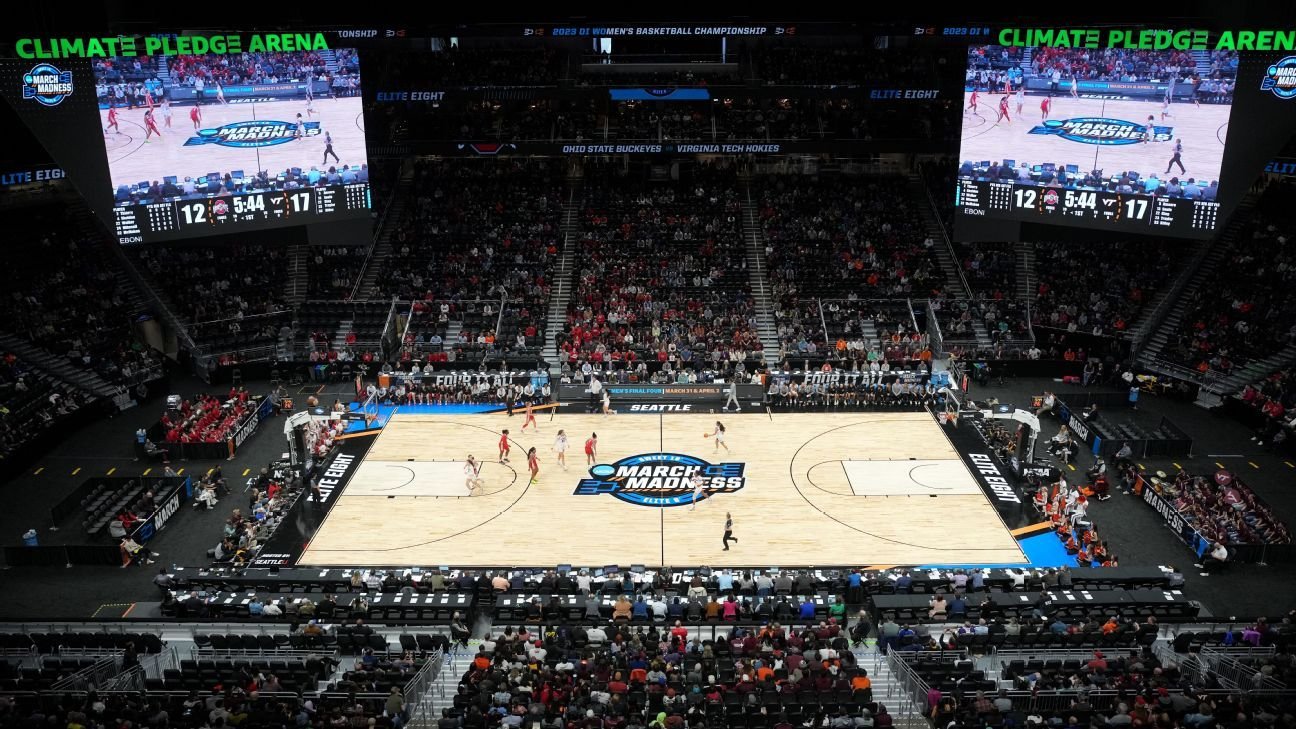
In 2023, the tournament changed from having four sites for its regionals — which had always been the format — to having two sites that each host two regionals on alternating days. The NCAA’s goal was to create a better atmosphere with increased attendance.
The two-site system used in the past three years has drawn the highest attendance numbers in tournament history, the NCAA said. The best total attendance for the regional rounds with the four-site model was 73,954. Last year’s attendance — with sites in Birmingham, Alabama and Spokane, Washington — totaled 84,754.
Holzman said there was still some concern about how having two sites impacts television broadcast windows and the availability of the main court for all eight teams for practice at each site. For now, the NCAA says the positives outweigh the negatives, but with attendance growth could come a move back to four sites.
The regionals this year are at Dickies Arena in Fort Worth, Texas, and Golden 1 Center in Sacramento, California. Regionals have been awarded for the next two years: They will be in Philadelphia and Las Vegas in 2027, and in Portland, Oregon, and Washington, D.C., in 2028. The bid process for the next three years of regional sites opens this summer, and they will be awarded in 2027.
The NCAA is also committed to continuing the system of the top-16 seeds hosting the early rounds of the tournament through 2031.
The women’s Final Four is awarded through 2031. It’s in Phoenix this season, followed by Columbus, Ohio; Indianapolis; San Antonio; Portland; and Dallas. The NCAA announced in September that the 2028 Final Four in Indianapolis would be at Lucas Oil Stadium after it was initially scheduled to be held at Gainbridge Fieldhouse. The move will expand capacity by about 13,000 seats.
Holzman said that all aspects of the women’s tournament undergo periodic reviews with stakeholders at member institutions surveyed. She said the event continues to grow, including the move in 2025 to unit payments to teams for participation in the women’s tournament.
“When you look at some of the demographics, one of the things we’re seeing is an increase of the age 18-34 female viewership,” Holzman said. “We can translate that over to several things, including the WNBA as part of the ecosystem. The players are using their own platforms to connect with fans, and it’s positive for us to see these trends.
“We see certain programs that are sustaining their [attendance] success year after year, but there is still work to do. We still need to keep increasing the attendance and engagement at the local levels … that translates then to our championships.”

