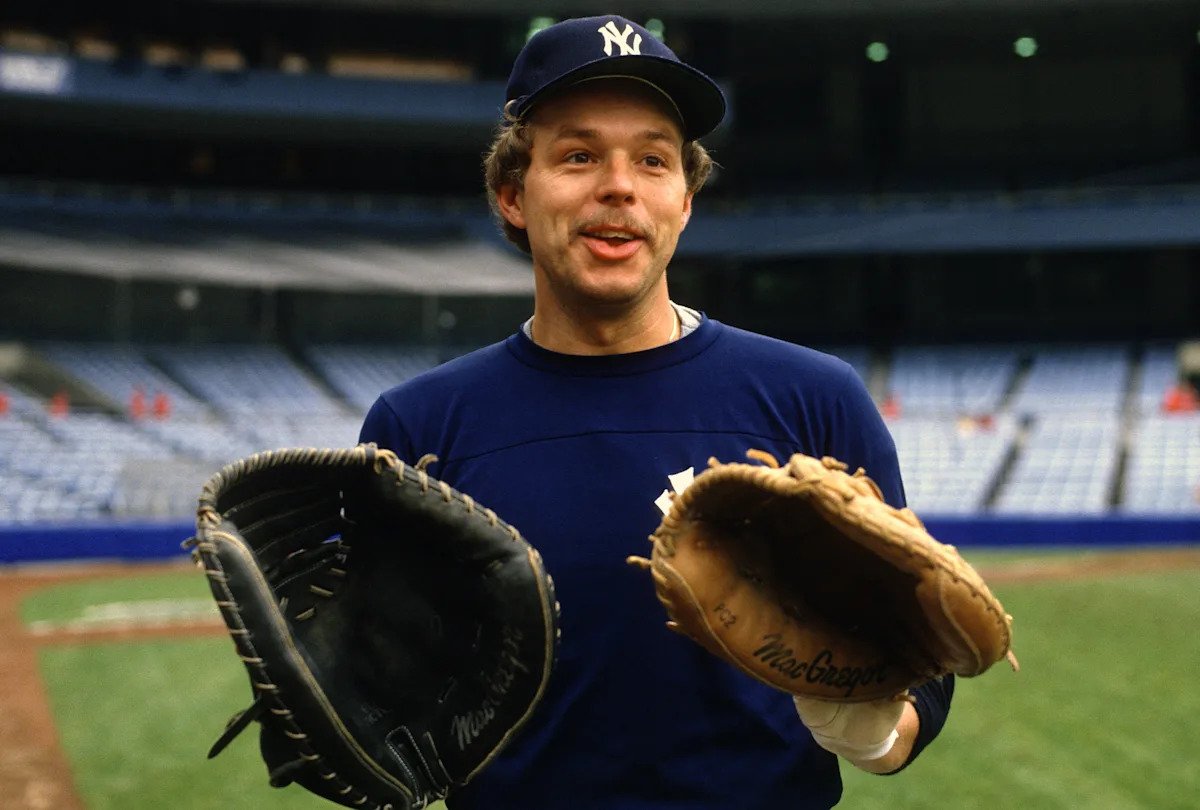
Butch Wynegar had such exciting potential when the Twins traded him to the Yankees in 1982. A Rookie of the Year runner-up and already a two-time All-Star catcher at the age of 26, he should have been a foundational piece of the offense alongside Don Mattingly, Dave Winfield, and later Rickey Henderson. Instead, the end of his tenure in pinstripes serves as a crucial reminder of the prominent role mental health plays in professional sports and indeed in life, reinforcing the attention and care that must be paid to it if we want to perform at a desired level in any of our pursuits.
Harold Delano “Butch” Wynegar Jr.
Born: March 14, 1956 (York, PA)
Yankees Tenure: 1982-86
Advertisement
Harold Delano “Butch” Wynegar Jr. was born on March 14, 1956, in York, PA, to Harold D. Wynegar Sr. and Dorrea L. “Dee” Wynegar. He earned his nickname “Butch” from an aunt on account of his chubby appearance as a baby. A multi-sport athlete at Red Lion High School, Wynegar idolized Mickey Mantle growing up, crediting the Yankees legend as the inspiration for Wynegar to become a switch-hitter when he was nine. He was a star football center and third baseman, but moved behind the plate for his final two years of high school, batting .370 as a senior.
Those performances his senior year caught the eye of the Twins, who drafted him in the second round of the 1974 MLB June amateur draft. He began his professional career with the Rookie-level Elizabethton Twins of Tennessee and led the Appalachian League with a .346 batting average while also leading his team with eight home runs and 51 RBIs. This earned him a promotion to the Class A Reno Silver Sox of the California league in 1975, where he would again lead the team with 19 home runs and 119 RBIs to go along with a .314 average, his contributions leading the team to win the pennant.
In 1976, the Twins fired manager Frank Quilici and replaced him with Gene Mauch, previously of the Phillies and Expos. Unimpressed with the catching options at his disposal, Mauch surprised Wynegar by inviting him to spring training despite the young catcher never having played a game above Class A. After an owner lockout delayed the start of spring training, Wynegar came out on a tear including a grand slam in his first spring exhibition. Though he cooled off to bat just .187 that spring, Mauch was impressed enough by his all around game to allow Wynegar to break camp with the big league club, praising his new catcher’s maturity:
“When spring training opened, I had no right to expect he’d be as polished behind the plate as he is. He looks like he’s 15, plays like he’s 25, and has the maturity of a man of 30.”
Wynegar made his debut on Opening Day, April 9, 1976, against the Rangers, collecting his first big league hit and RBI with a single off Gaylord Perry in the sixth inning. A week later at Yankee Stadium, Wynegar slugged his first big league home run — a game-winning solo shot in the ninth inning off Catfish Hunter. The next night, he homered off Jim Palmer in a game against the Orioles in Minnesota, meaning in the span of a week, the rookie had amassed his first big league hit and first two big league home runs off three future Hall of Famers.
Advertisement
His strong performances continued that year including an impressive ability to throw out runners — he had an almost 50-percent caught-stealing rate in those opening months — earning the rookie an All-Star selection alongside Rod Carew as the Twins’ representatives. At just 20 years old he was the youngest ever participant in an All-Star Game at that point, earning a pinch-hit appearance in the seventh against Luis Tiant and drawing a walk.
He finished his rookie year batting .260/.356/.363 with ten home runs and 69 RBIs to earn a runner-up finish in AL Rookie of the Year balloting behind Tigers pitcher Mark Fidrych. He followed that up with a nearly identical sophomore campaign, slashing .261/.344/.370 with ten home runs, 79 RBIs, and an AL-leading 60 runners caught stealing to earn his second consecutive All-Star nod in his first two seasons in the bigs. He suffered a downturn in form the following season but rebounded to again lead the league with 64 runners caught stealing in 1979, finishing with a .270/.363/.351 triple slash line, seven homers, and 57 RBIs.
Wynegar retained his grasp on the starting catcher job into the ’80s, earning a five-year, $2 million extension in 1981. This made him a target for cost-cutting owner Calvin Griffith as the Twins floundered in 1982, and Wynegar found himself traded alongside Roger Erickson to the Yankees for Larry Milbourne, John Pacella and Pete Filson on May 12, 1982. Thus, Wynegar found himself playing for the team of his childhood hero, but little did he know the perils that come with playing for the Yankees teams of that era.
He more than acquitted himself in that debut Yankees season, batting .293/.413/.393 the rest of the way. The following season, he found himself in a platoon with Rick Cerone behind the plate. He appeared in just 94 games but was one of the Yankees’ best hitters that season, slashing .296/.399/.429 with six home runs and 42 RBIs — good for a 136 wRC+. Despite having his playing time reduced for the first time in the bigs, that season featured one of the most memorable moments of his career, Wynegar catching Dave Righetti’s no hitter at Yankee Stadium against the Red Sox on Independence Day.
“It was one of my biggest thrills, no doubt about it. Raggsy and I were close, having had a pitcher-catcher relationship… If I remember right, if Raggsy shook me off that day, it wasn’t very much. We seemed to really be on the same wavelength. When you’ve got a guy who has four pitches working for him, it’s a lot of fun, so there wasn’t a whole lot of thinking that had to be going on. We stayed hard, just mixing enough soft stuff in there to keep them off balance.”
Wynegar won back the full-time starting catcher role in 1984, but would never again reach the heights on offense of his first year-and-a-half in pinstripes. He batted .267/.360/.342 with six home runs and 45 RBIs, playing in 129 games for the first time since 1980. But then came the 1985 season and the beginning of Wynegar’s loss of desire to play baseball.
Advertisement
The season started on inauspicious terms, the Yankees firing manager Yogi Berra — a decision Wynegar says caused many of his teammates to throw things in anger in the clubhouse — replacing him with the volatile temperament of Billy Martin. That offseason also brought a contract dispute with Wynegar entering the final season of his five-year contract, Wynegar initially being offered a three-year extension with a fourth year option. However, when his agent proposed that the fourth season be converted to a guaranteed year, George Steinbrenner angrily pulled the offer off the table (though he would eventually sign for three years and $2.2 million at the conclusion of the season).
His performances suffered at the plate as he dealt with the lingering effects of being struck in the head by a foul ball while he stood in the on-deck circle early in the season. He also could not adjust to Martin’s confrontational style of managing, rankled by Martin’s habit of frequently embarrassing his pitcher and catcher in front of the whole team with an expletive-laced tirade when opposing batters found success. Martin certainly didn’t help matters with his confrontational style with umpires, Wynegar confirming that several umpires confided in him that they intentional called close calls against the Yankees as a result. His .223 average also made him a target for Steinbrenner, the owner demanding an explanation when Wynegar had a bad night at and behind the plate. The lone bright spots that season for Wynegar came when the backstop caught both the 300th win and 3,000th strikeout from Phil Niekro.
Already falling out of love with the game, things reached a head in 1986. The Yankees fired Martin and replaced him with Lou Piniella, and though Wynegar had a good relationship with him when he was hitting coach, he saw Piniella transform into a carbon copy of Martin once he took the helm of the team. Wynegar fell into a deep depression as his performances plummeted, creating a brutal reinforcement loop as both Piniella and Steinbrenner became increasing critical. He finally realized he needed help when, on July 29th, he rejected a hug from his 17-month-old son:
“I had goose bumps all over. It just hit me that I had brushed off my little boy, the pride and joy of my life, one of the only people who really matters. I just wanted to get home and get out of there so badly. I thought I’d been dealing with my depression, but then I said to myself, ‘Holy cow, you’re really taking your work home with you now.”
Earlier that day, Wynegar was the starting catcher in a 6-4 loss against the Brewers. He was in a haze during his pre-game routines having gotten into an argument with Piniella, which reached full blown apathy by the first pitch:
“That was pretty much the last straw. I was back there calling signals and not caring what I was calling. I’d call for a curveball or a slider and have no idea why. I was watching the scoreboard. I was watching the innings tick off. That was the only thing that mattered, not whether we won or lost. It was like I was in a fog. When I got back to the hotel, I realized I’d never want to go through that again.”
Scott Nielsen was the pitcher that day and gave up five runs while recording just one out, leading to his demotion to Triple-A. Two days later, Wynegar called GM Clyde King and begged to be given time off. King needed permission from Steinbrenner, who initially advised Wynegar to see a doctor in Cleveland before acquiescing to a single day off. However, the issues ran much deeper than that.
“I don’t even want to see my glove or a baseball. I’m not going to see some strange doctor in a strange city. I want to go back home. I’m not doing the team any good. This is not a one-day thing. I’m not coming back.”
Wynegar eventually resolved to take the rest of the season off. He saw seven different doctors including two psychiatrists, and was eventually prescribed antidepressants and anti-anxiety medication. In response, Steinbrenner added Wynegar to the restricted list, enabling him to withhold the remaining $250,000 owed to Wynegar for the rest of the season. Wynegar filed a grievance at the season’s conclusion, which unfortunately for him killed a trade the Yankees had agreed to send him to the Angels. However, Wynegar followed through with his resolve to not play another game for a team from New York, thus forfeiting the $1.4 million remaining on his contract for the 1987 and 1988 seasons.
Advertisement
Just when it seemed like his career was over, Wynegar found new life after withdrawing his grievance and earning the trade to California for pitchers Ron Romanick and Alan Mills on December 19, 1986. Key in his decision to keep playing was his old manager from Minnesota, Gene Mauch, now at the helm of the Angels. Wynegar considered Mauch to be a father figure, the man who gave him his first shot and his second wind. In a far more peaceful environment and playing for a man who always supported him, Wyengar was happy to be backup to Bob Boone, and he played 58 games across his final two seasons before retiring at the age of 32.
Wynegar put together an admirable career as a major league backstop, with a pair of All-Star appearances, an impressive 40.3-percent caught stealing rate, and 626 walks drawn against just 428 strikeouts. However, his greatest legacy is the courage to put his family and mental health before the game and the courage to seek professional help in an era when mental health was heavily stigmatized, especially for professional athletes. He may not have achieved the on-field results that his first few seasons presaged, but he can be more than proud of the human results he achieved.
References
Butch Wynegar. Baseball-Reference.
Advertisement
Butch Wynegar. Baseball Almanac.
Wancho, Joseph. “Butch Wynegar: From Single-A to the Major League All-Star Game in One Year.” The National Pastime: Baseball in the Land of 10,000 Lakes. 2024.
Weyler, John. “Big Apple Turned Sour for Wynegar : Angels’ New Catcher Had to Get Out of New York Before He Lost His Mind.” Los Angeles Times. March 26, 1987.
Verducci, Tom. “This Yankee Goes Home.” Reading Eagle. December 10, 1986.
Laurila, David. “Prospectus Q&A: Butch Wynegar.” Baseball Prospectus. September 21, 2008.
See more of the “Yankees Birthday of the Day” series here.

