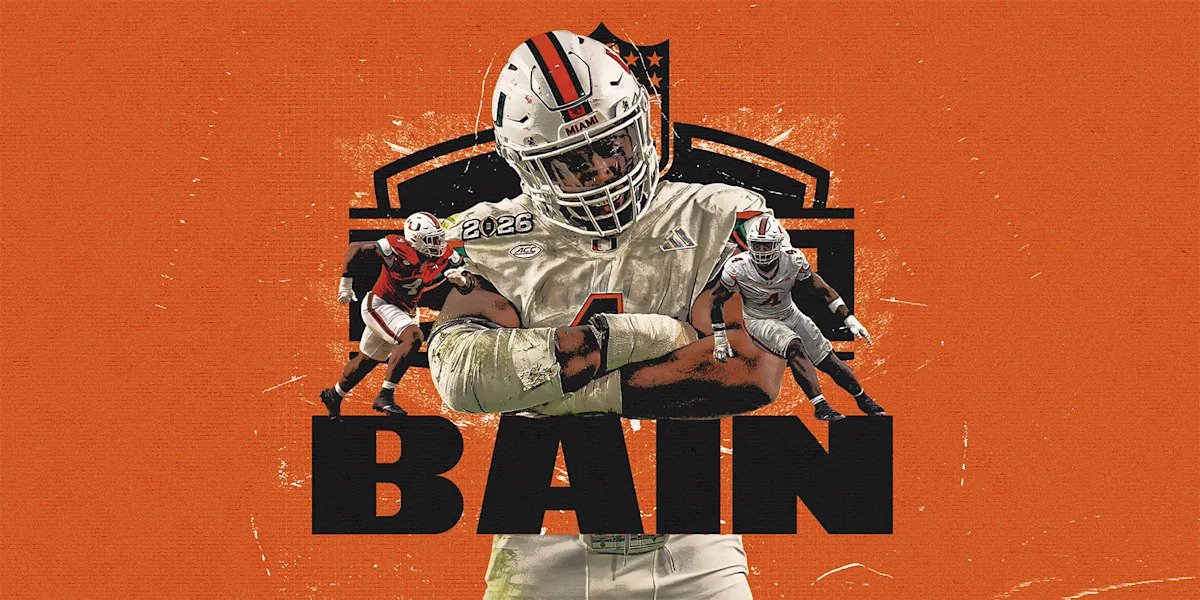
As April’s NFL Draft inches closer and closer, one of the hottest debates this year revolves around Miami star edge rusher Rueben Bain Jr. The debate isn’t surrounding whether or not he’s good enough to go in the first round; that much is a consensus and resounding yes. It’s exactly how good he can be within the framework of his tangible physical benchmarks.
Draft your Yahoo Fantasy Baseball team for the 2026 MLB Season
Advertisement
To be specific, Bain’s arm length (measured in at 30 7/8” at the NFL combine) has some worrying that he’s not worth a top draft pick and that his potential is low due to having short arms, which is a fair concern to have — but it’s incomplete. Part of the reason why Bain is considered a high draft pick is because he’s already shown the ability to mitigate this shortcoming, and he has the physical traits needed to thrive with shorter arms.
Rueben Bain Jr. has already shown ability to mitigate shorter arms
Thanks to a dominant run through the College Football Playoff, Bain has become a well-known player at the top of this draft and likely won’t wait long to hear his name called. While it’s not the entire season, that run to the national championship game is a great framework through which to view Bain. In the four playoff games that Miami played, Bain was a menace with five sacks and eight tackles for loss, most of which came in Miami’s win over Texas A&M in the first round of the playoffs. While that game was the peak of his destructive powers, he still showed that he’s got enough solutions already to counter the arm length critics even in the games where he didn’t stuff the stat sheet.
For defensive ends with shorter arms, one thing they absolutely have to have is the weight and frame to play a more physical brand of football. Where defensive ends with the Mr. Fantastic arms can use their arm length to keep offensive tackles at bay as they rush, shorter armed players play almost the exact opposite way. Having enough power to play through the chest of an offensive linemen is a critical skill to have — just about every single starting offensive tackle, and their backup, in the NFL has arms that measure far beyond Bain’s 30 7/8 inches. For Bain, and players built like him, playing through offensive tackles post-contact is normally going to be the cleanest mode of operation. Bain weighs over 260 pounds, which makes him a dense player at 6-foot-2.
Advertisement
The power he’s able to generate is the base of his game. Everything else that he can do on the field starts here. Bain didn’t do any athletic testing at the combine or his pro day, but the explosion he possesses as an athlete is readily apparent on the field. He’s a load at the point of attack and his ability to quickly get into, and power through, the bodies of offensive linemen is a signature trait.
When he does keep his chest clean during a rush, which he does exceptionally well for someone with his lack of length, Bain has routinely shown off the burst and closing speed to rush around the edge and put pressure on the quarterback. His effort is consistently high and he clearly has the speed to be a threat outside of the pocket.
Bain’s strength and speed at the point of attack allowed him to play on the interior from time to time in Miami’s defense as well, where he was able to cause havoc and open things up for his teammates. While the arm length may affect what his base counting stats look like in the NFL, his body type gives him positional flexibility on rush downs that can unlock a defense’s pass rush in the right looks. Being a squattier player on a position that stresses leverage isn’t necessarily a huge knock, especially since he has the strength to play with the stronger offensive linemen that he saw at the college level.
Advertisement
Rueben Bain Jr. won’t be a fit for every team, and that’s OK
While Bain is a complete player at defensive end, the arm length critics do have a point to a degree. Bain’s overall game sets a tremendously high floor for him as a prospect, but there just aren’t many players with his build who have been consistent double-digit sack threats. My Football 301 co-host Nate Tice compared Bain to Brandon Graham. That would be a great career for Bain to have, but even Graham only had one 10-sack season in his career — which came at age 34 in 2022. Graham’s frame helped him be a durable player for a long time in the NFL and hopefully that can translate for Bain as well. Still, the idea that a defensive end taken in the top five might not be a consistent 10-sack guy is a hard pill for some people to swallow.
There’s also the truth that Bain isn’t really a fit for every system. Unlike Arvell Reese or David Bailey, whose builds and top-end speed make them a fit for 3-4 teams that stand their edge rushers up in two-point stances, Bain is a classic 4-3 “hand in the dirt” defensive end. For teams that play that style, that’s not a concern, but for teams that might require a bit more versatility from their edge rushers in terms of being able to drop into space, Bain won’t be a fit for them. However, that really just comes down to personal preference and scheme fit.
Bain just offers so much from a run defense and physicality standpoint that it’s hard to get too caught up on that. It’s not like he’s a one-trick pony that can only rush the passer. He truly is a technician as a run defender and takes advantage of the inherent athletic traits that he already possesses. If Bain can come in and be a Brandon Graham-level player for a decade, he’d likely be worth a top-five pick in what’s perceived to be a weaker draft class. If the Titans aren’t done adding to their defensive line room, there might not be a more perfect player-scheme fit in the top five than Bain to Robert Saleh’s defense. He’d plug in cleanly as a defensive end in that scheme, and playing next to Jeffrey Simmons would give him a credible interior presence to give him better rush opportunities as a rookie.
Advertisement
Don’t let combine thresholds be the end of the story of a prospect. Bain already offers a lot of solutions to the problems that his arm length should cause and has set himself up to be, at worst, a capable starter from a physicality standpoint. Considering he won’t turn 22 until September of his rookie year, he’s still just scratching the surface of the player he can become.

