On the eighth floor of the Pearl Continental Hotel in Lahore on an unseasonably cool, wet April morning, one of the heavy oak doors creaks open. Adam Zampa makes a short walk to another room. Marnus Labuschagne has just fired up his coffee machine. A few of their mates are already there, and they catch up over whatever artisanal brew it is so many current Australian cricketers seem so passionate about.
They take their time over coffee, but soon enough, Zampa’s making the walk back. Once inside his room, he starts up his own coffee machine, and enjoys another one. The time is ticking along now, but then again, Zampa doesn’t have anywhere to be.
“These days are long,” Zampa tells ESPNcricinfo. “You get the social aspect done in the first little part of the day and then the days feel a little bit long once you get to the afternoon. That’s when it can be a little bit tough. Round about now you kind of want to go to training.”
Not that he feels he needs to train too much. Spin bowling may be about getting into a rhythm, but you are unlikely to catch Zampa putting himself through his paces in the nets.
“I don’t really train a hell of a lot,” he shrugs. “I don’t bowl much in the nets. I’ve got a lot of clarity, and a repeatable action.”
It wasn’t always this way for Zampa, who was 23 when he made his international debut. “If you look back at when I was in my early 20s, you’d say, I don’t know if that guy’s going to have a long career.”
Zampa is one of the most reliable white-ball spinners in the world now, and has been for a decade. He is a shout for the highest quality overseas player at PSL 2026, one of few to have been signed at or near the peak of his powers. While he was sold at the auction for a relatively modest US$160,000, a deal worked out between the player, his franchise and the PCB meant he stands to earn in excess of US$400,000 over the course of the tournament.
It is that dependability across tournaments, and across the world, which convinced the PSL that it didn’t matter that he had never played in the league before; they knew what they were getting. “I’ve played over 300 T20 games now and become a universal bowler, and tried to be smart about where I’m bowling,” he says. “I prepare well. I leave no stone unturned in terms of who I’m bowling against in every league that I play in. I try and do as much work as I can behind the scenes to make sure I’m ready.”
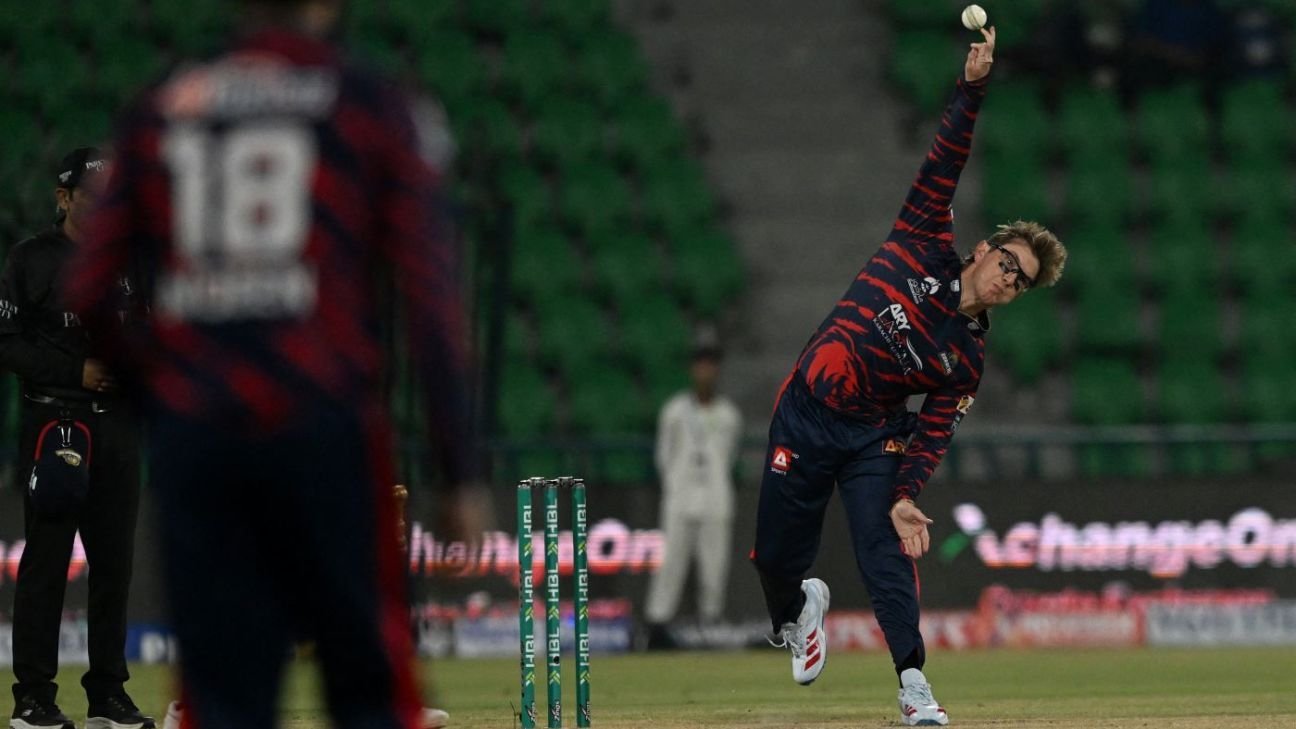
“I think some legspinners get trapped with worrying what it looks like. They feel like it’s got to look pretty, the way the ball comes out of the hand, or think they’ve got to bowl a particular way that looks like legspin. I’ve never really worried about it”
Somehow, Zampa has managed to develop himself into that rare entity: a consistent legspinner whose immaculate control allows him to keep turning in solid displays, rather than one vainly chasing perfection. “Wristspin is one [of those things] where you can be an attacking wristspinner and you can potentially change the odd game, or you can be a banker and contribute as consistently as possible. That’s what I’ve tried to do as long as possible.”
A glance through his numbers paints that exact picture. Across the BBL, the Hundred, the T20 Blast, the CPL, and now the PSL, his economy rate hovers between 7.10 and 8.10, improving dramatically to 6.28 in the ILT20, and dropping slightly to 8.37 in the higher scoring IPL. It is a degree of consistency few legspinners have been able to match across as long a timespan.
Zampa believes that for some, it comes down to a misunderstanding of what the role actually requires. “The secret to not getting smashed around is the ability to understand when you need to attack and defend yourself. The game has changed and you’ve got to stay with where it’s moving. When I first started [playing] T20 cricket, you could attack guys for a little bit longer and defend the backend of your over a bit more. Now, sometimes new batters have the ability to come out and hit for six first ball, so that affects when is the right time to attack or defend, and getting that right more times than not is where you become a banker.”
When Zampa was starting out, it was far from clear this was the reputation he would build his career on, that this was the life that the skills he ultimately came closest to perfecting would provide. Initially, like any young Australian leggie growing up in the shadow of Shane Warne, Zampa wanted to play Test cricket. He ended up playing the vast majority of his first-class cricket early on in his career – well before, he feels, he was able to truly master legspin. All but seven of Zampa’s 41 first-class matches were played when he was 23 or younger. A first-class bowling average of 46.56 offers a sobering assessment of how it all went.
Zampa feels playing so much first-class cricket in those early years didn’t help with perceptions of his ability. He describes his bowling action when he first moved down to South Australia in 2013 as “terrible”, before Darren Berry took him through a pre-season the following year that Zampa views as formative. He considers himself blessed by the quality of spin-bowling coaches who have made him the bowler he is, in particular shouting out Trent Woodhill, his oldest mentor.
But in those early, uncertain throes at the beginning of his journey, Zampa was learning the value of making difficult compromises. After a while, he accepted he would never get the baggy green he always wanted, with Australia’s tour of Sri Lanka last year finally killing his hopes.
“That [Sri Lanka tour] was in my sights,” he says. “I was nowhere near the same bowler when I played a lot of first-class cricket, so my numbers I felt like were irrelevant. That was probably the time I thought ‘maybe’, and then when that didn’t happen for me, that dream kind of went away. It was a dream that was always there. I felt like I was good enough now during my 30s and bowling well enough.”
It’s not a dig at the selectors; Zampa simply doesn’t feel there’s much of a place for wristspin in Test cricket anymore. “Who can you name outside the subcontinent [who plays regularly],” he asks. “I understand it now. I was frustrated for a while, but the accuracy, the results kind of speak for themselves. There’s not a lot of wristspin out there that you would say is playing a lot of Test cricket, or is a better option than the second fingerspinner in each Test team, unfortunately.”
It wasn’t, by any means, wasted time. Zampa believes he owes the repeatable, dependable bowling action that has earned him T20 riches and white-ball silverware with Australia to the base he built playing red-ball cricket in his early 20s. He learned how to make subtle changes – to his delivery stride, his arm speed, his wrist position, his release point – that make his variations so difficult to spot, much less dispatch without risk.
While honing that craft, Zampa made another calculated compromise, stripping bare his skill into what was effective, and casting aside the aesthetics.
“I think some legspinners get trapped with worrying what it looks like. They feel like it’s got to look pretty, the way the ball comes out of the hand, or think they’ve got to bowl a particular way that looks like legspin. I’ve never really worried about it.”
“I’ve never really been happy with how I look when I bowl. It’s always been result-driven rather than worrying about how the ball comes out of if I’m hitting the right length every ball. We hone in on the process, but I’ve focused on the result, and not cared about whether it’s ugly. If I’ve had to bowl 24 balls defensively when I’m under the pump to get through a game, then that’s fine with me.”
Coming from the land of Warne, who often spoke about legspin in venerable, almost spiritual terms, it feels iconoclastic, but as a spinner who has evolved with the times in T20 cricket, Zampa understands the futility of using the past as a reference point better than most. There are just two wristspinners with more T20 wickets: Rashid Khan and Imran Tahir – both more celebrated for their guile than their style. For Zampa, it is hardly surprising that his laser focus on problem-solving to the exclusion of all else has placed him where he is in T20 cricket.
Halfway through the PSL, Zampa is holding up his end of the bargain, as he appears to do everywhere he goes. In three of his five games, his bowling figures read 1-26, 0-28, 1-27, one blowout compensated by figures of 2-11 in the other spell. He’s the only spinner to have bowled a maiden over this PSL; 63 of his 120 balls have yielded either no runs, or just one. (Only Usman Tariq has managed a higher number. Another bowler, incidentally, supremely unconcerned by how pretty he looks.) For four overs, Zampa can take the unpredictability out of a volatile T20 game seven out of ten times. It’s not exactly priceless, but Zampa has done very well out of the market value of that skill.
It’s late afternoon by now, just about the time Zampa might have begun to feel a bit restless. We are sat in the hotel coffee shop, which swarms with cricketers from all nationalities and franchises. The entire first phase of the tournament is in Lahore, so you hear Sikandar Raza’s sociable calls from across the room. Zampa’s Karachi Kings teammate Moeen Ali comes over to say hello, gently backing away once he notices the ongoing interview.
But there’s another reason the place is so busy; torrential rain the previous day has ensured training for all sides has been cancelled. “Yeah, the outfield’s wet, so it’s been called off today unfortunately,” Zampa laughs. “So you’re kind of stuck in your hotel room. But game days help that for sure.”
That’s one problem Zampa can’t solve. But there’s nothing, you suspect, another leisurely coffee won’t fix.

