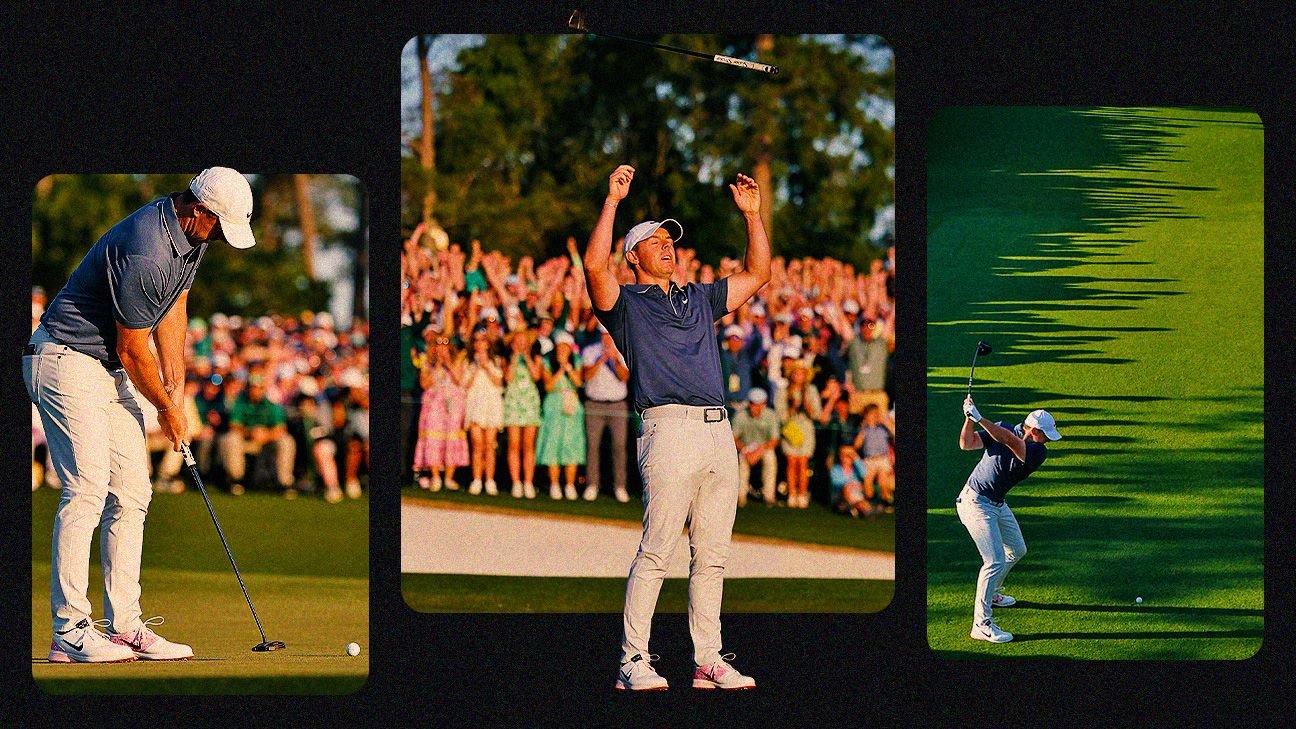
AUGUSTA, Ga. — There is something about the way that shots at the Masters become etched in our memories more than at any other tournament.
The setting — its green hues and bright azalea pinks free from corporate dressings — gives the tournament’s best moments a timeless filter. The camera quality of past video clips is the only clear distinction of the passing of time. Whether a tournament produces a tight finish or a runaway winner, every shot on Sunday carries the gravity of what a victory here, of all places, would mean. History colors every swing.
It’s why, even though Rory McIlroy can say that he won the 2025 Masters thanks to his Friday round of 66 or his scorching Saturday start (6 under through six holes), both of which are true, history will remember Sunday. It always does.
Golf demands that every shot during a 72-hole tournament matters. During the final round, however, it felt as though all of McIlroy’s shots existed in a vacuum. One moment, it was the best shot he had ever hit; the next, it was the worst. In the end, McIlroy’s masterpiece was more Pollock than Rockwell. It was an imprecise feat of letting it fall apart just enough that failure remained as likely as glory. In so many ways, it was fitting for him — the shots that willed him over the line were made more memorable by the shots that nearly produced another heartbreak.
A year removed from his historic win, here is a look at the five shots that won McIlroy his coveted green jacket and the career grand slam.
The pivotal pitch and putt on No. 3
The essence of McIlroy’s final round played out right away that Sunday. After a listless double bogey on the first hole and a disappointing par on the par-5 second hole, McIlroy stepped up to the third and smashed his driver 333 yards, perfectly placing the ball 24 yards short of the precarious left-hole location.
McIlroy’s length meant he could be more precise with his pitch, but the slope he faced is one of the steepest on the golf course, nearly 30 feet up from the flat ground. With the pin cut on that left knob, it requires a flawless pitch to get remotely close. Push it long and the up-and-down can be vexing. Hit it short, and it’s back at your feet.
McIlroy, whose short game often plays second fiddle to his long game, clipped the ball just right, allowing it to bounce only once before touching the surface and rolling out to eight feet. The putt was no simple roll either, breaking hard from right to left, and McIlroy had to play it well outside the hole. It snuck in, and suddenly, McIlroy had taken his lead back.
Eight of the past nine green jacket winners have gone on to birdie the third hole in the final round. It is a pivot point, and though it was far from McIlroy’s last that Sunday, it was one that immediately came to mind after his round.
“The best shot I hit today was — it could be the second on 7, but I think the most — one of the most important ones for me was the second shot on 3,” McIlroy said. “That’s not an easy second shot, bumping it up that hill. To judge that well and make a 3 there, when Bryson [DeChambeau] then made 5, and then to go ahead and birdie the next hole, as well, I thought that was — you know, it was very early in the round, but it was a huge moment.”
The circus shot on No. 7
In any other round, McIlroy’s shot into the seventh hole would be the one that leads highlight reels. The daring nature of it, the way he argued against his caddie, Harry Diamond’s, wishes, to pitch out, the way he contorted his body to get the ball up as quickly as possible and through a window of trees perhaps only he could see. It had all the makings of a classic Augusta shot — aggression, creativity, luck, skill and the thrill of not knowing where the ball would end up.
Instead, McIlroy’s next 12 holes had enough drama to nearly overshadow what happened on seven. The scorecard doesn’t help either — he made par. But the importance of this shot is not found in its score but rather in McIlroy’s reaction.
After driving it way left on the relatively straight seventh fairway, McIlroy had more tree trouble than most. With 153 yards to the hole, it would have made sense to pitch out or hit it low in the front bunker to get up-and-down for par. McIlroy said Diamond nearly begged him not to go for it.
“I like it,” McIlroy can be heard on the broadcast. “I think I’ve got a shot.”
I’ve watched this shot nearly 50 times, and it’s still unclear if the ball went through the gap McIlroy had seen and even more unclear what gap it went through. Regardless, the ball landed like a parachute on the green, nearly in the hole, and set off an early roar.
Back in the shade, cameras caught McIlroy doubled over and cackling. He couldn’t believe it. Diamond shook his head. After six holes of grit and grind, this was a reprieve. Not only had McIlroy relied on his artistry to see the shot and craft it — a part of his game that wasn’t present in the early part of his career — he also allowed himself to recognize the ridiculousness of the shot.
“My reaction said it all,” McIlroy said in a recently released video by the Masters. “I think for how tense the first six holes were … it broke the tension of the final round, and I think that was helpful as well.”
He didn’t make the birdie putt, but seemingly freed up after that moment, McIlroy birdied two of the next three holes to take his biggest lead of the day, one that felt insurmountable.
The ‘shot of a lifetime’ on No. 15
So many things had to go right and wrong for this shot to exist. It is the ultimate paradox of the Rory McIlroy experience. After being up by four strokes at the turn, should he have needed it? Absolutely not.
But there he was, suddenly one back of the lead after making a mind-numbing double bogey on 13 that will be equally as unforgettable and a bogey on 14, needing to find magic on Augusta’s most iconic second shot.
“When I got to 15 again, I needed to be aggressive,” McIlroy said in the recently released Amazon Prime documentary on his final round. “I needed to pull something out of the bag at that point because I was going in the wrong direction.”
The hill on 15 that crests to one of the better views on the property has seen its share of iconic approach shots. Gene Sarazen’s “shot heard around the world,” Tiger Woods’ several picturesque irons (and club twirls) over the years and Sergio Garcia’s eagle in 2017. After a 332-yard drive on Sunday, McIlroy had a different view. His ball was in the fairway but too far left to have a clear shot at the green.
Once again, McIlroy had to paint a picture in his head and swing it into reality, but he had the wrong club in his hands — an 8-iron. He watched as DeChambeau hit that club and came up short, landing in the water beneath the green. McIlroy swapped clubs and stepped up to it.
“He needs a [shot] that starts low, underneath one limb, rises and turns over,” CBS’s on-course analyst Dottie Pepper said in a hushed tone. “Two-hundred and seven [yards], 7-iron.”
The sound of the club striking the ball tore through that eerie, tense silence at Augusta that Sunday, and McIlroy started walking after it. As it curved around trees and perfectly onto the green, McIlroy, unlike he did at the seventh, barely provided a reaction. His face gave away nothing.
“I’ll remember the feeling of hitting that shot for the rest of my life,” McIlroy said in the documentary. “I don’t know if I’ll ever hit a better golf shot under that amount of pressure again in my career.”
As the ball continued to feed toward the hole, CBS’ Jim Nantz perfectly encapsulated the moment.
“The shot of a lifetime,” Nantz said.
McIlroy missed the eagle putt. A birdie was enough to get him back on track but not enough to avoid a collapse. He needed more.
The prayer into No. 17
There can be no greater sense of desperation in golf than needing a birdie with two holes left to win the Masters. The 17th and 18th aren’t birdie holes — both have historically played over par. With Justin Rose making birdie on 18 to tie McIlroy at 11-under late Sunday, McIlroy needed one more to win.
After righting the ship following the disaster at 13 and regaining the lead on 15, 17 is where you can see McIlroy once again start to grip the steering wheel tight. He had hit 3-wood off the tee on this hole all week, and he did again Sunday, trying to play a safe cut into the middle of the fairway. But the swing in the final round, on replay, looks like he’s trying to guide the ball to safety.
“When Tiger won in ’19, he hit like this little peeler cut off the 17th tee, and I just tried to do the same thing, a cut with a 3-wood, get it in play,” McIlroy said. “I left myself quite a long ways back but just long enough back to hit a great iron shot in.”
On Sunday, that 3-wood went 20 to 30 yards shorter than that club usually goes for McIlroy. Instead of a wedge into the green, he had an 8-iron in his hand. And because the 17th’s fairway undulation requires you to hit the right center of it to have a flatter lie, he was on a tricky upslope 184 yards from the hole.
McIlroy could see only the top half of the flag. With an 8-iron in his hand, trusting that he could hit it well enough to just barely cover the false front, he swung and immediately started to plead.
“Go, ahhh, go, ahh go, go, go, go go, go, go, go.”
The ball barely carried the false front and perfectly rolled out to a few feet for birdie that gave him a one-stroke lead heading into 18.
“I knew I hit it good. I just needed it to go a little bit,” McIlroy said in the aforementioned video. “It wasn’t the best shot of the day, but it was certainly the most timely shot.”
The mulligan on No. 18
In golf, you almost never get to take a second chance at the same shot. And even though the yearly trip to Augusta creates a kind of perception that we have seen many players hit the same shots before, every shot is different.
But when McIlroy needed it the most Sunday, he got a mulligan. After flaring out a gap wedge into the right bunker during regulation and failing to get up and down for par, he got a chance to play 18 again.
“I just told myself when I put the tee in the ground and stepped back, just make the same swing you made 10 minutes ago, that’s all you need to do,” McIlroy said in the Masters’ hole-by-hole video. “It was a carbon copy of the drive in regulation.”
Even McIlroy recognized that if the drive was hit the same, no two shots at Augusta are the same. He was one to two yards closer to the hole, but more importantly, the bounce he got was slightly to the right of the slope, giving him a flatter lie.
“I knew I had a perfect three-quarter gap wedge, it was going to land into the slope and come back,” he said that Sunday after the round. “So, it was a good number. I just needed to make a good, committed swing, and I made one at the right time.”
McIlroy’s evolution as a golfer was encapsulated there. He has spoken at length about taking speed off wedges and irons to allow himself to develop more shots in his arsenal, and that has allowed him to win at various types of courses and setups. Augusta was always the white whale, and after rolling in the final birdie putt, the satisfaction of winning was overwhelmed by another feeling.
“This was pure relief,” McIlroy said. “This is done.”
Earlier this year, at a press call speaking about his year with the green jacket and his champions dinner menu, McIlroy was asked about the idea of winning multiple Masters without the burden that was palpable for years and especially vivid on that Sunday a year ago.
“I think now going to win the Masters just to win the Masters is a nice thing,” he said. “I think that I’ve won it once, and I feel like that will make it a bit easier for me to win again.

