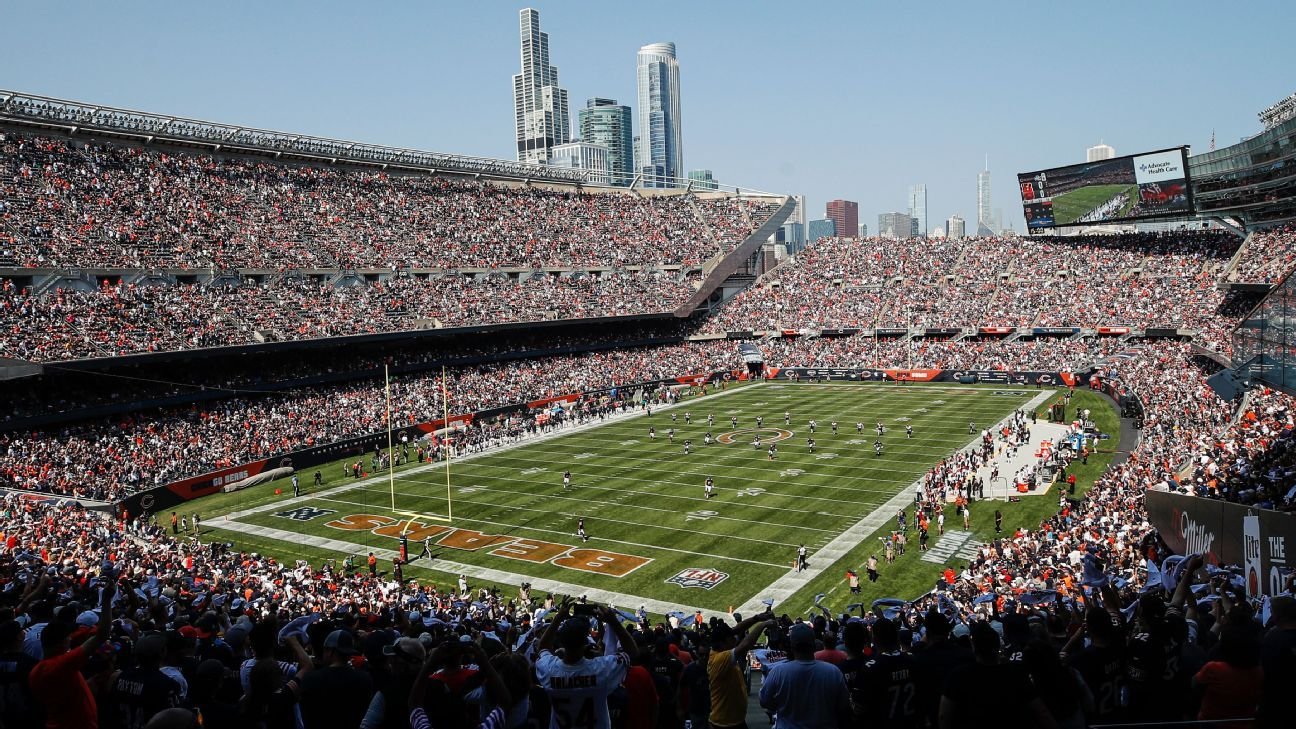
The NFL’s stadium committee has scheduled a meeting with Chicago Bears brass during the week of April 27 to hear the latest developments regarding the team’s two proposed sites for a new stadium — Arlington Heights, Illinois, and Hammond, Indiana.
The Bears’ stadium is the only item on the agenda for this virtual meeting, sources told ESPN on Thursday, confirming a report by the Chicago Tribune.
The committee, which Bears chairman George H. McCaskey is a part of, is chaired by Minnesota Vikings owner Mark Wilf and includes Pittsburgh Steelers owner Art Rooney II, Tennessee Titans owner Amy Adams Strunk and high-ranking NFL officials.
The Bears are closing in on a critical decision that will eventually move the team from Soldier Field, their home for the past 50 years.
Commissioner Roger Goodell, speaking at the NFL’s annual league meetings in Phoenix earlier this month, urged the Bears to come to a resolution “relatively soon.” The Bears will need to provide a progress report to the NFL.
Team president and CEO Kevin Warren said the Bears will have a decision by “late spring, early summer.”
Here’s a look at some of the biggest questions around the team’s stadium venture.

Three years after closing on land in Arlington Heights, there’s no stadium. Why?
When the Bears purchased the 326-acre property that was the former home of Arlington International Racecourse for $197.2 million, they made no assurance that buying the land would lead to the construction of their domed stadium.
“Finalizing the purchase does not guarantee the land will be developed, but it is an important next step in our ongoing evaluation of the opportunity,” a statement from the team read on Feb. 15, 2023.
The Bears promised to contribute $2 billion of the team’s money — which they will acquire by borrowing the funds “because we don’t have it,” per McCaskey — toward the construction of the stadium. The team is also seeking an estimated $850 million in public funding to cover “essential local infrastructure,” including roads, sewers and improvements to adjacent commuter rail lines.
The impasse is over the amount in property taxes the Bears would have to pay in Illinois. Because the team does not own Soldier Field, it does not pay property taxes.
“I think the biggest thing is, in all these big projects, you have to have tax certainty, which is critically important,” Warren said. “We would not be able to build a stadium without tax certainty.
“Fortunately, we do have tax certainty in the state of Indiana. There are no property tax taxes for our stadium in the state of Indiana, so that is certain. That legislation has passed. But here in Illinois, for us to even consider an opportunity we have to have tax certainty. Without that we can’t proceed forward. “
Why were the Bears unable to secure property tax certainty in Illinois prior to purchasing land in Arlington Heights?
“Well, we didn’t control the timing of the acquisition of Arlington Park,” McCaskey said. “Churchill Downs [which previously owned the land] was in a position where they were ready to sell, so they largely determined the timing.”
How serious is Indiana about this move?
Warren penned an open letter to fans in December about expanding the search to include Northwest Indiana, and two months later the Indiana House passed Senate Bill 27 by a 94-5 vote. The bill establishes a Northwest Indiana stadium authority to issue bonds to finance, build and lease a stadium.
“Hammond, [Indiana], near Wolf Lake. … It’s going to be easier to probably get down there for most of the current Bear fans.”
Governor Mike Braun on the proposal for a Chicago Bears’ stadium in Indiana 🐻
(via @PatMcAfeeShow) pic.twitter.com/6Tc2jw80dD
— NFL on ESPN (@ESPNNFL) February 26, 2026
Indiana House Speaker Todd Huston said the state will invest around $1 billion in the stadium through various financing avenues. The state is moving forward with plans to provide that funding. On Tuesday, The Indiana Finance Authority approved a resolution to allow the Indiana Toll Road to increase tolls by at least 1.5% or by inflation, whichever is greater, twice a year in exchange for $700 million in payments.
“We made it clear from the beginning that Indiana is open for business,” Indiana Gov. Mike Braun said upon the passing of Senate Bill 27 in February. “I’m thrilled to sign Senate Bill 27 to create the framework to build a new world-class stadium in Northwest Indiana. Now let’s get this across the goal line.”
What’s the latest on Illinois’ plans?
The Illinois General Assembly is in session until May 31, which serves as a deadline for the Bears. Members of Illinois Gov. JB Pritzker’s team and Bears brass have been meeting regularly after the House revenue and finance committee approved legislation on Feb. 26 by a 13-7 vote that would allow the Bears to negotiate a special payment to local taxing bodies in lieu of property taxes.
House Bill 910, known as PILOT (payment-in-lieu-of-taxes) legislation, would freeze property tax assessments on the sites of so-called “megaprojects,” such as the Bears’ stadium, and allow developers to negotiate a payment-in-lieu-of-taxes with local governments.
The bill has failed to reach the 60-vote threshold needed to bring it to the House floor for a vote. The Illinois Spring Legislative Session deadline to send bills to the Senate was April 17, but that deadline can be extended.
“It’s not specifically for the Chicago Bears,” Warren said. “I think the perception and the focus from a legislation standpoint is that it’s good for business in Illinois to be able to allow businesses to at least have a manageable amount of taxes that they will be required to pay.
“As you’re aware, this is something the Illinois legislature has been working on for many years.”
If the PILOT legislation passes, does that guarantee the Bears will stay in Illinois?
The PILOT bill would require businesses with mega development plans to enter into an agreement for making special payments in lieu of property taxes for at least 20 years. Given the Bears are seeking long-term tax stability, legislation passing in Illinois to provide that certainty doesn’t automatically mean the Bears will commit to building in Illinois.
“I would say it’s not as simple as that,” Warren said. “I would say the biggest thing on all these stadiums is you need to make sure these projects, you can finance them.
“One of the biggest focal points now is to check on the capital markets, the financial markets. So PILOT legislation is a critical component of it. That’s only one step. Then you have to deal with the infrastructure on any of these stadiums — the roads, the highways, the sewers, the storm water, all those things have to be a focal point to be able to build and operate, especially when you are going to host that many people at one point in time.”
How would the Bears feel about leaving Illinois?
Since they became a franchise, initially as the Decatur Staleys in 1920 before being named the Chicago Bears two years later, the team has always played its regular-season home games in Illinois. Before moving to Soldier Field in 1971, the Bears played at Wrigley Field for their first five decades in Chicago.
The team’s fight song, “Bear Down, Chicago Bears” proclaims the franchise as “the pride and joy of Illinois.” That sentiment doesn’t change for McCaskey, even if the Bears end up heading to Indiana.
“I don’t think in the end it’s going to matter to people,” McCaskey said. “Back in 1976, the New York Football Giants went across state lines to New Jersey. They have been there ever since. The Jets joined them shortly thereafter. And then 35 years later, both teams had an opportunity to reevaluate their situations and recommitted to New Jersey. And somehow the Republic has survived.
“When the Bears moved from Wrigley Field to Soldier Field, it required an adjustment. When we went to Champaign (for the 2002 season while Soldier Field underwent renovations), it required an adjustment. And whether we go to Arlington Park or to Hammond, there is going to be an adjustment period. People are going to have to be allowed some time to get used to it. I think Bears fans are up to it.”

