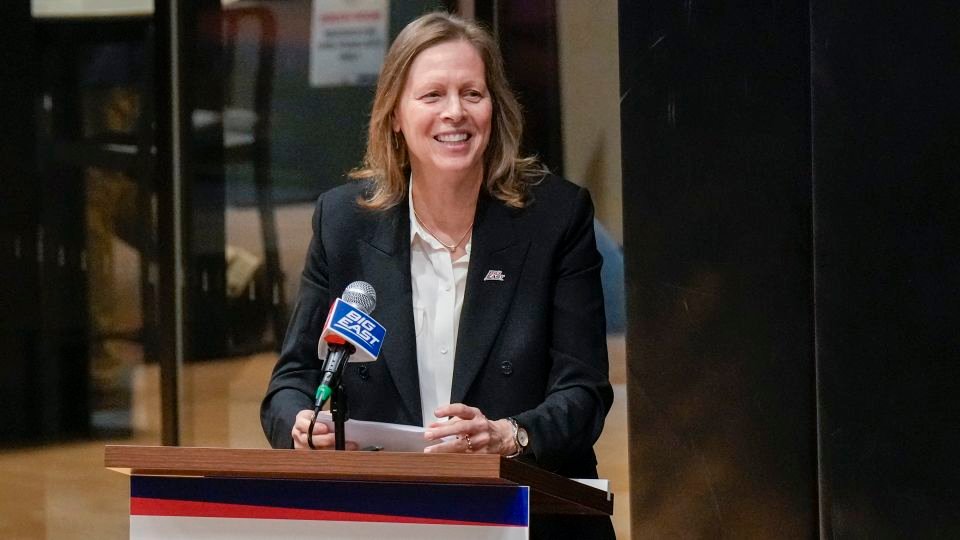
In 2013, Val Ackerman was teaching a leadership course at Columbia University as the Big East scraped its way back to existence after being left for roadkill amid college football realignment.
Fascinated by the moxie shown by the remaining seven Catholic schools, Ackerman used the league’s plan as a case study for her students.
Advertisement
Six months later, she was named the league’s commissioner.
Since then, Ackerman, who announced she will retire in August, has presided over what might arguably be the greatest start-up business in college athletics history. In its early days, the Big East had no office, borrowing space in a Manhattan-based law firm. It had no benefits packages to offer to employees and no email accounts. Ackerman used her personal Gmail for correspondence.
The Big East has steadied its membership, since the conference’s revival, by adding Butler, Creighton and Xavier, luring UConn back to its rightful home, winning four men’s basketball national championships, four women’s hoops titles and now operating out of the Empire State Building.
Above all else, the Big East cleared space for college basketball in a world increasingly run roughshod by the pigskin.
Advertisement
Yet, Ackerman leaves as the Big East faces another critical juncture in its existence. Revenue sharing has underscored the line between those with and without football money. The Big East’s expected draw – that it could put all of its money into basketball – has proven more difficult to actually pull off. Largely because, while its member schools can put cash behind hoops, it has fewer funds to offer. It is no coincidence that the three schools that spent the most money – St. John’s, UConn and Villanova – finished 1-2-3 in the conference for men’s basketball.
Furthermore, the league’s hold on UConn, while stronger than tenuous, is less than airtight. The Huskies are always a dangling goalpost away from a jump to save football.
And while college basketball is coming off of its best NCAA Tournament viewership in more than 30 years, football continues to siphon all it can from the coffers. Calls to expand the tournament are largely fueled by football-first conferences looking not just to get more teams into the dance but also to earn more units from March Madness payouts.
McGlade also leaves a massive void
With the departure of Ackerman – coupled with the retirement of Atlantic 10 commissioner Bernadette McGlade – hoops is losing not just two powerful women, but two champions of its game. Both Jersey girls came up similarly: star players who pivoted into administration.
Advertisement
McGlade, a UNC graduate, first coached before heading into conference leadership and, like Ackerman, deftly and delicately shepherded the Atlantic 10 through its own vulnerability via thoughtful expansion. The A10 found a basketball steward in new commissioner, Dan Leibovitz, who cut his teeth as John Chaney’s assistant at Temple before charting his own path through coaching and on to admin.
Atlantic 10 commissioner Bernadette McGlade attends a tournament game in Pittsburgh last month. – Charles LeClaire/Imagn Images/Reuters
Replacing Ackerman is even more critical in the big picture. Since its inception in 1979, the Big East has stood as the epicenter of college basketball. Its name synonymous with hoops excellence. When at its best, it is because the Big East leaned into its identity and on a leader who made basketball its priority.
Dave Gavitt started the league while finishing up his coaching career at Providence, and then tapped his right-hand man, Mike Tranghese, to take over. Only the respect owed to Tranghese helped the league stave off total implosion from its first football dalliance, back when it bloated its geographic reach to South Florida, Cincinnati and Virginia Tech.
Advertisement
As Ackerman was studying the league’s rebirth, the Big East rightfully was studying her. An outstanding player at Virginia, Ackerman worked first as legal counsel in the NBA before being tabbed by then-commissioner David Stern as his special assistant. She was one of the original NBA appointees to USA Basketball’s board of directors and, in 1996, was named the first president of the WNBA, guiding the league through its first eight years.

Ackerman’s unwavering devotion to basketball served as the stabilizer as she maneuvered the Big East through its very delicate rebirth that many observers initially dismissed as folly. It is easy to forget, given the league’s current haul of trophies, that a conference predicated on basketball would fold like a house of cards upon arrival.
Instead, the Big East flourished under Ackerman’s disciplined stewardship. While outsiders crowed for her to add more teams, she remained steadfast in keeping the league small but mighty, recognizing both its name-brand strength and the value of a true round-robin. She and the university presidents wisely kept their relationship with Madison Square Garden, refusing to budge from its historic tournament location, cementing the conference’s elite status.
Advertisement
And as the leader of the basketball version of the sixth league in the so-called Power 6 (the American Conference gets the nod in football), Ackerman had a seat at the big boys’ table – literally in her case.
Of the then-12 and now 10 female commissioners, Ackerman was the only woman in charge of a league with that sort of institutional muscle. Like that of her predecessors, her voice garnered respect based on a lifetime of service at the sport’s highest levels. She didn’t preside like an SEC king or prance like a Big Ten prince, but with a relentless, lived-in devotion to the game.
It is difficult to envision the Big East straying from this established blueprint.
However, money has a way of blurring a league’s vision. More leagues are pivoting toward corporate-minded administrators tasked with running collegiate athletics like the businesses they are.
Advertisement
Now is not the ideal time for the Big East to pivot from its roots. The league needs a basketball champion, a forward thinker and maybe above all else, a fighter. It may not be a fledgling start-up anymore, but it’s not a bad idea to think like one.
For more CNN news and newsletters create an account at CNN.com

