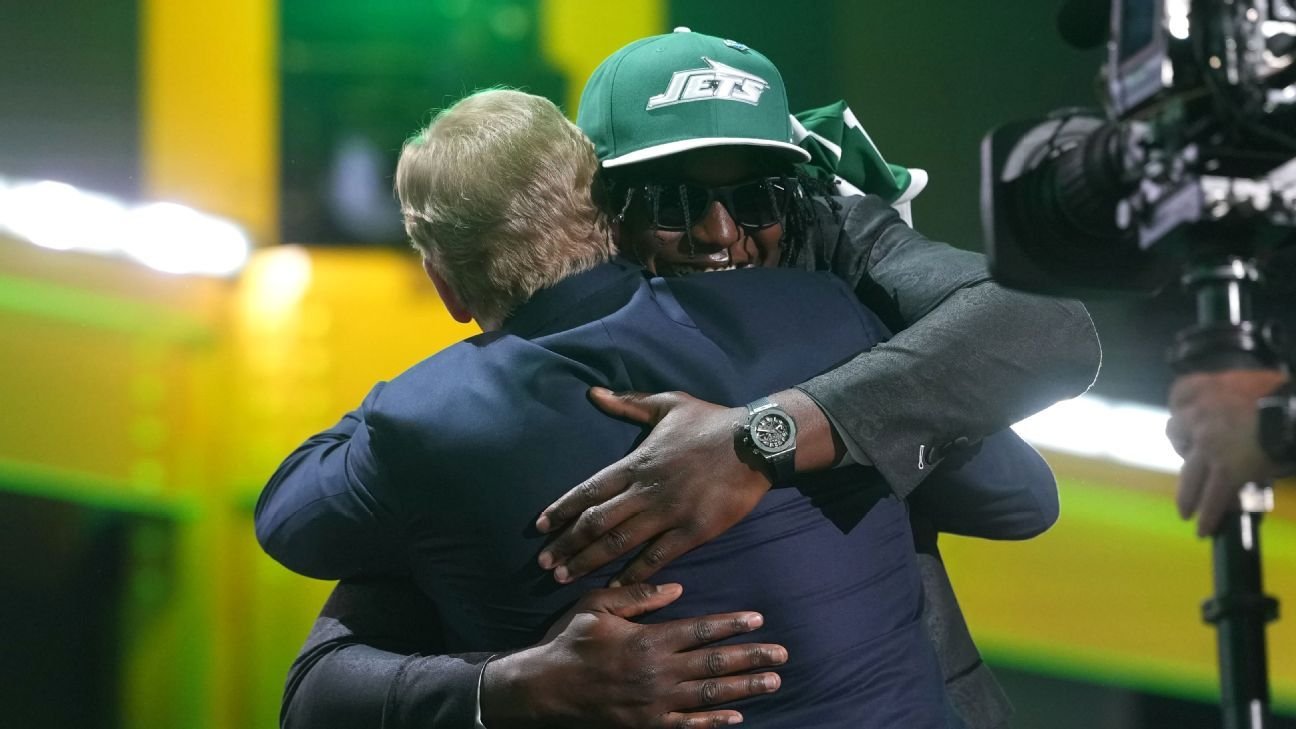
FLORHAM PARK, N.J. — The 2026 NFL draft wrapped up on Saturday after three days in Pittsburgh.
The New York Jets made three picks in the first round, drafting edge rusher David Bailey (Texas Tech) at No. 2, tight end Kenyon Sadiq (Oregon) at No. 16 and wide receiver Omar Cooper Jr. at No. 30.
Here’s a list of the Jets’ selections and what you need to know about them.

Round 1, No. 2 overall: David Bailey, Edge, Texas Tech
My take: The Jets passed on the ultra-talented and versatile Arvell Reese to take the most accomplished pass rusher — a decision that will be scrutinized for years. To validate the pick, Bailey needs to produce like Houston Texans star Will Anderson Jr. (No. 3 in 2023), who averages 10 sacks a year. Bailey has the speed (4.5 seconds in the 40-yard dash) and the get-off to burn the edges, and we all know the Jets’ pass rush needs a jolt — only 26 sacks last season. They patched some holes in free agency, but the defensive rebuild won’t be successful unless Bailey becomes a dynamic front-seven presence.
Will he start as a rookie? It would be a bad look if the No. 2 pick in the draft, which means a $55 million guaranteed contract, is limited to third-down pass rushing. Ideally, he should be on the field for at least 60% of the snaps, either as a 4-3 DE or 3-4 OLB. But here’s the thing: Bailey (6-foot-3, 251) isn’t known as a strong run defender. One NFC personnel executive said: “Putting Bailey and [Will McDonald IV] on the edges makes them really light versus the run. But Denver [GM Darren Mougey’s former team] is undersized, so maybe it doesn’t matter to them.”
Key stat: The Jets lean on analytics in player evaluations, which explains the affinity for Bailey. He has the highest career quarterback pressure percentage (18.7) in the FBS over the past 10 seasons. In 2025, he led the FBS in sacks (14.5) and pressure (20.4%), though he had one of his worst games against Utah’s Spencer Fano, one of the top tackle prospects. Bailey finished with a monster game against Oregon in the CFP Playoff — 11 tackles, six pressures and one sack. He made himself a lot of money with that game.
Round 1, No. 16: Kenyon Sadiq, TE, Oregon
My take: Sadiq doesn’t address a positional need, per se — but he brings much-needed explosiveness to an offense that finished 29th in scoring. Sadiq has rare physical traits for the position. At 6-3, 241 pounds, he ran the 40-yard dash in 4.39 seconds at the combine — the fastest mark by a tight end since at least 2003 — when they first officially started recording 40 times. In his only season as a starter, he made 51 receptions for 560 yards and eight touchdowns, including 13 catches of at least 20 yards. One opposing scout said of Sadiq, “He’s an athletic-mismatch guy who will play detached [from the formation] and serve a similar role to what Darren Waller was for Miami, [Isaiah Likely] for the Ravens, [Travis Kelce] and Trey McBride.” The Jets chose Sadiq with the pick acquired from the Colts in the Sauce Gardner trade.
Will he start as a rookie? Probably not, but the Jets figure to use a lot of “12” personnel — one running back, two tight ends, two wide receivers. Let’s not forget about Mason Taylor, drafted in the second round last year. Coach Aaron Glenn said he expects Taylor to have “a hell of a year” in 2026. You will see a lot of formations with Taylor as the in-line tight end, with Sadiq flexed out in the slot. In fact, 59% of his snaps last season came out of the slot. The Jets passed on some quality wide receivers (Makai Lemon and Omar Cooper Jr.) to double down at tight end, though they will tell you Sadiq is more than a traditional tight end.
Key stat: Sadiq dropped six passes last season, tied for the most among FBS tight ends. Speaking to reporters after he was drafted, he confirmed the stat is accurate and that he needs to work on his hand-eye coordination. Sadiq said he dropped “too many easy ones.” The Jets need more production from their tight end. It was a black hole in their offense, as their tight ends had the second-fewest receiving yards (593) and were tied for the fewest touchdown catches (two).
My take: The Jets wanted Cooper so badly that they traded up three spots, surrendering the first pick in the second round (33) and a fifth rounder (179) to change places with the 49ers. The 33rd pick would’ve been a valuable trade chip for Friday. The Jets evidently were concerned that Cooper wouldn’t last until then; they also wanted the contractual benefit of the fifth-year option. He definitely fills a need, as wide receiver was the thinnest position on the team. Cooper is a rugged player with run-after-the-catch skill, which should be a nice complement to Garrett Wilson‘s elusiveness and Adonai Mitchell‘s vertical speed.
Key stat: Cooper is only the fourth wide receiver drafted in the first round by the Jets in the last 30 years. He joins some pretty good company — Wilson (2022), Santana Moss (2001) and Keyshawn Johnson (1996).
Will he start as a rookie? Yes, there’s a chance because the only proven receiver is Wilson, but there will be a steep learning curve. He played in a college offense that relied heavily on RPOs (run-pass option), so this won’t be an overnight transition. He needs to refine his route running and learn a pro-style offense. He’s at his best with the ball in his hands. He forced 26 missed tackles on receptions in 2025, sixth-most most in the FBS. He produced 505 yards after the catch, most in Big Ten. All told, he made 69 catches for 937 yards and 13 touchdowns, including his epic game winner against Penn State — one of the signature moments in Indiana’s march to the CFP championship.
0:48
Omar Cooper Jr.’s NFL draft profile
Check out some of the top highlights from Indiana’s Omar Cooper Jr.
Round 2, No. 50: D’Angelo Ponds, CB, Indiana
My take: Ponds has been compared to Glenn: Same size (5-foot-9) and same speed (sub 4.4 seconds in the 40-yard dash). This would be a home run pick if Ponds, who the Jets drafted after trading down six spots (where they also acquired Pick 128), has the same kind of career. Ponds has heard the comparisons, saying Thursday night, “That’s a testament to his game and my game. I think we have some similarities and that’s definitely a compliment to me.”
Thing is, football has changed a lot. The corners are bigger — even Glenn prefers tall corners for his scheme — which made this selection a bit of a surprise. Ponds played on the outside for Indiana, and played very well (21 passes defensed and five interceptions in two seasons), but he could encounter problems against bigger wideouts on this level. There’s no doubt about his competitiveness, though. He’s an aggressive, yet disciplined player (only one penalty last season). He knocked Alabama QB Ty Simpson out of the Rose Bowl.
When will he be expected to get regular playing time? There’s a lot of competition at corner. Brandon Stephens is locked into one spot. On the other side there’s former Chicago Bear Nahshon Wright, Azareye’h Thomas (coming off shoulder surgery) and Ponds. Maybe they will move Ponds inside to nickel, where Jarvis Brownlee Jr. is the favorite to start, but Glenn said they will “cross train” Ponds, meaning he will play both inside and outside corner. Ponds will have a familiar face on the team, as he will be reunited with his former Hoosiers teammate in Cooper.
0:51
D’Angelo Ponds NFL draft profile
Check out some of the top highlights from Indiana’s D’Angelo Ponds.
Round 4, No. 103: Darrell Jackson Jr., DT, Florida State
My take: Switching to a 3-4 front, the Jets are adding size to their defensive line — and Jackson (6-foot-6, 315 pounds) fits right in. He’s raw because he didn’t start playing football until his junior year in high school, but he has some intriguing traits — 35-inch arms and 11-inch hands. Dude is massive.
He played at Miami and Maryland before becoming a two-year starter at Florida State. Primarily a first- and second-down player, he didn’t provide much as a pass-rusher — only 14 quarterback pressures and one sack last season.
“I’m bringing physicality in the run game,” he said after being drafted. It won’t be easy for him to crack the Jets’ rotation because they’re fairly deep along the interior, with Harrison Phillips, David Onyemata, T’Vondre Sweat and Jowon Briggs.
Jackson’s uncle is former Buccaneers DB Dexter Jackson, the MVP in Super Bowl XXXVII.
Round 4, No. 110: Cade Klubnik, QB, Clemson
My take: This was a surprise. Klubnik was projected by many talent evaluators as a late-round prospect, but the Jets traded up 18 spots, sending two fourth rounders (128 and 140) to the Bengals for this selection and a sixth rounder (199). The Jets wanted to add a developmental quarterback to the pipeline. Klubnik, after a promising 2024 season, regressed in 2025, throwing only 16 touchdowns and 2,943 yards — down from 36 and 3,639 the previous year. It wasn’t all his fault; Clemson had a rough year. Klubnik projects as the Jets’ QB3, behind Geno Smith and Bailey Zappe — or a still-to-be-acquired veteran backup.
An NFC personnel executive said Klubnik’s ceiling probably is a backup, adding, “He doesn’t have a particularly strong arm and has a skinny-type build. He was way overhyped as a potential first-round quarterback for this year.” The executive praised Klubnik for showing “grit, resolve and determination” while finishing strong in 2025.
Round 6, No. 188: Anez Cooper, G, Miami
My take: Cooper addresses a need (interior line depth) and was a good value at this point in the draft, which explains why the Jets traded up 11 spots. They sent a sixth-round pick (199) and a seventh rounder (242) to the Seahawks.
Cooper (6-foot-6, 334 pounds) is a massive right guard with a ton of experience (45 college starts). He and right tackle Francis Mauigoa, a Giants first-round pick, formed one of the best right-side combos in college football. Cooper struggles in space, yet he allowed only one quarterback pressure and no sacks last season in 518 pass-blocking snaps.
The Jets are set at guard with Joe Tippmann and Dylan Parham, but they needed a young player in the pipeline. Cooper is known as a big-time trash talker.
Round 7, No. 228: VJ Payne, S, Kansas State
My take: Payne joins a crowded safety room, led by Minkah Fitzpatrick, Malachi Moore, Dane Belton and Andre Cisco. It will be tough for Payne to crack this group, but he can make his mark on special teams.
Payne (6-foot-3, 206 pounds) has rare size for a safety, including an 81-inch wing span. He had some missed-tackle issues in college and his ball production wasn’t stellar (four career interceptions and 13 passes defensed). He’s versatile, having played free and strong safety and big nickel.

