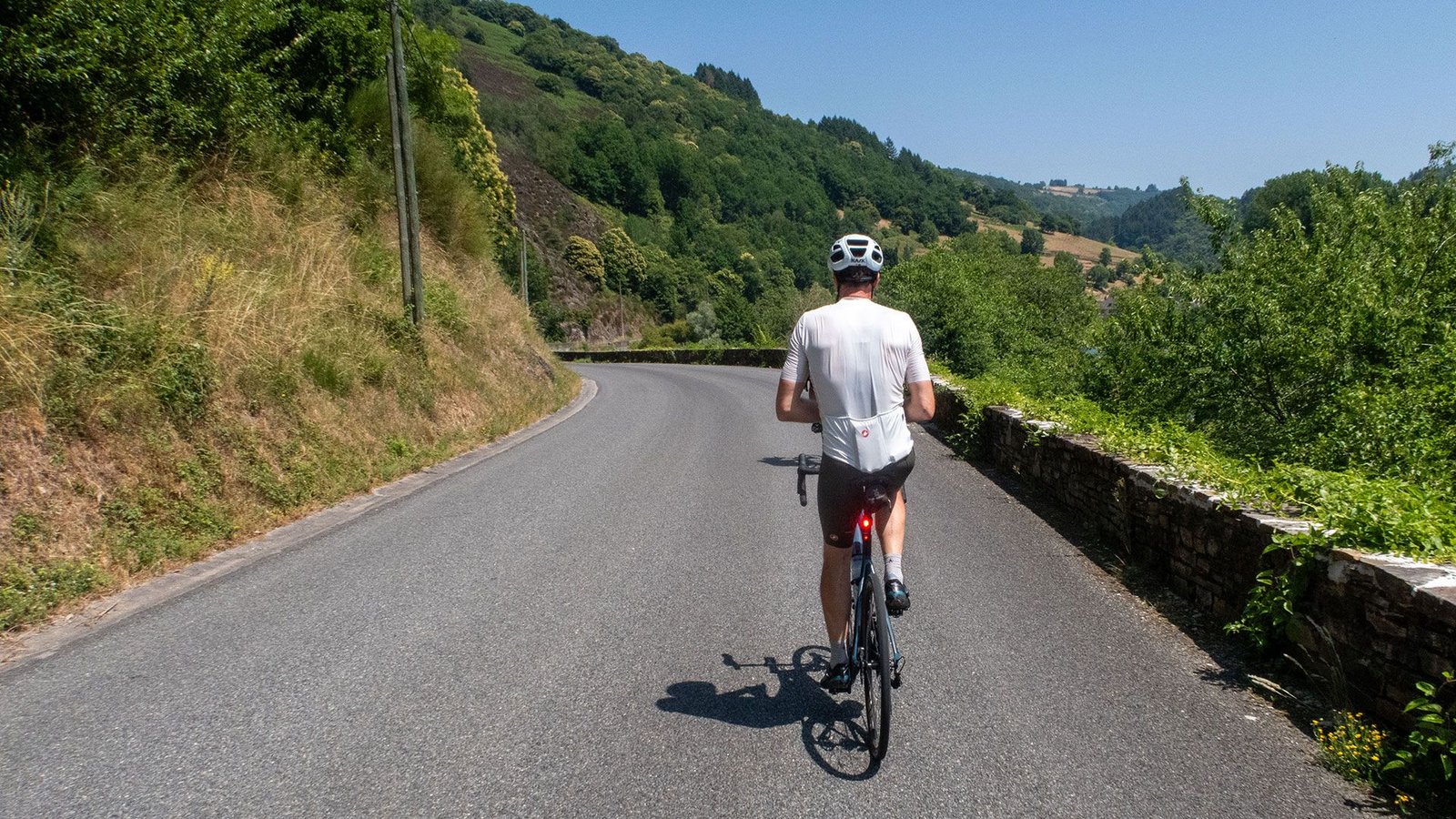
When, six years ago, my brother announced he’d bought a bike radar, my response was a raised eyebrow and a lower opinion of his bike component choices. More high-end clutter to bolt to the bike, and yet another gadget to remember to plug in post-ride. Why on earth would anyone choose to ride with radar?
Looking back, I was suspicious that his new purchase sounded too ‘out there’ to be of any practical use. Even if it worked, knowing that a vehicle was approaching from behind wouldn’t prevent it from running me down, would it? I dismissed it as an expensive gimmick, a rich boy’s toy.
However, within months, I transformed from cynic to convert. One ride, and I was hooked; it’s no exaggeration to say that radar has transformed the way I ride. So, here’s why you should ride with radar.

How bike radar works
A bike radar unit strapped to your seatpost is a miniature transceiver that emits high-frequency radio waves in your wake. As these waves hit a moving object, such as a truck, car, or motorbike, they bounce back to the unit. By measuring the time it takes for these waves to return and the shift in their frequency (the Doppler effect), the bike radar calculates exactly how far away the vehicle is and how fast it’s closing the gap between you and it.

Bike radar, in this case a Wahoo Trackr Radar, communicates traffic threats to your smartphone or GPS head unit.
(Image credit: Simon Fellows)
This vehicle data is transmitted seamlessly to your head unit or smartphone, via ANT+ or Bluetooth, where it’s typically shown as a moving dot, or a series of dots for multiple vehicles, on a colour-coded sidebar, representing the traffic’s progress in real-time. Not only does it warn you that a vehicle is there, but it also provides insight into whether it’s moving in a slow, controlled manner or represents a high-speed threat. These visual cues are reinforced by audio tones that warn of impending threats and sound the all-clear when they’re gone.
On that first test ride, about six years ago, I quickly realised there’s more to radar than flagging individual threats; it’s more cohesive than that. It has vastly improved my situational awareness, to the point that my riding style has completely changed. I was concerned it would make me a more nervous rider, one who rode more defensively. Instead, having an accurate 360° mental map of traffic conditions has liberated me to ride more assertively. It’s boosted my confidence, allowing me to better dictate my relationship with surrounding traffic – knowing when to safely adopt a primary position and when to fall back to a secondary position.

Typically, traffic appears as a stream of dots or icons on the side of your GPS head unit’s screen. Here, two cars are approaching from behind.
(Image credit: Wahoo)
Additionally, most bike radar units have an integrated rear light that enhances your visibility on the road. These lights are typically programmed to increase in intensity and switch to a more frantic flash pattern when a vehicle is detected, alerting drivers to your presence. Ultimately, this means that with radar, you can both see and be seen.
We ask a lot of these devices; they must translate a rapidly changing environment into instant, actionable prompts without becoming a dangerous distraction. When they work well – admittedly, some work better than others – they provide a layer of peripheral vision that fundamentally changes the psychology of a ride.
Why Radar is so effective
Read any radar rider reviews, and the same phrases recur. “I wish I’d discovered it earlier.” “I never ride without it.” “If it broke, I’d replace it immediately.” To understand why some cyclists, myself included, have become such enthusiastic proponents of radar, I spoke with Professor Cristofer Englund. As the Dean of the School of Information Technology at Halmstad University and a leading researcher in Humanised Autonomy, Englund is one of the world’s foremost experts on how humans and automated systems interact. His career has been dedicated to modelling road-user behaviour to improve safety for all road users.
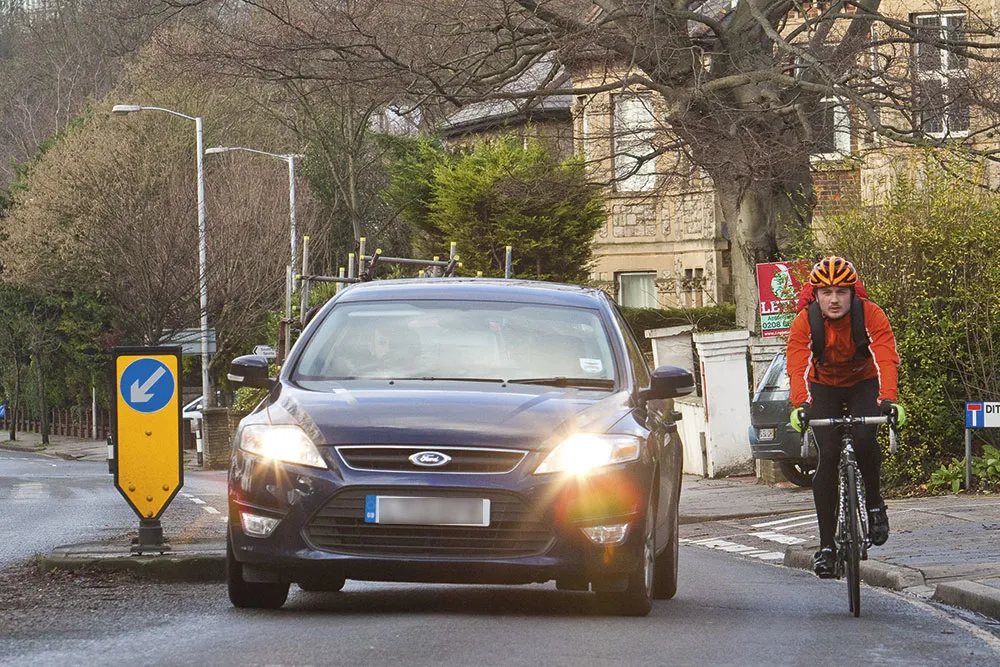
Radar has all the benefits of a mirror with none of the disadvantages. It can prevent a momentary ‘wobble’ caused by the shock of being startled by an unexpected car or truck.
“Our hearing, one of our primary senses, is often the first to fail us as we start moving,” explains Englund. “As we pick up speed, the wind noise quickly becomes very loud, so sometimes we don’t hear vehicles until they are very close, if at all. Some riders may have earphones in too. A major benefit of radar is that it alerts the rider to something coming up from behind, which means they won’t be surprised when it passes them.”
I recognise this; like most cyclists, I don’t enjoy riding with mirrors, so the only warning I have of a vehicle approaching from behind is the faint hum of an engine or the thrum of tyres. These cues are so unreliable that I’d unconsciously default to assuming there was always likely to be a vehicle tailing me, which was both distracting and unnerving on fast, busy highways.

Professor Cristofer Englund, Dean of the School of Information Technology at Halmstad University, has dedicated his career to modelling road-user behaviour for the benefit of all.
(Image credit: Cristofer Englund)
“The early confirmation of a vehicle – that lack of surprise – is a vital safety measure,” says Englund. “It prevents the momentary ‘wobble’ caused by the shock of being startled by an unexpected vehicle, the pressure wave of a passing HGV or both. It’s the speed difference that is the danger,” he continues. “When you have advanced notice that a vehicle is approaching from behind, radar gives you time – even if only a few seconds – to position yourself more appropriately, more safely, on the road.”
These vital seconds give the rider the confidence to navigate the UK’s increasingly potholed tarmac. With radar, you can move out to avoid a wheel-smashing crater, knowing exactly how much time you have before a car closes the gap. Although an over-the-shoulder glance is recommended as an added precaution at fast-moving junctions, I know very few cyclists who can look back without inadvertently veering off course by a few feet. With radar, your primary focus always remains on the road ahead.
Sound first, screen second
The most significant – yet underrated – feature of a modern radar system isn’t the sophisticated, animated screen on your phone or head unit; it’s the speakers. Unlike a mirror, which requires an active visual check that briefly pulls your focus from the road, a radar unit pushes information to you, initially via audio prompts.
Radar products and head units differ, but typically a distinctive, high-pitched ‘chirp’ announces a detected threat. This warning tone enables a rider to remain eyes front, maintaining their line with 100% focus. Only when ready does the rider choose to glance down at their head unit for more detail. When the road is once again clear, a lower-pitched, ‘all-clear’ tone sounds.

Radar offloads the cognitive burden of scanning for danger, leaving the rider free to focus on the road without distraction.
(Image credit: Getty Images)
This audio feedback provides a massive advantage over a mirror or a traditional shoulder check. A mirror is passive; if you don’t look, you don’t know. If you do look, you’re immediately distracted from the road in front. A radar, however, acts like a digital tap on the shoulder. It offloads the cognitive burden of scanning for danger to the machine, leaving the rider free to focus on their route without distraction.
When a rider glances down momentarily for more detail, their gaze will be met with a colour-coded system that most brands follow. An orange overlay signifies a medium-level threat, while a red overlay warns of a high-level threat. According to Hunter Scanlon, Wahoo’s Product Manager, the system isn’t just looking at distance; it’s looking at closing speed.

The iGPSport smartphone app clearly communicates medium (orange) and high (red) level threats at a glance.
(Image credit: Simon Fellows)
“The ‘high threat’ alert is triggered by the approaching speed of the vehicle,” Scanlon explains. “If a car is closing in at a much higher speed than you are moving, the system detects that as a high threat, shifting to that red colour zone.”
This intelligence extends to the light itself. Most of the time, Wahoo’s twin-LED design uses a pulsing pattern to draw attention, while a steady, solid light helps drivers judge their distance. However, when a vehicle enters the Trackr Radar’s 150-metre detection zone, it triggers a continuous, high-intensity flash pattern designed to grab the driver’s attention, specifically as they begin their approach.
“It’s about starting a conversation with the driver,” adds Tyler Harris, Category Director of Cycling at Wahoo. “A solid light improves depth perception, and the flashing light draws the eye. The high-intensity flash pattern – we call it the quick alert mode – makes the rider even more conspicuous on the road ahead.”
Radar smarts over hardware specs
To be of any benefit whatsoever, a radar unit must be reliably accurate. The two most common faults with poor-performing units are false positives – warnings of vehicles when there are none – and false negatives – a failure to warn of approaching vehicles that are present. The first issue is, at best, an irritation, at worst a distraction. The second problem – false negative – is downright dangerous.
Very slow-moving vehicles and those that match the rider’s speed will, quite literally, fall off the radar screen.
Because these products rely on the Doppler Effect to detect threats, very slow-moving vehicles and those that match the rider’s speed will, quite literally, fall off the radar screen. This is an unfortunate limitation of the technology, and one that affects all units. However, some perform much better at persistently tracking vehicles moving at the same speed than others, just as some units report far fewer false negatives and positives. Erroneously, I always thought this was an issue with cheap hardware.

Poorly performing bike radar units can report false positives – warnings of vehicles when there are none – and false negatives – a failure to warn of approaching vehicles that are present. False negatives can be highly dangerous.
(Image credit: Getty Images)
In fact, bike radar tech has matured to the point where there are plenty of good-quality, inexpensive, off-the-shelf radar PCBs available to brands keen to enter this burgeoning market. However, as Harris explains, hardware is only half the story. “It’s less about the hardware and more about the algorithms used to detect cars and remove false positives,” he says. “At Wahoo, we undertake a massive amount of R&D, software development and testing to ensure that a radar is effective rather than just a nuisance. Not all brands are able to invest so much time.”
Some development decisions can also seem counterintuitive in a world where less can sometimes be more. All radars have a field of view, or beam width, which is their arc of lateral coverage. It typically falls between 35° and 60°. While it’s tempting to opt for the widest possible field of view, the Wahoo went narrower when developing its Trackr Radar. “We landed on 35° after a lot of testing because a super-wide field of view has its downsides,” Harris explains. “If you’re riding on a path alongside a road, a wider beam picks up cars that aren’t actually a threat to you. We tuned it to be the best compromise for real-world riding.”

Radar can struggle on bendy roads, especially those products with a narrow field of view.
(Image credit: Unknown)
During my time reviewing the Trackr Radar for Cycling Weekly, I rated it highly for being one of the few bike radars available that rarely reports false positives. I suggest this is due to a combination of Wahoo’s work on its detection algorithm and its narrow field of view, which is less prone to picking up both random traffic and spurious reflections from walls, buildings and so on. On the flip side, I found it wasn’t so good at detecting threats on winding roads, where a wider beam is an advantage.
Interestingly, Garmin radar products typically went slightly wider at 40°, but its new Varia RearVue 820 model boasts a much broader 60° field of vision without sacrificing accuracy. It’s the first bicycle radar to use high-resolution, automotive-standard 60 GHz radar, which provides a more precise ‘image’ than the 24 GHz tech used by its competitors. This jump in frequency also enables the RearVue 820 to track same-speed vehicles with higher persistence.
The distraction dilemma
Garmin’s Varia RearVue 820 is the most accurate bike radar I have ever reviewed. Its 60 GHz radar provides longer range and more precise imaging, enabling it to identify vehicles by type and lane position. For example, you can see on your head unit whether you are being followed by a motorbike, a car, or a truck, and exactly which lane they are occupying. The increased range also allows you to ‘see’ a greater number of vehicles.

The Garmin Varia RearVue 820 is currently the most fully-featured radar product available, but does it report too much?
(Image credit: Simon Fellows)
However, all of this information takes the rider longer to process, with the potential for more time spent looking at the screen and less time at the road. There’s also a fair chance that more range will warn of vehicles that will never pose a threat, because you, or they, are about to turn off the road. Are we in danger of trading physical safety for digital distraction?
“We are more distracted when we have to look down all the time,” Professor Englund admits, reflecting on his research using bicycle simulators to model visual distraction. He suggests that while more data is useful, how we consume it should remain simple. For most of us, the traditional “series of dots” moving up a sidebar is the gold standard of UI design—it’s glanceable, intuitive, and requires zero cognitive load. The risk with ultra-high resolution is that we stop riding the road and start ‘riding the screen’.
Having spent a lot of riding hours with the RearVue 820, I don’t believe we have reached that point yet, but I wouldn’t want to have to register much more information. If my brain cannot interpret it within a momentary glance, it’s too much.

The Garmin Varia RearVue 820 can distinguish between motorbikes, cars and trucks, and report their lane positions. The concern is whether this is too much information to process with a momentary glance.
(Image credit: Simon Fellows)
The road ahead – V2X and the connected bike
If newer radar products, such as the Garmin Varia RearVue 820, strike you as state-of-the-art, boy, you ain’t seen nothing yet. For decades, Englund and his peers have been developing Vehicle-to-Everything (V2X) connectivity technologies that promise safer, more efficient road transport for all. The catalyst for this tech was the invention of the autonomous vehicle, but subsets of V2X are even more far-reaching.

Imagine a world where all vehicles, including bikes, are connected – where every vehicle knows the position of every other vehicle.
(Image credit: Getty)
Vehicle-to-Pedestrian (V2P) comms enable real-time data exchange between vehicles and vulnerable road users, such as pedestrians, cyclists, horse riders and wheelchair users. In a nutshell, vehicles will always know the precise position of cyclists (and other road users), and vice versa, making accidents far less likely. Because this technology will be factory-installed in vehicles and embedded in smartphones or wearables, it will remain entirely seamless and unobtrusive for the user.
“This connected technology is so much more effective than radar and lights,” says Englund, “not least because it doesn’t rely on line of sight. V2X can ‘see’ through obstacles like parked trucks, or around corners where a pedestrian or cyclist might be hidden.”
…traditional bike radar is – by comparison – as blunt as a worn stone axe…
If V2X offers the precision of a digital scalpel, traditional bike radar is – by comparison – as blunt as a worn stone axe. This isn’t fanciful science fiction; the technology is here right now, with widespread trials already conducted in the USA, China, Europe and Japan. However, privacy concerns are putting the brakes on implementation.
“Understandably, there’s considerable debate about how the data is collected, stored, used and owned. Should governments gain detailed insights into people’s daily routines? Should employers know that I’ve visited a competitor for a job interview or a clinic for a medical condition? Will the data be monetised? Privacy is a legitimate concern, but taking steps to anonymise data should alleviate it. Ultimately, this technology will make our roads safer, less congested and healthier for all.”
Embrace the benefits of radar

Radar products, such as the iGPSport SR Mini are now available for less than £100/$100.
(Image credit: Simon Fellows)
After years of riding with radar, my conclusion is simple: radar doesn’t just tell you a car is coming; it changes your relationship with the road. It replaces the low-level anxiety of the unknown with the confidence to ride your space on the road like you own it.
Expense is perhaps the final barrier to widespread radar adoption. Initially, these units were expensive, and even today, the latest tech from established brands such as Garmin, Wahoo and Lezyne isn’t an impulse buy. However, very recently, brands such as iGPSport and Magene have entered the market with radars costing under £100/$100, making this tech far more accessible. So, I implore you to give radar a try – you won’t look back, I promise…

