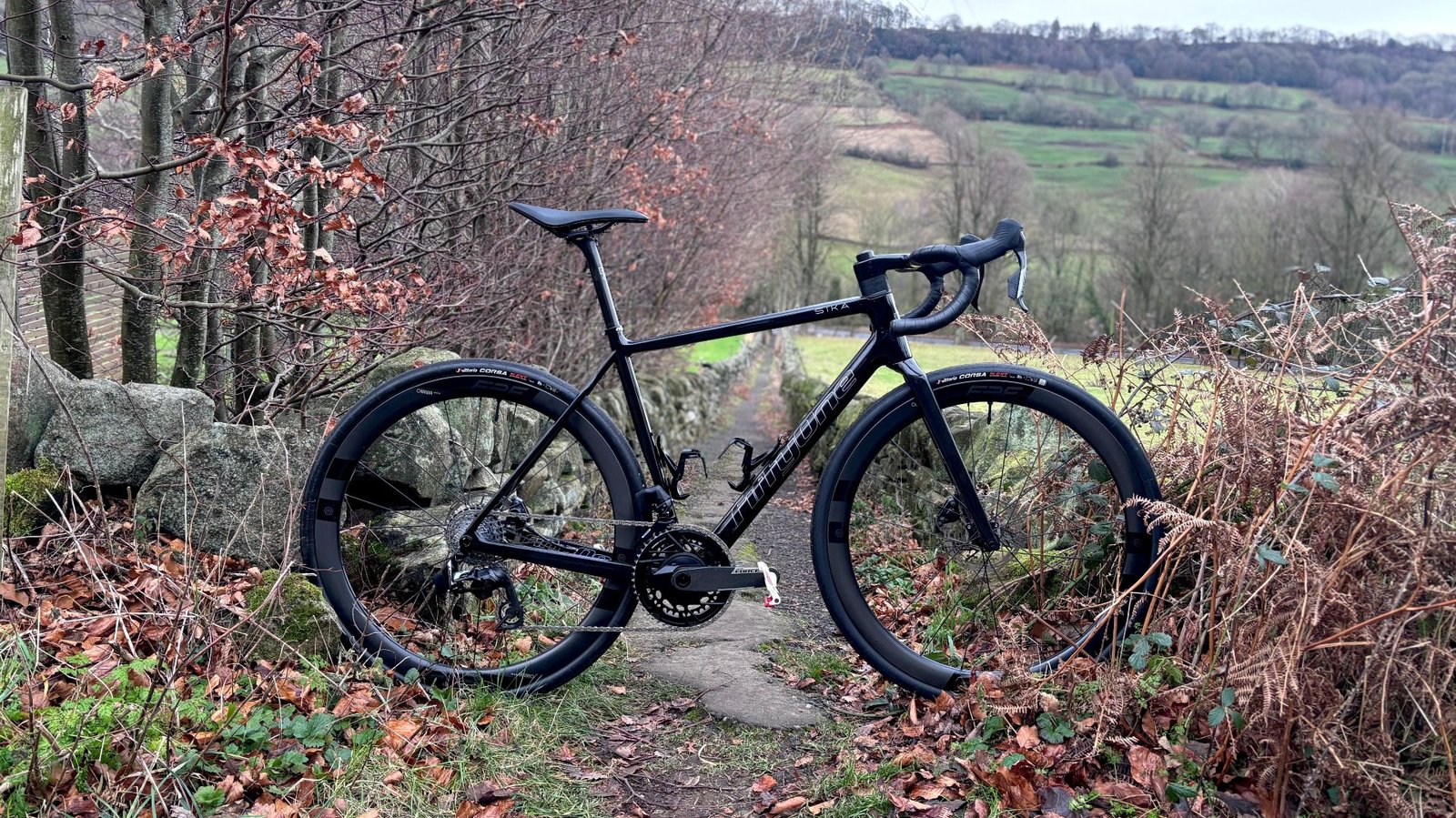
There’s a pattern in road cycling that the team at FiftyOne wasn’t happy with: the industry designs bikes for professional racers and then sells them to the rest of us, rather than putting the needs of the majority of riders first. So we, the everyday rider, end up with geometry that is too aggressive, the tyre clearance too narrow, and a position that is too unforgiving for anyone that isn’t a full-time athlete. What’s more, if you want to change anything, it’ll likely cost you extra. The FiftyOne Sika is the brand’s first non-custom road bike, and it’s their answer to the aforementioned conundrum.
On paper it’s an almost confusing prospect. Endurance bike clearances, but no provisions for things like mudguards or bags, combined with climbing bike weights and geometry that sits somewhere between race and endurance. So how does that play out on the road? I rode it through a pretty grim few winter months on my local Peak District roads to find out.
Design details
FiftyOne is a Dublin-based brand with its roots in hand-built, tube-to-tube custom carbon frames. The Sika is its first non-custom road frameset, following the Assassin gravel bike into production, and it’s been designed with a clarity of purpose that larger brands sometimes lose. The team, led by ex-Pro Aidan Duff, has reportedly built over 500 custom frames and conducted an equal number of bike fits, and that accumulated knowledge was used to design the Sika.


(Image credit: Tim Russon)
The frame itself weighs a claimed 690g for a medium and is built using a blend of Toray fibres, which is all the more impressive given it accommodates 40mm tyres. That clearance is achieved through a combination of dropped chainstays and a taller fork with a shallow crown and long-legged straight fork blades that sit proud or slightly further forward than normal on smaller sizes; it gives the bike an increased level of versatility, while still keeping a classic race-bike aesthetic.

(Image credit: Tim Russon)
Tube profiles look traditional and round at a glance, but actually use NACA aerofoil designs and plenty of clever forming. There’s no aero data from the brand, but the shapes are clearly more than decorative, showing performance intentions whilst still maintaining a classic look.

(Image credit: Tim Russon)
The open wishbone seatstay connects near the top of the seat tube rather than using the dropped-stay look that has become de rigueur elsewhere, giving the rear a compliant, damped feel. Combined with a standard 27.2mm round seatpost in an external clamp, it makes for a comfortable ride and offers plenty of options for upgrades or fit changes that would be more troublesome with a specific aero setup.
The frame uses a T47 inboard threaded bottom bracket, which is as wide as possible for frame stiffness while retaining the alignment and easy-to-work-on benefits of threaded cups. The rear derailleur hanger is SRAM’s UDH universal standard, so spares are easily available and leave the option of using SRAM’s gravel T-type rear mechs should you fancy going for the simplicity of a single-ring setup.

(Image credit: Tim Russon)
Geometry is on the racier side of endurance, or on the endurance end of race, depending on how you look at it. My medium bike has a stack of 555mm and a reach of 380mm. The Specialized Tarmac SL8 in a medium or 54cm, for example, is 544mm and 384mm, whereas Specialized’s endurance bike, the Roubaix, is 585mm and 381mm. The closest bike ive found in geometry terms is the Cervelo Caledonia with near identical stack and reach figures, with it just being 2mm shorter and the same height, though its ride characteristics are more of a cruisy endurance bike than the Sika.
The bike is available in five sizes from XS to XXL. My test bike featured the Black Ops raw clear coat, which looked good if a little understated for my tastes; there is a great-looking white and blue option too, and the guys at FiftyOne are always happy to talk custom should you have something special in mind.
Specifications
My test bike was specced with the latest SRAM Force AXS groupset, featuring revised ergonomics, lighter overall weight, and a cleaner hood profile that trickled down from the top-tier Red option. It’s a genuinely excellent groupset: the wireless shifting is crisp and reliable, the brakes offer strong modulation and impressively light lever feel. I’ve used this set-up on plenty of bikes in the last 12 months, and I’m a huge fan.

(Image credit: Tim Russon)
Gearing on my bike was dealt with by 50/37 chainrings and a 10-33 cassette which was perfect for me, offering a good spread but with good tight ratios for the occasional through and off session, but I think it’s worth pointing out one of the upsides to dealing with a small brand like FiftyOne is that you can custom spec the bike and get what exactly what you need. Using the configurator on their site, you can choose between four wheelsets, cockpit width and length, crank length, gear ratios, and even a power meter for an extra £436.
Wheels were the ERE Research Omnia CLR45 carbon clinchers. It might not be a name familiar to many, but having tested some of its gravel wheels I’ve been very impressed with the brand. The Omnia features an internally rimmed 45mm-deep, 21mm-wide rim, weighs around 1500g, and has a ratchet-drive rear hub. They were shod with the Vittoria Corsa N.EXT in a 34mm width and set up tubeless, which worked well for this bike’s intentions.

(Image credit: Tim Russon)
The cockpit is FiftyOne’s own one-piece carbon bar and stem in a gloss finish to match the frame and seatpost. It’s available in four widths, from 380mm at the hoods up to 440mm, and five stem lengths, from 80 to 120mm. The tops are nicely flattened with no sharp edges and have a wrist-angle-friendly three-degree angle that sweeps back towards you. The 125mm deep drops feature a slightly different shape to most, with an almost old-school ergonomic bend. It’s not as pronounced and square as ergo bars from the 90’s/early 2000’s, but has a deeper feel compared to the more common semi-ergo design favoured currently. The bars also flare out by 2cm on each side in the drops, giving a more controlled and comfortable position.
The seatpost is FiftyOne’s own round 27.2mm carbon item in a 15mm offset, which was fine for me. They don’t offer any other options at the point of order, but they will take the seatpost price off if you ask, and since it’s a standard round 27.2 post, you have a ton of other options.
Performance
The Sika feels like a bike designed by someone who’d actually use it. By that I mean it just felt right, whether that was a long day out in the hills or a smash fest on the local chain gang, it never felt out of place. The geometry decisions that Fiftyone have made – marginally more stack, a slightly taller fork, longer chainstays, bigger clearances – haven’t blunted the bike’s character, rather they’ve refined it. This isn’t a race bike that’s been softened. Instead, it feels like a performance bike that’s been made smarter.

(Image credit: Tim Russon)
On the climbs and descents around the Peak District, it felt light and direct without the slightly skittish edge you get from some ultralight race bikes. I was lucky enough to have both the BMC Teammachine SLR 01 and Cervelo R5 on test at the same time, both of which are true out-and-out climbing bikes, and if I’m honest, the Sika is the bike I went for most often despite being around a kilo heavier at 7.65kg. That might have partly been down to more suitable rubber, but I also just loved its character; it has a real Goldilocks feel, not too stiff, not too soft, just right.
In fact, I think this is what other brands should be looking to do with climbing bikes. With these machines being used less and less on the professional tours it seems wise then to spec them with more robust rubber options, giving us non-racers the sprightly ride of a light, stiff frame, but with greater comfort and grip afforded by wide tyres; similarly a touch more stack is always a good thing for most of us mere mortals too
The bike is responsive, and there’s a real stiffness through the bottom bracket. The T47 shell is as wide as any road bike frame will accept, and that, combined with some clever lay-up tricks, means no effort is wasted. It’s a similar story up front; other bikes with space for wide tyres tend to feel muted in comparison. Bikes like the Cervelo Caledonia and Giant Defy, for example, are extremely comfortable, but lack that sharpness of a race bike, and that’s not the case here.
Handling is the Sika’s party piece. On paper, the geometry numbers don’t suggest anything exceptional: the tested medium has a 1,010mm wheelbase, 420mm chainstays, and a trail figure of around 58mm with 34mm tyres. What those numbers produce in practice is a bike that is remarkably stable at speed while still feeling lively and responsive in direction changes, with a front wheel that tips in beautifully when cornering at speed. The longer wheelbase and lower bottom bracket give it a planted, but pointy, quality that immediately gave me the confidence to go as fast as I dare. It manages to be a halfway house in a good way. Somewhere between an endurance bike and a race bike, but with the best of both worlds.

(Image credit: Tim Russon)
Now normally I’d only talk about the tyres that come specced, but as one of this bike’s key features is its clearance, I think it’s worth mentioning how it feels with different set-ups. I rode the stock 34mm setup, but I also rode it with a racier 30mm set of Vittoria Corsa Pro tyres on a set of Corima wheels, and with a head-turning pair of Challenge Strade Bianche tyres on a set of Reynolds wheels in a 40mm width. The narrower setup sharpened how the bike felt, but it was the almost balloon-tyre-esque 40mm tyres that made the most profound difference. In terms of perceived rolling resistance, there wasn’t much in it, though the Challenge tyres are a fast tyre even in a bigger size. The extra width does give extra comfort as I could run them down to 40 psi comfortably, but it was the cornering feel I noticed most. The extra depth lifts the BB, making me feel like I need to take a wider arc on corners, with a slightly delayed sensation when tipping into an apex. It wasn’t bad, just different. If it were my bike, I’d keep the 34mm as they feel like the sweet spot of speed, comfort, and handling on this bike, though it was cool having the option.

(Image credit: Tim Russon)
Comfort, much like the rest of this bike, is somewhere between a true endurance bike and a racier option, not quite an armchair ride but certainly more forgiving than other race bikes. I found it to be a great bike for long days out. The longer fork and wheelbase, combined with a 34mm tyre, was an ideal compromise between efficiency and speed, and yet it still maintained a sharp, positive reaction that felt very engaging.
Value
The Sika in this SRAM Force AXS configuration costs £6,499 / $9,999, which strikes me as good value for a unique bike from a smaller manufacturer, and its versatility makes it difficult to draw direct comparisons with. The Tarmac SL8 Pro with SRAM Force AXS is more expensive at £7,249 (but $8,499 in the US), as is the Cervelo R5 Force at £8,500 ($9,950); though neither offers the same tyre clearance, they are more race-focused offerings.
The Roubaix from Specialized matches it in terms of clearance but is heavier with its Future Shock suspension and offers a slower, more comfort-oriented ride, while still being more expensive at £6,999 ($8,299 in the US). Cervélo’s Caledonia is lighter and has the edge in speed over the Roubaix, but is around £1k more expensive at £7,500 ($6,500 in the US), though it does have frame storage and mudguard mounts.
The Sika is hard to compare against other brands and that’s exactly why I think it’s such a compelling option. It offers the best of both a race and endurance bike in an adaptable and performance-focused package, with the ability to change the specs of key parts as you wish at the point of order, which larger brands always struggle with. Good bike shops will always try to help, but all too often, there is a cost implication to changing out components that don’t exist here, and it’s another thing that helps set the Sika apart for me.
It’s also available as a frame-only at £3,899, which includes bar, stem and seatpost, should you fancy building something a bit different, or you have an existing groupset and wheels you want to use.
In pure price terms it’s competitive, which surprised me. I’d generally expect a more boutique offering to suffer from economies of scale and have a higher ticket price, but not so here, and when you factor in its easy customisation, it looks like even more of a bargain.
Verdict
The FiftyOne Sika is what happens when someone builds a road bike based on what riders actually need rather than what their pro riders demand. It’s light, stiff, handles with confidence and precision, and offers 40mm tyre clearance without any of the usual compromises. The SRAM Force AXS spec I tested is well matched to the bike’s character, and the overall package represents good value at a price point where the competition is fierce.
I’d heard good things about this bike from other folk whose opinion I respect, but I thought something that doesn’t fit neatly into existing niches might be too much of a compromise. I was wrong. FiftyOne has made a bike that’s pretty much perfect for the kind of riding I like to do. It’s light and fast yet still comfortable with impeccable handling and the added versatility of being able to fit wider tyres too. I’m just gutted they wanted it back.
Tech spec
- RRP: £6,499 / €7,250 / $9,999
- Frame: FiftyOne Sika, high-grade Toray carbon, NACA aero tube profiles, T47 inboard threaded BB, UDH rear hanger, 12 x 142mm thru-axle, flat mount disc
- Sizes: XS, S, M, L, XL (M/Medium tested)
- Weight: ~7.1kg (M, as tested)
- Groupset: SRAM Force AXS
- Wheels: ERE Research Omnia C45
- Tyres: Vittoria Corsa N.EXT 34 mm wide
- Brakes: SRAM Force AXS hydraulic disc, 160mm rotors
- Bar/stem: FiftyOne Sika integrated one-piece carbon cockpit, 75mm reach, 125mm drop, 3° backsweep tops, 20mm drop flare
- Seatpost: FiftyOne Sika carbon round, 27.2mm, 15mm offset
- Saddle: Fizik Argo Vento R1

