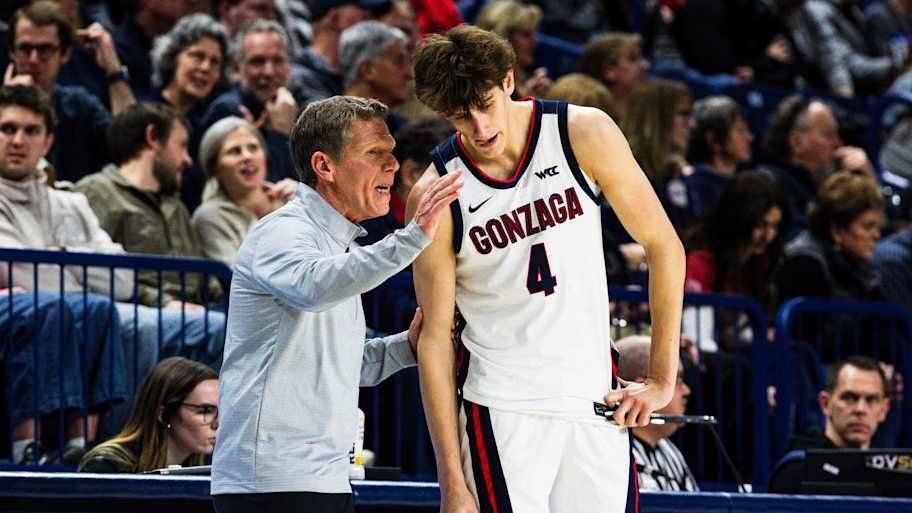
Mark Few and the Gonzaga Bulldogs have made a pair of high-profile transfer portal additions so far this offseason, but still have quite a bit of work to do to complete the roster heading into 2026-27 and the new Pac-12.
Part of that is because of the recent news that Jack Kayil – a 20-year-old German guard projected to be among the team’s starting five – is planning to stay in the NBA draft process rather than honoring his commitment to Gonzaga.
Advertisement
That leaves the Zags with five open roster spots – and plenty of concerns – as the available options dwindle in the transfer portal, and on the international market.
Below is a look at the three biggest concerns right now on GU’s roster, with Few and the staff working to address each of them before the season begins in November:
1. Where is the three point shooting?
Two years ago, in 2024-25, the Zags posted the worst three-point percentage in Mark Few’s history, a record that would only last one season after Gonzaga shot a pitiful 33.3% from deep this past year.
While team leader Mario Saint-Supery (40.3%) returns, the Zags also lose Steele Venters and Adam Miller, and transfer replacements Isiah Harwell (27%) and Massamba Diop (30.8%) aren’t exactly going to light it up from beyond the arc.
Advertisement
It’s reasonable to expect growth as a shooter from Davis Fogle, who shot 35% last year as a freshman, and incoming freshman Luca Foster is lauded for his outside shooting – but there isn’t a ton of optimism around this team’s overall three-point ability…for now.
Ethan Copeland (Stetson) drilled 109 threes, the 21st most in college basketball, at a ridiculous 43% clip, and he recently held a Zoom meeting with Gonzaga. Should they land Copeland – or Campbell’s Jeremiah Johnson (37.4%) or Coastal Carolina‘s RaSheed Jones (36.7%) – they would instantly have a much-needed floor spacer at the shooting guard position, helping to take gravity away from Huff and Diop on the block.
2. Backcourt depth

The announcement that Kayil plans to stay in the NBA draft was a major blow to Gonzaga, which was counting on the 20-year-old to start at shooting guard and serve as the team’s backup point guard behind Saint-Supery.
Advertisement
His expected absence means the Zags have just Saint-Supery and Harwell in the backcourt, with Fogle and Foster primarily playing the three.
Gonzaga not only needs another shooting guard to compete with Harwell, but they also need someone who can play point guard when Saint-Supery is off the floor. With five open roster spots – potentially six if Izan Almansa runs into eligibility trouble – the staff must prioritize finding at least two guards who are capable of serving rotation roles this upcoming season, and ideally one who can start alongside Saint-Supery and Fogle in case Harwell needs to come off the bench to begin the campaign.
3. More college experience

Currently, Braden Huff is the only player on Gonzaga’s roster who has played more than 35 college basketball games, and exactly half the team has yet to play even a single one.
Advertisement
While Massamba Diop and Mario Saint-Supery have international experience – which obviously helps – it’s fair to be concerned about the relative lack of Division 1 experience on coach Few’s roster at the current moment. It’s a stark difference from last year’s team that graduated five seniors – Graham Ike, Jalen Warley, Adam Miller, Tyon Grant-Foster, and Noah Haaland – and also had upperclassmen in Steele Venters, Braeden Smith, and Emmanuel Innocenti.
Now this year will rely on Huff to provide that senior leadership, while the sophomore class of Saint-Supery, Diop, Fogle, and Harwell will be counted on more than usual in that regard.
Of course, Gonzaga does have roster spots to fill, and the previously mentioned transfer portal targets – Copeland, Johnson and Jones – are entering their junior or senior years, which will help boost the team’s experience level as they head into the new Pac-12 in 2026-27.
This article was originally published on www.si.com/college/gonzaga as 3 biggest concerns facing Gonzaga entering 2026-27.

