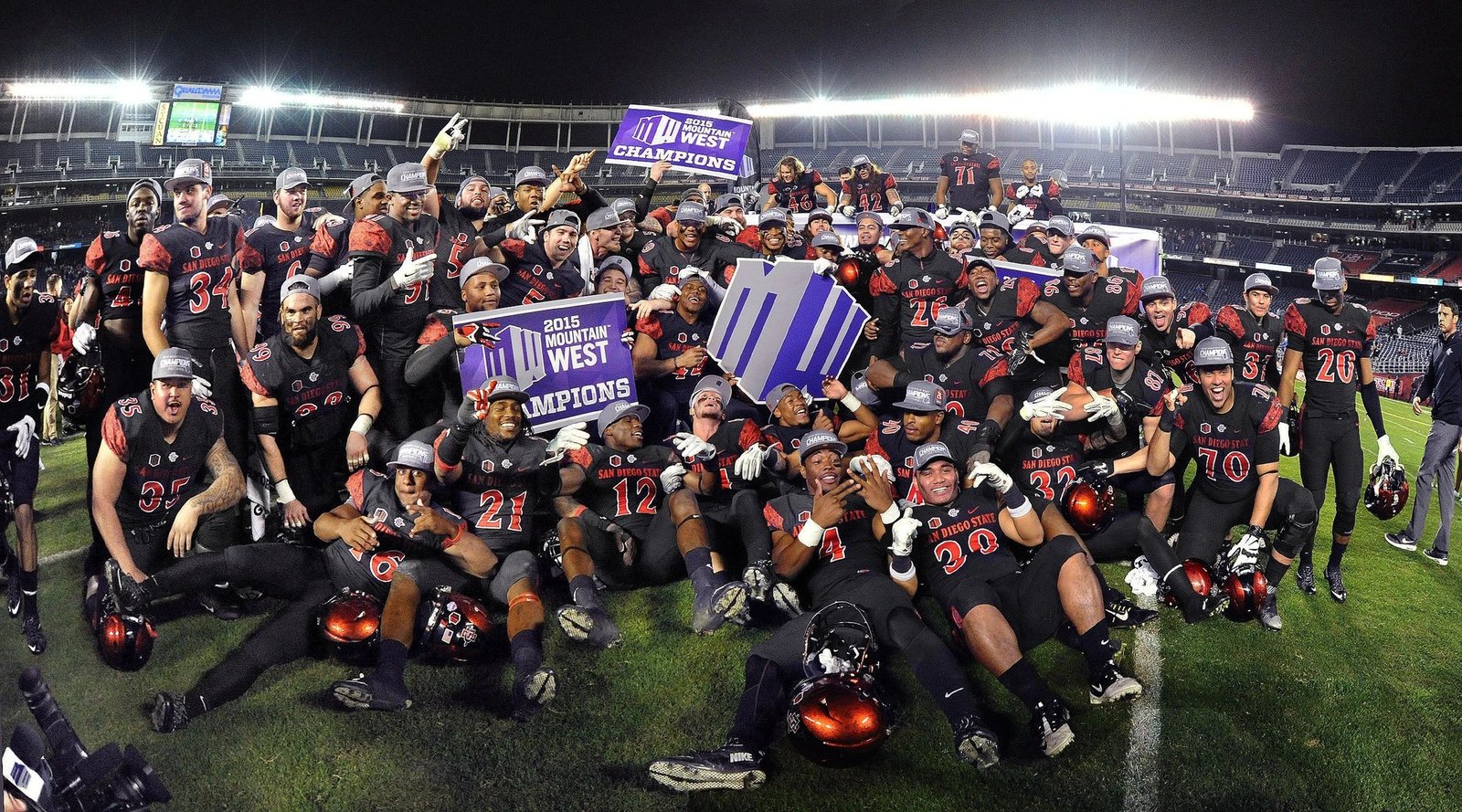
*With the Mountain West changing, I thought it would be fun to go back and highlight the best players, games, and teams over the past 13 years, since the last phase of conference realignment. Previously I’ve covered top 10 football players and top 10 basketball players. Today is for the Top 10 football teams
I’m only looking at teams from the 2013 onward, since before then some of the teams were in different conferences (such as Utah State and San Jose State were both in the WAC until 2012).
Methodology
Between being a stats nerd and indecisive, I went with a points system to make this list. I gave points for four areas:
- Quality of team, weighted for strength of schedule: This is the SP+ score, which served as the baseline amount. Points given were equal to their SP+ score
- Accomplishments: I gave a few extra points if they won the conference. I weighted it based on years the conference was stronger, on average, to give the champions in more competitive years a slight edge over those winning it in down years. For example, Fresno got more points for winning the conference in 2018 than 2022 (5 vs 0.83).
- Recognition: If a team finished ranked, I gave them 26 minus that final ranking, multiplied by 1.1 (so a team ranked 18th got 7.7 points). A conference champion is guaranteed every year, but being ranked is not, so a small adjustment was made to reflect that.
- Talent: I gave 0.5 points for every player that was First-Team All-Conference and 0.25 for each that was Second-Team. It was a simple and publicly recognized way to acknowledge how deep a team may have been.
The final score was the sum of all points in each area, which was included for those interested. I didn’t look at the final list until I had this all together, and it was interesting to see who came out on top. There were some solid teams I’d forgotten about that thankfully popped up from the model.
Honorable Mention
2020 San Jose State
San Jose’s best record, percentage-wise, for a single season was 87.5% (finishing 7-1), when they went undefeated in conference play for the first time in 30 years. The downside was it came in 2020. Because of that, when so many players nationwide were unavailable, which occasionally led to games being cancelled, it’s hard to compare teams from that season to others. Which is a shame, because San Jose steamrolled their way through the regular season. They beat every conference team by at least 10 points, including a 34-20 win over Boise State to win the championship (Boise had nearly all of their key players for that game, based on reports). San Jose had eight players named All-Conference, one being Defensive Player of the Year Cade Hall Jr, who had 10 sacks in just seven games. Head Coach Brent Brennan was also named Coach of the Year.
The model didn’t give them many points – just 2.87, ranking them 47th – but that really can be attributed to everything around them being out of the norm. They did well when you look at their final ranking, win-loss record, and overall talent. But, they had an SP+ score of 0.1, which basically means it had no idea how well they’d do against other teams. But again, that had more to do with the pandemic than the team itself. Had the 2020 San Jose State team been able to play in a “normal” year, I think more people would have taken notice.
Normally the honorable mention is a “best of the rest”, but in this case, it’s the best team that couldn’t fairly be compared to everyone else due to circumstances they couldn’t control.
10. 2024 UNLV (11-3) – 16.00 points
From 1978 – 2022, UNLV had exactly two seasons with nine or more wins. They’ve now had three in a row, winning 30 games from 2023-2025. Former head coach Barry Odom deserves a lot of credit for turning them around. There were some concerns with him leaving following the 2024 season, but UNLV still managed to go 10-4 their first year without him.
Since the turnaround, the 2024 team was arguably the best. While Odom was a huge reason for the success, offensive coordinator Brennan Marion played a large role. They finished the 2024 year averaging 35 points per game (15th most nationally), while 20th in total yards per game at 446. They put up 40 points in five games, including 72 against Utah Tech. They did this despite their infamous switch at quarterback mid-season. Matthew Sluka started hot, with seven total touchdowns to one interception in three starts, but then pulled himself out due to a dispute over NIL funds. Hajj-Malik Williams stepped in and was arguably just as good. Williams went on to have a conference-best passer rating of 145.1, while also rushing for nine touchdowns – 11th most nationally among quarterbacks.
Meanwhile, on defense, they forced 24 turnovers, tied for 14th most in the country, six of which were caused by the conference’s Defensive Player of the year, Jackson Woodward. Woodward also had 17 tackles for loss, tied for 10th nationally, and was one of four players to have 70+ tackles and five interceptions that season. Fellow teammate, safety Jalen Calaton, was a semi-finalist for the Jim Thorpe award, given to the nation’s top defensive back. They also did well on special teams, with kicker Caden Chittenden as one of the top kickers in the FBS, and Ricky White led the nation with four blocked kicks (while also getting 1,000 receiving yards and 11 touchdowns on offense).
UNLV that year had 12 players named to the First or Second-Team All-Conference, which was tied for second most by any Mountain West school since 2013. They ended the year ranked 24th, the first time they finished ranked in school history, and their 11 wins was tied for most in school history.
9. 2019 Air Force (11-2) – 16.30 points
Air Force was a consistently good team in this era. Only Boise State had more seasons with 10 or more wins since 2013, peaking at 11 in 2019. That season PFF gave them an overall grade of 94.2, fourth highest in Division I, and best for any Mountain West team since 2013.
The offense did exactly what head coach Troy Calhoun prefers, which was to run the ball. Their 34 points per game was 23rd most in the FBS, and their 299 rushing yards per game was second only to Navy that season. Quarterback Donald Hammond III was the main driver, leading the team with 13 rushing touchdowns, while also passing for 13. Five players ran for over 500 yards, while receivers Geraud Sanders and Benjamin Waters collectively averaged 27 yards a catch on 52 receptions (Sanders himself led the nation on 25 yards per reception – fourth-best in conference history). PFF gave the offense a grade of 95.7, highest in the nation.
I think most defenses would have described them as “frustrating” to play against. The offense had the third-highest rate of possession in the FBS (33 minutes a game), fourth-highest fourth-down conversion rate (75%), and second-highest third-down rate (53%).
Defensively, they were a solid group, even if they didn’t have a lot of headline players. Mosese Fifita was First-Team All-Conference for getting six sacks on the defensive line, and linebacker Kyle Johnson finished Second-Team. While they were the only two with notable honors that year, the defense as a whole did their job. They finished 20th in points per game (19.8) and 17th in yards (319).
Air Force finished the year with an 11-2 record (tied for best in school history) after beating Washington State in the Cheez-It Bowl. They also finished ranked 22nd in the AP poll, the first time since 1998.
8. 2016 San Diego State (11-3) 17.32 Points
When Rocky Long was the head coach, San Diego State won with “old school” football; running the ball and playing solid defense.
Their offense had one of the deepest backfields in recent memory. The number two back, Rashaad Penny, had 1,018 yards and 11 touchdowns, while the FBS all-time leader in rushing yards, Donnel Pumphrey, had 2,133 yards. As far as I can find, this is the only team ever to have a 2,000 and 1,000 yard rusher in the same season. The two combined for 3,606 yards and 31 touchdowns from scrimmage, helping San Diego State finish seventh in the FBS in rushing yards per game. They didn’t do it on their own, though; future fourth-round pick Nico Siragusa was an All-American at guard, while tackle Daniel Brunskill and tight end David Wells were named Second-Team All-Conference.
Their defense was really a complete defense, highlighted by Damonta Kazee, the conference’s first two-time winner of the Defensive Player of the Year award. They played the 3-3-5 defense that lots of opposing offenses couldn’t figure out, which held six teams to 10 or fewer points. Their average of 20 points allowed per game was 17th best in the FBS, and their two turnovers forced per game was 10th most. The defense also had 38 sacks, 22nd most, while only five schools allowed fewer rushing yards per game. Their best stretch came in October that year, where across five games they allowed a total of 19 points (it’s fair to point out one of those touchdowns was a fumble-return by UNLV’s defense, so really the defense only allowed 13 total points over a month).
San Diego State finished the year as one of eight teams to finish top 30 in scoring on both offense and defense. Their best win of the year was probably in the conference championship against Wyoming. Two weeks before that, San Diego State lost to Wyoming on the road in a heart breaker. The Aztecs scored a touchdown as time expired, but failed on the two-point conversion to lose 33-34. But when they returned to Laramie, they won the rematch 27-24. After beating Houston 34-10 in the Vegas Bowl, San Diego finished the year ranked 25th. Over the next few years, five players from that team went on to be drafted in the NFL
7. 2018 Boise State (10-3) – 18.15 Points
A brief spoiler, but three teams from that 2018 season will be on this list. That may have been the most top-heavy the Mountain West was during this era; the three teams with the highest SP+ score all played that season. Of the 48 players with All-Conference honors in 2018, 26 were on these three teams. Had this 2018 Boise State team played any other season they may have been the heavy favorite. But they did win it the year before, for what it’s worth.
Their offense was pretty well rounded. Quarterback Brett Rypien was named the conference’s Offensive Player of the Year after throwing 3,700 yards and 30 touchdowns (that year he also set the conference record for career passing yards). On the ground, Alexander Mattison ran for 1,415 yards and 17 touchdowns. They together helped Boise be the 20th highest scoring offense that year, averaging 35.4 per game. Five times they scored at least 40 points, including 62 against UConn, where they accomplished the rare feat of 400 passing and rushing yards. On the year, five players had over 500 yards from scrimmage and nine scored multiple touchdowns.
Defensively they had three players named First-Team All-Conference, tied with Fresno that year for most. That defense was highlighted by the conference’s all-time leader in sacks, Curtis Weaver, who helped the team average three sacks a game (13th best). As a whole they had five non-offensive touchdowns, returning interceptions, fumbles, and a kickoff for touchdowns. They held teams to 22 points per game, 30th best in the FBS
Their season ended on a disappointment, though. They were playing Boston College in the First Responder Bowl, when nearby lightning strikes caused weather delays until it was ultimately canceled. Eight players from that team were drafted in the NFL, and Rypien has had a decent NFL career as a backup quarterback.
6. 2018 Utah State (11-2) 20.00 points
Many teams will tell themselves they’re just a single piece away from being great. Usually that isn’t true, but Utah State may have been the exception in 2018. They had three straight losing seasons from 2015 – 2017 and returned most of their starters going into 2018. They brought in David Yost at offensive coordinator, who had a reputation for getting the most out of quarterbacks, and his impact was immediate.
They averaged a whopping 47.5 points per game, second only to Kyler Murray’s offense at Oklahoma in 2018. They were ruthless at home, where they averaged 59.5 points per game. Only once did they fail to put up 50 in Logan, and they still managed to score 42 points that game. Future First-Round pick Jordan Love was at the center of it all, responsible for 39 total touchdowns, while also being Second-Team All-Conference. Running backs Darwin Thompson and Gerold Bright each gained over 1,000 yards from scrimmage, while combining for 29 total touchdowns. Additionally, Savon Scarver earned All-American honors for returning two kickoffs for touchdown.
As good as their offense was, PFF liked their defense more. Their defense had the 12th highest grade that year in the FBS, while ranking top 10 in run defense and tackling, and earned an elite grade of 90 in coverage. The raw stats back it up; they allowed 22.2 points per game, 33rd best, while also leading the nation with forcing 2.5 turnovers per game. The defense also had a whopping six interceptions returned for touchdown. Aaron Wade and DJ Williams tied for the conference lead in interceptions with four each, and edge defender Tipa Galeai led the conference in sacks with 10.5. Linebacker David Woodward was PFFs highest rated linebacker that season, with 134 combines tackles (including 12.5 for loss), on top of five sacks, two interceptions, and two forced fumbles.
Their season ended with a 52-13 pounding of North Texas. They ended the year ranked 22nd, second time in school history appearing in the rankings. They even spent a few weeks ranked 14th, best in school history. Matt Wells was named Coach of the Year, seven players were named First or Second-Team All-Conference, with 10 others named honorable mention.
*In case some people ask, yes, Boise State did beat Utah State in 2018, so why was Utah State higher here? Reviewing the model, really it came down to Utah State having an SP+ score of 14.2, compared to Boise’s 12.2. If I had to guess, Utah State’s big bowl win over a 9 win team helped them out, where Boise didn’t have a chance to boost theirs further since their bowl game was cancelled.
5. 2013 Fresno State (11-2) – 20.08 Points
Most of the teams on this list were well rounded, without many weak spots. Fresno in 2013 had an above-average defense; they finished 13th in third down conversion rate allowed and sack rate. Derron Smith led the conference with seven interceptions and Ejiro Ederaine had 10 sacks. But they finished 87th in points allowed per game (30.3), 53rd in turnovers forced per game, and 96th in yards allowed (430). So if the defense wasn’t elite, why are they ranked so high? Well, the defense didn’t need to be great; they just had to hold offenses in check, because Fresno had probably the scariest passing offense in recent Mountain West history.
Derek Carr and Davante Adams are among the best Mountain West players since 2000, and maybe some of the best all-time. That year they broke single season records for passing yards (5,083), passing touchdowns (50), receiving touchdowns (24), and receptions (131). Adams was one of the top receivers in the country (a trend he carried into the NFL), while Carr finished eighth in the Heisman voting. But they weren’t just a two-man offense. Fellow receivers Isaiah Burse and Josh Harper each put up 1,000 receiving yards. On top of that, running back Joshua Quezada had a total of 1,097 yards from scrimmage. They may be just one of four teams ever to have four players to get 1,000 yards from scrimmage. Adams and Harper were easy selections for the All-Conference team, but Burse wasn’t entirely left out; his two punts returned for touchdown was enough to be named to the Second-Team as a returner.
The offense put up 40 points in nine games, and it wasn’t until December that a team managed to hold them to fewer than 35 points. Even if you weren’t a Fresno fan, their games were fantastic to watch; five were decided by less than a touchdown, and in half their games the two teams combined to score for at least 70 points.
Fresno beat Utah State to win the Conference that season. While Carr did well that game with 400 yards, the offense struggled and only scored 24 points. But their defense came through, getting eight sacks and two interceptions. The ended the year with an 11-2 record, their best in 12 years. Along with Carr and Adams, the 2013 Fresno team featured three other future NFL draftees.
4. 2014 Boise State (12-2) – 21.77 Points
The 2014 season was expected by some to be a down year for Boise. Their coach, Chris Petersen, left for Washington the prior off season after Boise finished 8-4. New coach Bryan Harsin managed to quickly get the team going.
Their defensive strategy was to attack opposing offenses. They finished with 3.4 sacks a game, sixth highest in the FBS. That was led by Kamalei Correa, who led the conference with 12 sacks, with 15 other players managed to get at least one sack (my friend who edits these asked me twice to verify that number). In the secondary, Darian Thompson and Donte Deayon combined for 13 interceptions and were responsible for four of the teams seven non-offensive touchdowns. The defense didn’t excel too much in the basic stats, finishing 64th and 48th in points and yards allowed per game. But like Fresno the year before, the offense was so good they didn’t have to.
Running back Jay Ajayi tied with Melvin Gordon that year to lead the nation with 32 total touchdowns, and was second nationally with 2,358 yards from scrimmage (a conference record at the time). The other half of their offense was dual-threat quarterback Grant Hedrick. He completed an FBS best 70.8% of his passes (3rd best in conference history) with 23 passing touchdowns. On the ground he also ran for 592 yards and eight touchdowns. The offense that season took a little while to get going, but from October onward they averaged 46.6 points a game, including scoring 50 in five of their final nine games.
The season ended in their third Fiesta Bowl Win, an upset over then No. 12 Arizona. That moved them up to 16th in the final AP Poll and had seven players go on to be drafted in the NFL
3. 2019 Boise State (12-2) – 23.65 Points
Boise in 2019 started out with a bang. They went on the road to play Florida State and found themselves down 31-13 in the second quarter. After some furious work, they went on to win 36-31. True freshman Hank Bachmeier threw for 407 yards, in one of the better debuts you’ll see for a starting quarterback. What’s interesting about that season was Boise started three different quarterbacks due to injury, and still managed to finish 19th in points per game at 34.7. Those three quarterbacks each threw for at least nine touchdowns. It’s not often you can play so many quarterbacks without skipping a beat.
Another freshman, George Holani, led the team in total yards and touchdowns (1,220 yards and 10 touchdowns from scrimmage), but they were great at spreading the ball out. Eight players scored three or more times, six had 20 or more catches, and three had 50 or more rushing attempts. It really was an offense-by-committee approach that was very consistent; only four teams held them to fewer than 30 points.
Defensively they didn’t have much to complain about. On a per-game basis, they finished top 25 in points, yards, and sacks. Defensive end Curtis Weaver led the conference with 18.5 tackles for loss and 13.5 sacks, which were good enough to earn him All-American Honors and Defensive Player of the Year. Their special teams also did well, returning three punts and kickoffs for touchdowns, two of which came from Special Team Player of the Year Avery Williams.
That season ended what was the best four-year run by any team in this window we’re examining (2013-25). Boise went 43-11 from 2016-2019, the only team in the conference to win 40 games in any four year stretch, plus going 2-1 in the Conference Championship across three consecutive years. This 2019 team had the most players with All-Conference honors with 14 (Five First-Team and Nine on the Second-Team). They ended with their second Conference Title in three years and were 23rd in the final AP poll. Eight players from this team would go on to be drafted in the NFL.
2. 2018 Fresno State (12-2) – 31.40 points
If this list was just the teams most likely to beat anyone else, this Fresno Team likely would have been number one. For SP+ score, which measures just that, they were the clear leader at 17.4, with the 2018 Utah State team next best at 14.2. They only had two losses on the year; the first came in an early road game against Minnesota (21-14), and the second was also on the road against Boise, also by seven points, but they won the rematch in the Conference Championship that year. Top to bottom, this may have been the most complete team the Mountain West has had since 2013.
Their defense was the main driver of this year. They finished third in yards and points allowed per game in the FBS that year, as well as 15th in turnovers. They held nine teams to less than 20 points, including four to under 10. Only one team put up more than 400 yards of offense, and their season high for points allowed was just 27 (14 of which came in the fourth quarter when Fresno was already up 49-13). Nine teams were held to fewer than four yards a carry, and six completed less than 50% of their passes.
JuJu Huges and Anthoula Kelly combined for eight interceptions, with Kelly returning two for touchdowns. Linebacker Jeffrey Allison was named Defensive Player of the Year by getting two interceptions and leading the conference with 72 solo tackles (with 132 combined).
Offensively, they were about as efficient as it gets. They were 26th in scoring, 16th in fewest turnovers, 26th in third down rate, and 18th in time of possession. Basically they hit the field, scored, didn’t mess up, and made life easy for their already great defense. After moving over from Oregon State, quarterback Marcus McMaryion threw 25 touchdown passes and only five interceptions, tied for 6th best interception rate in the country, and his completion rate of 68.6% led the conference (8th highest in the FBS). Plus, on the ground he ran for another eight touchdowns. Running back Ronnie Rivers scored 13 total touchdowns with 1,247 yards from scrimmage, while receiver KeeSean Johnson had career highs in catches, yards, and touchdowns (95, 1,340, and 8 respectively).
They won the conference in one of the more top-heavy years (two other teams on this top-ten list played this season) by beating Boise State in a snowy game on the road. The win capped a great turnaround for the program, as Fresno went 1-11 two seasons earlier. After beating Arizona State 31-20 in the Vegas Bowl, Fresno ended the year with 12 wins and ranked 18th in the AP poll, both highest in school history.
1. 2024 Boise State (12-2) – 35.15 Points
While Fresno in 2018 was probably the most complete team (and a likely favorite to win in a round-robin tournament of all Mountain West teams), this Boise team had accomplished the most of any. They were the only team to finish a season ranked in the Top 15, or at any point be Top 10, and they finished eighth. They beat the second best team that year, UNLV, twice by 21 combined points. In week 2 they went to Oregon, one of the toughest environments in all of college football, and lost by a single field goal. They also have the distinction of being the first G5 school to make the expanded playoff, and are a big reason why the selection criteria for the playoffs was immediately changed.
It’s really easy to pass this team off as the “Ashton Jeanty and friends” squad, which is fair. But even Superman had the Justice League to help out. On top of Jeanty’s numbers that might not be topped for a long time, they had seven players named First-Team All-Conference, a total only exceeded by San Diego State in 2021. Three of those were guys up front that helped make Jeanty’s job easier. One was tackle Kage Casey, recently drafted by the Denver Broncos, who was PFF’s fifth highest rated tackle that year (among those with at least 500 snaps played). Meanwhile, quarterback Maddux Madsen very quietly had a solid year, leading the conference in passing yards and touchdowns, along with five touchdowns on the ground. It’s easy when you have someone like Jeanty hogging the attention, but Madsen was still able to make defenses pay for it. In the three regular season games Jeanty didn’t average 6 yards per carry, Madsen had eight touchdowns, 0 turnovers, and completed 68% of his passes.
Defensively, they had their issues, but still managed to finish a respectable 28th in points allowed per game at 22.6 and only four teams scored at least 30 against them (worth noting they allowed 19.5 per game from week 3 on). It seems like they knew as a team that Jeanty would always get the offense going, so the defense’s job was to put pressure on the opposing offense, and boy did they. They finished with an FBS best 56 sacks, which per StatMuse, is tied for third most by a team since at least 2015. 15 players got a sack, including eight with at least three. Jayden Virgin leading the team with 10 and future NFL pick Ahmed Hassenein was close behind with 9.5. They did so with some creative blitz packages; 22 sacks were by players not listed as defensive linemen, and 10 came from defensive backs Rodney Robinson and Seyi Oladipo.
While their season did end with a whimper against Penn State, getting to the Fiesta Bowl by itself was a huge accomplishment. This Boise team was the first team to make a NY6 bowl for the Mountain West in 10 seasons, and first to be ranked in the top 10 in 13 years. Those two accomplishments are really why it’s hard not to say they were the best Mountain West team since this current group aligned together in 2013.
BONUS
Each team’s best season during this era, according the model:
| School | Season |
| Air Force | 2019 |
| Boise State | 2024 |
| Colorado state | 2014 |
| Fresno State | 2018 |
| Hawai’i | 2025 |
| Nevada | 2021 |
| New Mexico | 2025 |
| San Diego State | 2016 |
| San Jose State | 2020 (2021 was highest outside of the COVID year) |
| UNLV | 2024 |
| Utah State | 2018 |
| Wyoming | 2018 |
Conclusion
While NIL and the transfer portal have changed college football dramatically, one thing that stood out from this project was that schools were able to stay competitive. Four schools had their highest-rated team in the past two seasons, despite the concerns about recruiting and player retention.
There were also a lot of talented players; some set FBS records, others received Heisman votes, some were drafted in the first round of the NFL draft, and others have gone on to have great pro careers. This era of Mountain West football really did have some great teams.
Up next: Top 10 Men’s Basketball Teams

