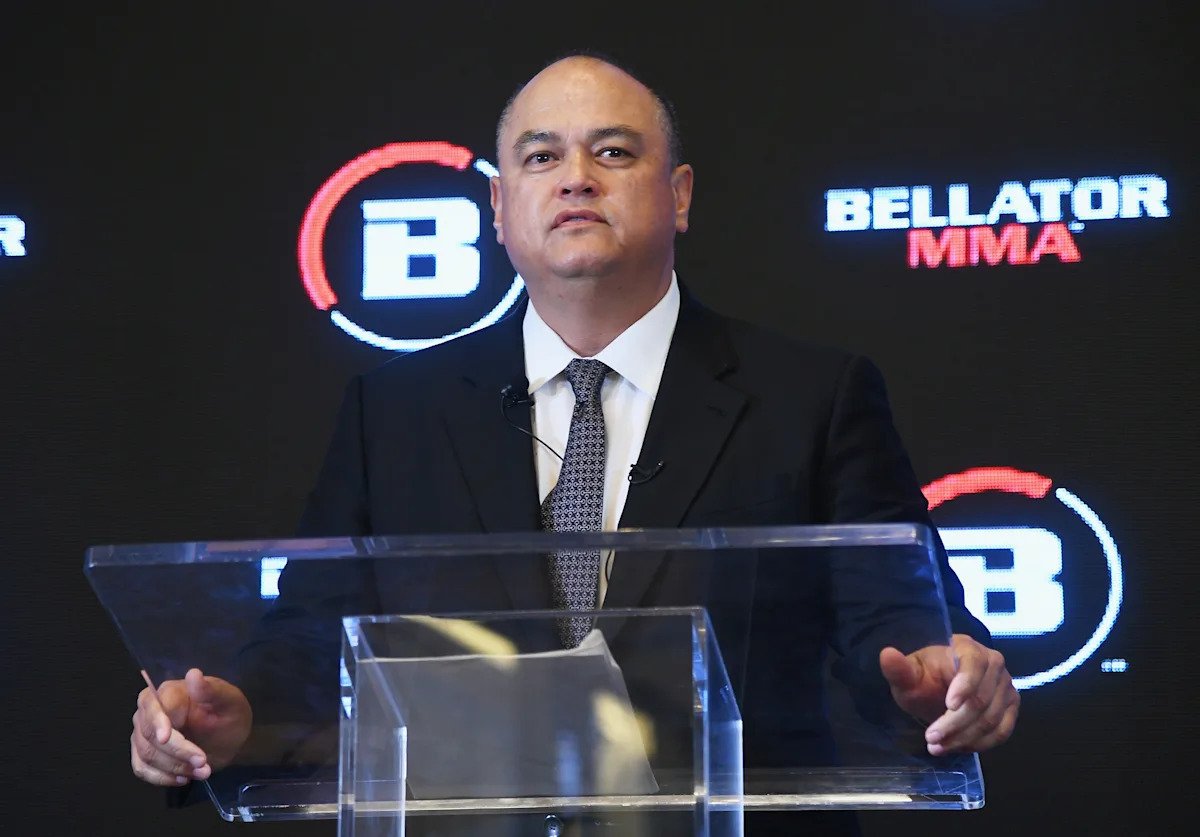
When I heard that Scott Coker, founder of the now-defunct Strikeforce fight promotion and former CEO of Bellator MMA, was coming out of retirement to launch what’s being described as a new “global mixed martial arts league,” I had questions.
The first question was: Why would he do this to himself? He knows what this business is like. He knows how hard it is for an upstart promoter to scratch out any patch of firm earth to stand on in an industry dominated by the UFC. He experienced it firsthand when he built Strikeforce from a regional fight show to a genuine competitor that the UFC’s parent company bought just to shut down and pillage for parts. He went through it again when he was brought in as a hired gun to steer Bellator toward a new version of itself.
Advertisement
After all that — and after making good money from the various sales and shutdowns, including a period where the UFC was essentially paying him not to promote any fights — why would he want back in? And yet, Thursday’s press release announcing the launch of a new MMA organization with $60 million in financing would suggest that Coker is very much back.
That’s when I reached out with more questions: Is there enough unsigned talent in MMA to make this work? And is this really a good time to try, considering that MVP MMA has also just entered the fray? Coker offered to talk. Below is our conversation, lightly edited for length and clarity.
Uncrowned: Scott, when I got the email this morning, my first thought was, ‘Has he really not had enough of this crazy world?’ What made you want to get into all this again, and what made you think now was a good time to do it?
Coker: Well, you’re right. It is a crazy business and you’re dealing with a lot of moving parts. But when I left Bellator I took about six months off, and after that I really started thinking, OK, what is it that I want to do and what does it look like? All roads led back to doing what we’re doing now, which is putting together a great team, putting together the proper funding, putting together a format that we really love and that I really love. It’s kind of going back to the old-school tournament format, and it’s different than what others have been doing lately. But really it goes back to working with the people that I want to work with, having the right amount of funding to do it properly, and building a business, which I think is something that I’m really good at.
Advertisement
And so that’s what we set out to do. I had a friend, Peter Levin, who has an amazing background. He was the former manager of Randy Couture, Mark Coleman, [Quinton] ‘Rampage’ Jackson. After a period of years he went into the financial business and he started a fund called Griffin Gaming, and it’s the largest video game fund in the world. I think they managed about [$1.6 billion]. He kept bugging me, for about the last eight or 10 years, actually, saying, ‘Let’s go do something, let’s go do something.’ So I started talking to him and we asked, ‘OK, what does this look like? What does the fundraising look like to do it right?’ And we went out, we did it. So that process started probably about 18 months ago and here we are ready to go.
You mentioned a tournament. In the press release, it was repeatedly referred to as a league. Do you envision this being something with a different structure than what we see from most promoters now?
Coker: I do. I don’t want to give away all of our secrets right now, but I do. I do believe it’d be a little bit of a different twist, but we’re not going to do multiple tournaments and multiple weight classes on the same months and same weeks. We are going to do something that is kind of a throwback to having one weight class and finishing it out and finding the best fighter in the world in that class. I know one of the questions you’ve asked was about talent. Is there enough talent out there? And my answer is very simple. As far as talent development, procurement, star-building, I think I’ve done it better than anybody else. Me and my team, not just myself, but me and my team, have done it better than anybody, including the UFC, because I don’t think they really do it.
Advertisement
[The fighters] are out there. I believe that they’re out there, and there’s so many more fighters than there are slots now for all the different leagues that are out there. And we’re looking for something a little different. A good example would be, we’re looking for somebody that’s a great fighter, that’s going to move the needle, that also has that x-factor. So we’re going to put them in tournaments, it’s going to be sudden death. Winner moves forward, loser goes home. And they’ll be fighting for a big chunk of prize money at the end. So that part has been done. It’s just, I think the idea of having multiple weight classes and trying to do it all at once, it was just really confusing the way it’s been done. I think we’re going to kind of go back to the Strikeforce heavyweight tournament model, or the Bellator tournaments that we did.
That’s kind of what really excited me was when I was a kid doing martial arts. That’s how it was, everybody fought in a tournament, and in that tournament you would find multiple fights in one day. I think martial arts was meant to be in a tournament style. And if you look at all the great leagues, like Pride had a tournament style, K-1 definitely had a tournament style. Even UFC was a tournament all in one night originally. We were working out some of the details, and we still have a lot of work to do, because we have a lot of things that need to happen between now and the beginning of next year. But I feel really good about it and I’m excited about this project.
Scott Coker has been out of the fight game since the sale of Bellator in late 2023.
(Icon Sportswire via Getty Images)
Timing-wise, it seems tricky. We’re coming off the big MVP MMA show on Netflix, and especially after they saw the viewership numbers, they’re talking about doing more. That leaves more promoters competing to sign a relatively small pool of fighters. That’s good for the fighters, but it seems like the marketplace for promoters is more crowded now than it was six months ago.
Coker: I disagree. I think that, listen, MVP definitely came in and made a lot of noise and did what they did and congratulations to them. They did a good job. To me, there’s going to be consolidation of these leagues around the world at some point. Some of them won’t make it. Some of them will be strong enough to go, but the nature of the business is that some will be able to continue and thrive and some will end up consolidating or eventually selling. So I think there’s plenty of room and I think that a company like this needs to happen because I feel like, I don’t know if you agree with this or not, but I feel like there’s a little bit of a lull in mixed martial arts right now. Even though there’s so many different leagues, it has a little bit of a funk to it. You know what I mean? There’s something wrong. There’s a disturbance in the force.
Advertisement
It’s like there’s something wrong and I can’t even put my finger on it. My friends that used to love watching [MMA] don’t even watch anymore. I have a lot of friends that have kids and they’re not watching. They’re doing other things because there’s something missing. I think that MVP coming, making a big event, and rallying the case a little bit is great. We’ll do the same. There’s plenty of room for everybody.
Do you see yourselves trying to jump out right away and compete with the UFC? Or will this be more of the approach you took with Strikeforce, starting out in one region and then growing over time?
Coker: We’re going to be global. This is going to be a global company. We’re going to do events in Asia. We’re going to do events in Europe. We’re going to do events here in North America. But when you say compete with UFC, I never really thought of it as like, ‘Hey, we’re trying to take down the UFC.’ Even in Strikeforce, I always looked at it like, there’s a mixed martial arts community out there and not everybody is a UFC fan. Not everybody is only a UFC fan. So to me, Strikeforce was always additive to the offering in the MMA community. I look at this product the same way. There’s plenty of room, because we’re not trying to bring down anybody. We’re just going to do what we do, and that’s kind of been my philosophy the whole time.
Advertisement
So when do you think people should expect to see the first event?
Coker: I’d say the beginning of 2027.
That’s pretty quick to go from concept to actual fights with blood on the canvas.
Coker: I can tell you confidently why this is going to happen. I’ve been in this business for four decades now, and everybody that we’re going to be in business with, there’s no learning curve. Everybody that I’m talking to internationally, there’s no learning curve. I don’t have to go and figure out how I’m going to do this or that. And I mean, like you said, the nature of the business is such a hectic, crazy business. But for the most part, I feel like we’re really good at this and we’re going to go out and execute.

RIZIN founder Nobuyuki Sakakibara (right) is just one of many figures with whom Scott Coker has co-promoted shows.
(Jun Sato via Getty Images)
You must actually like that it’s a crazy business. To be getting back into it now, after some of the experiences you’ve had, the craziness must be part of the appeal for you, no? I can’t imagine you’d keep coming back if a part of you didn’t actually enjoy that.
Coker: You know what, I look at it like this. I think that first with Strikeforce kickboxing, then Strikeforce MMA, I made a deal, worked with Pride, worked with Dream, worked with RIZIN. During my non-compete years, I was actually, for three years, an employee of the UFC, even though I was representing the Strikeforce brand when they took it over. Then I ran Bellator. It’s something that I think, like I said, I’m good at this. I’m really good at putting things together and building a company. Bellator, when I walked into my first fight there, I think it was like a 1,200-seat ballroom and I was like, ‘Oh, this is not going to happen. We’ve got to do better than this.’ So we built it to an arena show. We built it to a big brand name.
Advertisement
So it’s something that I love, because it goes back to, for me, growing up in a martial arts school. I just love martial arts and I always have. This is something I’ve always done since I was in my early twenties, and it’s my contribution back. It’s something I’m going to continue doing, and it’s something that the fans are going to get to watch and appreciate. I think they’re really going to love the format and how we’re doing it, and I feel very confident that we’re going to have a great launch in January.
I feel like there’s a little bit of a lull in mixed martial arts right now. Even though there’s so many different leagues, it has a little bit of a funk to it. There’s something wrong and I can’t even put my finger on it. My friends that used to love watching don’t even watch anymore, because there’s something missing.
When I talked to your former matchmaker Rich Chou, he mentioned that Bellator never felt the same as Strikeforce for him because you guys were taking over someone else’s show, whereas Strikeforce was one you guys built from the ground up. Is that part of this for you, wanting to have another chance to create something new from scratch?
Coker: Absolutely. When we came to Bellator, it was a small, tiny show. It was doing little business. We grew it to be a nine-figure business. So it went from doing $13 million a year in revenue to $100 million of revenue — real cash revenue. So we built it to a nice business. But I will say this, when I first got there, I said to [Spike TV/Paramount president] Kevin Kay, ‘I’m not sure I can even help you at this point.’ Because I was thinking, am I jumping on a ship that’s like the Titanic and is just about to go down? Am I going to be able to fix your ship? I don’t know, but we gave it a shot and it worked out.
But to me, I look at the other businesses that I built from the ground up, and to me it’s much easier to build the ship from the ground up than it is to jump on a ship that’s tilting and you’re trying to fix it and throw out the water and trying to build as you go. It’s hard. The foundation was already shaky when I got there, but we did the best we could. I think we did a great job. I think if you look at the stars, I mean, I found AJ McKee there. I found Usman Nurmagomedov. We signed Aaron Pico right out of high school. I think we found some young stars that we wanted to build, and we did it, and then we turned it from a ballroom show to a nice arena show and a nice brand. I think those are the metrics and those are the boxes that you check when you talk about having a successful fight company.
Advertisement
Well, I guess welcome back. Welcome back to the insanity of the fight business.
Coker: It’s going to be fun. We’re in the process of hiring a bunch of staff right now and we’ll have a couple announcements in the next couple of weeks and we’re going to build together. I call them my new Avengers team. So we’re going to have some fun.

