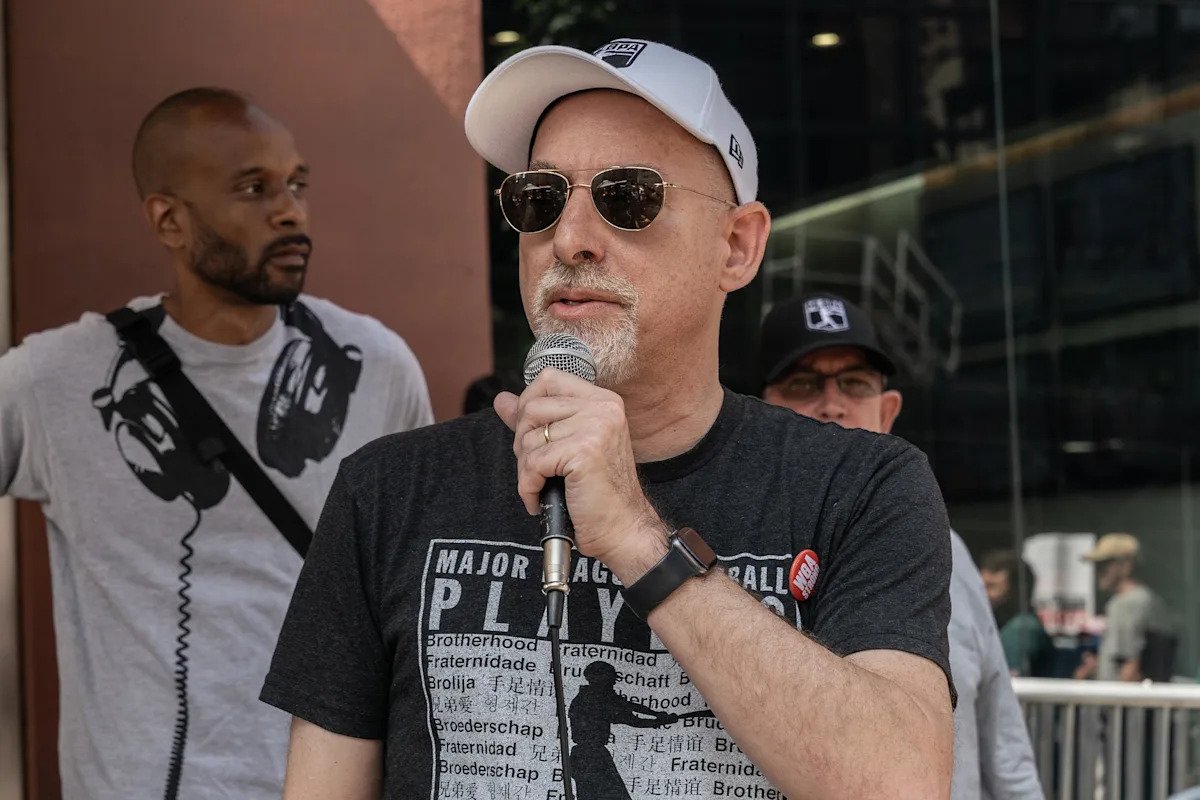
The labor negotiations between MLB and the MLBPA began on May 12, with each side making opening presentations. On May 27, the MLBPA released the first substantive policy proposals for the upcoming Collective Bargaining Agreement (CBA).
As expected, the MLBPA seeks to modify the current CBA system rather than pursue a dramatic overhaul. The major policy proposals include, per Jeff Passan:
Advertisement
-
A “competitive-integrity tax” for any team that does not spend $150M
-
An increase in the minimum salary from $780,000 to $1.5M
-
An increase in the base Competitive Balance Tax threshold from $244M to $300M
-
Changes to the revenue-sharing system that would distribute more money from local television revenue, but decrease the amount distributed from in-stadium revenue, to incentivize teams that win and draw larger crowds
-
Free agency for players who are 30 at 5+ years of service
-
Teams that receive revenue sharing forfeit portions of their checks depending on payroll levels. Recipients who win receive more money
-
Pre-arbibration bonus pool increases from $50M to $180M
-
$3M minimum tender in arbitration
-
Arbitration super 2s jump from 22% of players to 44%
Evan Drellich of The Athletic also listed some additional union proposals that Jeff Passan did not mention on Twitter:
-
The minimum salary would later climb to $1.65 million in 2028, $1.825 million in 2029, $2 million in 2030, and $2.2 million in 2031.
-
The first tier of the luxury tax would be set at $315 million in 2028, $330 million in 2029, $345 million in 2030, and $360 million in 2031.
-
The pre-arbitration bonus pool was a flat $50 million throughout the 2022-26 collective bargaining agreement. In addition to the initial $130 million increase, the union wants it to rise by $15 million each season.
-
There was no proposal to create an international draft, though players and owners made some conceptual progress in the last round of talks.
Under the MLBPA’s proposal, based on current payrolls, only the Yankees, Mets, and Dodgers would be above the CBT threshold, compared to the six teams currently over the $244 million threshold. Moreover, 13 teams would be subject to the Competitive Integrity Tax for having payrolls under $150 million.
Bob Nightengale reported on the league’s response to the union’s opening gambit on Twitter:
“We appreciate the union making a set of proposals and we look forward to continuing the bargaining process and working towards solving the competitive balance problem our fans are telling us needs to be addressed. We understand their proposals are designed to benefit players. Unfortunately, they do not address and in fact exacerbate the competitive balance problem our fans are telling us we must address. The MLBPA’s proposal would reduce the amount transferred to lower-revenue Clubs, weaken the Competitive Balance Tax, and lead to even more payroll disparity than exists today. For example, under the Union’s proposal, the Dodgers would pay less in luxury tax payments, giving them an additional $70 million to spend on payroll.”
(Emphasis added.)
As expected, the league will continue to use the Dodgers as a shiny object to push for a hard salary cap.
Advertisement
Never mind that four of the six current division leaders (Milwaukee Brewers, Tampa Bay Rays, Cleveland Guardians, and Seattle Mariners) are revenue-sharing recipients. Never mind that, per Fangraphs, the teams with the second- (New York Mets), fourth- (Toronto Blue Jays), seventh- (Houston Astros), tenth- (Detroit Tigers), eleventh- (San Francisco Giants), twelfth-(Boston Red Sox), and fifteenth-highest (Anaheim Angels) payrolls are either below .500 and/or essentially running out the clock until it’s time to go to Cancun.
Why acknowledge both the record sale of the San Diego Padres and the ongoing clown show in Queens instantly counter the league’s arguments for a hard cap?
Echoes of 1994
Regardless, the league was expected to announce its opening gambit in negotiations the following day, much faster than in the last CBA negotiations, when the league waited until August to make its initial proposal. On May 28, the league obliged, proposing a hard salary cap for the first time since the infamous 1994-95 strike, leading to the first canceled World Series in 90 years.
Advertisement
Per Ronald Blum of The Associated Press:
[MLB’s] proposal would cap spending in 2027 at $245.3 million, with a salary floor of $171.2 million.
“Our salary cap and floor proposal levels the playing field while sharing baseball revenue with the players 50/50 as we grow the game together,” MLB spokesman Glen Caplin said in a statement. “Further, by sharing media revenue equally as part of our proposal, we can address another top fan concern of local TV blackouts.”
Management gave the union its latest plan during a bargaining session at the commissioner’s office, one day after the union made its economic proposal. Owners say a cap is needed to improve competitive balance and restrain the Los Angeles Dodgers, New York Mets and other wealthy teams from assembling starrier rosters than their smaller-market brethren.
(Emphasis added.)
Under MLB’s proposal, using current payrolls, only nine teams would be in compliance using the proposed hard cap and floor: Houston Astros ($237 million), Chicago Cubs ($232 million), San Diego Padres ($209 million), Detroit Tigers ($207 million), San Francisco Giants ($201 million), Boston Red Sox ($196 million), Arizona Diamondbacks ($195 million), Texas Rangers ($187 million), and Anaheim Angels ($184 million).
Six teams would be above the hard cap, and 13 teams would be below the floor.
Also, per the AP, MLB’s last salary cap proposal in 1994 offered players a 50-50 split of revenue in a system that would have forced teams to maintain payrolls of 84-110% of the average. Salary arbitration would have been eliminated, and the threshold for free agency would have been lowered from six years’ major league service to four, with the provision that a player’s former club could match any offer until he had six years.
Advertisement
MLB’s offer came on June 14, 1994; players struck on August 12, 1994, and on September 14, 1994, the ‘94 World Series was canceled. Ultimately, MLB withdrew the cap proposal on February 6, 1995, after pressure from the National Labor Relations Board.
The strike ended on March 31, 1995, after then-U.S. District Judge Sonia Sotomayor (yes, that Associate Justice Sonia Sotomayor) issued an injunction restoring the work rules of the expired labor contract.
Two days later, the owners accepted the union’s offer to return to work without an agreement, and a deal wasn’t reached until 1997, causing reputational damage to the sport that arguably lasted until the steroid boom, punctuated by Mark McGuire and Sammy Sosa’s 1998 duel to break Roger Maris’ then-record of 61 home runs in a single season.
“Welcome to the party, pal!”
Mr. Drellich also posted an article in The Athletic on May 27 that made many of the same surface-level observations about private equity in baseball that our own “The Vulture of Private Equity” made and more, six weeks earlier. Ken Rosenthal made similar points, referencing Mr. Drellich’s work on Foul Territory.
Rather than repeat previously published work, which can speak for itself, for the convenience of either reporter or reader, all five revival “It’s Not My Money(ball)” articles are collated below. This collective body of work, all 13,764 words of it, covers an assortment of relevant topics likely to arise during the new CBA negotiations, in one form or another.
Advertisement
This process will undoubtedly be a slow one over the next six months, largely occurring in the background. In conclusion to this brief update, it is worth repeating that there is no reason for a lockout to occur. But as with most things, some lessons need to be relearned, even when there is no value to the lesson.
As shown during the aftermath of the 1994-95 strike, the parties could choose to keep the current system in place while a new CBA is negotiated and ratified — if the goal was stability. If the goal was disruption and chaos disguised to grow balance sheets that the public will never see, then locking out the players at the earliest opportunity would seem to be the only move in the league’s pocket, apart from turning the public against the players.
The quickest way to do that gargantuan task is to keep using the Dodgers as a foil to why your team is doomed to be bad; never mind the moronic decisions arising from front offices ranging from San Francisco to Queens and points in between.

