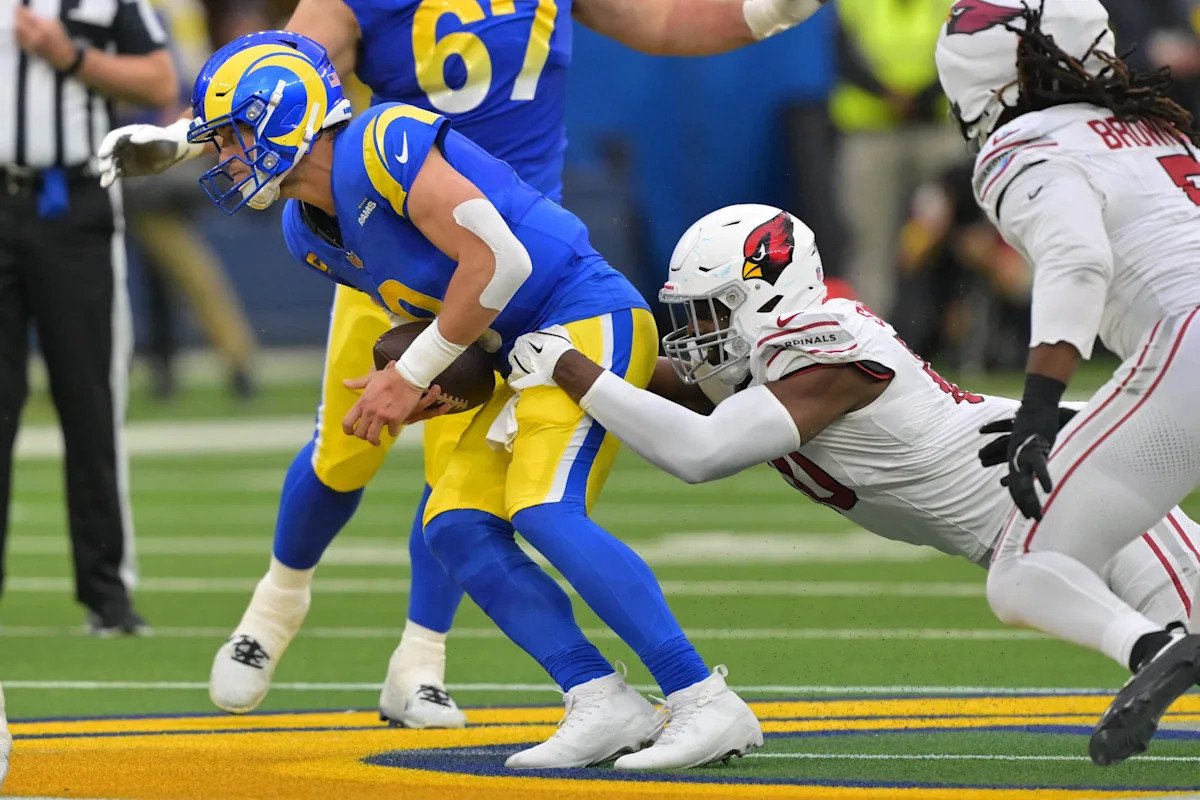
The Colts have done a lot this offseason, but the pass rush still feels incomplete.
Laiatu Latu gives them one quality starting edge rusher, and the additions of Arden Key, Michael Clemons and Colby Wooden strengthened the rotation. But depth and a true second pass rusher are not the same thing. If the Colts are serious about building a defense that can win right now, they still need another proven threat off the edge.
Advertisement
That’s where Josh Sweat comes in.
According to Jordan Schultz, multiple teams have expressed interest in trading for Sweat, and the Cardinals could be open to moving him if the right offer comes along. Sweat is a proven veteran edge rusher with good production, playoff experience and recent high-level tape.
Sweat is 29 years old and spent the majority of his career with the Eagles before signing a big contract with Arizona. He was productive in Philadelphia, helped anchor a strong defensive front, and was part of their Super Bowl-winning team. Last season with the Cardinals, he remained a legitimate impact pass rusher, finishing with 12 sacks and four forced fumbles.
For the Colts, that kind of player would immediately change the complexion of the defense. A front featuring Latu, Sweat, DeForest Buckner and Grover Stewart would give Indianapolis a much more credible pass rush. It would also allow Arden Key, Clemons and the rest of the group to settle into more natural rotational roles instead of being asked to provide starter-level production.
Advertisement
Not relying on your depth to take on a starter role and actually having four capable starters along the defensive line is exactly how the Colts can compete in 2026, at least defensively.
Do the Colts need an edge?
Yes, absolutely!!
The Colts have Latu, and he looks like a quality starting edge rusher. They also added Arden Key, Michael Clemons and Colby Wooden to improve the rotation, which was necessary. But there is a difference between having bodies and having a true second pass-rushing threat. Key is useful as a pure pass rusher, Clemons is depth, and Wooden can move around the line, but none of them should stop Indianapolis from looking for a real complement to Latu.
Advertisement
The Colts finished 15th in the NFL in sacks last season with 39. That is fine, but it is not good enough for a team trying to win now, especially when the secondary is projected to be one of the strengths of the roster. Adding Sweat to this group could easily push the pass rush into the top 10 if everything else holds steady. He gives them a proven double-digit sack threat, another player offensive lines have to account for, and someone who can win without needing the entire front designed around him.
That also helps Latu. Right now, Latu is the one edge rusher teams can focus on. Put Sweat on the opposite side and that changes because offenses can’t slide everything toward Latu as easily, and if they do, Sweat is good enough to punish them. That kind of balance is what turns a pass rush from ok into elite territory.
The ripple effect is just as important. More pressure means quicker throws, rushed decisions and more chances for the secondary to make plays. With Sauce Gardner and Charvarius Ward outside, and Cam Bynum helping stabilize the back end, the Colts have the coverage talent to take advantage of pressure. A stronger rush would make that secondary even more dangerous.
It also helps the run defense. Sweat is not just a one-dimensional pass rusher, and a front with Latu, Sweat, Buckner and Stewart gives the Colts legitimate strength at every spot of the line. With CJ Allen behind them, suddenly the defense has a much clearer structure. Buckner and Stewart can control the interior, Sweat and Latu can set the edge and create pressure, and Allen can clean up behind them.
Advertisement
If the Colts are serious about winning in 2026, this is exactly the type of move that fits. They don’t need another rotational piece; they need a player who changes how offenses prepare for them.
How much would it cost to acquire him?
This is where the conversation gets interesting, because edge rushers are not cheap when they become available.
The best way to frame Sweat’s value is by looking at recent trade comps. Brian Burns was traded for a second-round pick and a fifth-round pick. Montez Sweat was traded for a second-round pick. Matthew Judon, who was older at the time of his trade, went for a third-round pick. Those deals give us a pretty reasonable range.
Advertisement
Burns and Montez Sweat were both around 27 years old when they were moved, so they were a bit younger than Josh Sweat is now. Judon was 32, which makes him the older veteran comparison. Josh Sweat sits in the middle at 29 years old.
Because of that, a second-round pick probably gets the deal done. If the Colts offered a second, Arizona would have a hard time saying no unless there are multiple teams bidding. But that feels a little rich from the Colts’ perspective, especially with the team already missing a first-round pick and needing to fill several other roster holes.
A more realistic offer would be something like a 3rd round pick and a 5th round pick or a future 4th round pick instead of the 5th rounder.
That feels like the sweet spot. It is more than just a mid-round flyer, so Arizona gets some value back. It also protects the Colts from overpaying for a 29-year-old edge rusher on a significant contract. Sweat is a very good player, but he is not 25 years old and just entering his prime. There has to be some balance.
Advertisement
So if we’re putting a number on it, I’d peg Sweat’s trade value around a third and a fifth. A second-rounder likely wins the negotiation, but a third-plus-fifth is probably the kind of offer Indianapolis should be making first.
His contract for 2026 and beyond
Sweat signed a four-year, $76.4 million deal with Arizona, but the acquiring team would not be taking on the full cap burden the way the Cardinals currently are. According to Over The Cap, Sweat carries a $16.385 million cap hit in 2026, but if he were traded, the Colts would be responsible for roughly $10.88 million this season. That is very manageable for a starting-caliber edge rusher with recent double-digit sack production.
Advertisement
The future years are more expensive, but still not unreasonable. Sweat is set to make roughly $18.1 million in cash in both 2027 and 2028, with cap hits of $23.605 million in each season under his current structure. There is also flexibility after 2026, which is important. If the Colts traded for him and things did not work out, they would not necessarily be locked into a long-term disaster.
That makes the contract pretty appealing from Indianapolis’ perspective. The Colts currently have around $31 million in cap space, so absorbing Sweat’s 2026 cost would not be a problem. Even after accounting for in-season flexibility and general roster maintenance, they would still have room to operate.
The bigger question is whether they want to take on the 2027 and 2028 commitments. That is where the decision becomes more complicated. Sweat can’t be viewed as a one-year rental since the Colts are giving up decent draft capital to acquire him. He would likely be viewed as a multi-year piece, and that means committing real money to a player entering his age-30 season in 2027. There is a chance he asks for a contract extension as well.
Still, this is not an outrageous contract for a productive edge rusher. In today’s market, paying around $18 million per year in cash for a proven pass rusher is reasonable. If anything, the contract becomes part of the argument for making the move, not against it.
Advertisement
The Colts have the space to do it. The contract gives them flexibility after 2026. And if they believe Sweat can be the missing piece across from Latu, the money should not be what stops them.
Is it worth it?
Yes, but only at the right price.
If the cost is a third-round pick and a fifth-round pick, the Colts should seriously consider it. Sweat fills a clear need, his 2026 cap number is manageable, and he would immediately raise the ceiling of the defense. This is not adding depth for the sake of depth. This is adding a proven pass rusher to a team that badly needs one across from Latu.
The contract should not be the issue. The Colts have the cap space to absorb him, and his deal includes flexibility after 2026 if things do not work out. For a team clearly trying to win now, that type of structure makes sense. Sweat gives them help immediately without forcing them into a completely reckless long-term commitment.
Advertisement
The draft compensation is where the line needs to be drawn. A second-round pick is too much. The Colts already do not have a first-round pick in 2027, and giving up their second-rounder would leave them without a pick in either of the first two rounds. For a roster that still has holes and is not truly in the upper class of the AFC, that is a dangerous spot to put yourself in. Teams that are one piece away can justify that kind of move more easily. The Colts are trying to get there, but they are not there yet.
That is why a third and a fifth feels like the right range. It is aggressive enough to make a real offer, but not reckless enough to strip away the Colts’ remaining premium flexibility. If Arizona wants a second, the Colts should probably walk away. If the price settles closer to a third-round pick with another Day 3 selection attached, that is when the move becomes much easier to defend.
Sweat would make the Colts better immediately. He would give the defense a legitimate second edge rusher, help Latu, make life easier for Buckner and Stewart, and give the secondary more chances to capitalize on rushed throws.
So yes, it is worth it.

