Apparently, building an expansion team isn’t as hard as it used to be. After the success of Golden State in 2025, when the Valkyries became the first expansion team to qualify for the playoffs, the Portland Fire and Toronto Tempo are both in position to repeat the feat, albeit less than one month into the season.
The Tempo signaled their intentions to be competitive in their debut campaign early: They hired two-time WNBA champion Sandy Brondello as their head coach and added an All-Star veteran Brittney Sykes in free agency. Even their nominal WNBA rookies Maria Conde and Laura Juškaitė are 29 and 28 years old, respectively. Still, Toronto sitting second in offensive rating entering Sunday’s games is an impressive feat for a first-year squad.
Advertisement
The bigger surprise has been Portland. The Fire had a number of hiccups in their return to the WNBA. The initial prospective ownership group dropped out, their franchise’s president was fired three months into the job, and their head coach’s hiring was leaked prematurely on LinkedIn. Their first-round pick Iyana Martín was a draft-and-stash, and their first pick in the expansion draft, Bridget Carleton, had a career average of 5.7 points per game. But much like Golden State a year ago, Portland’s players have been empowered in their bigger roles, and they’re riding a great homecourt advantage to a 6-4 record. The Fire’s latest blowout win over Indiana resembled the Valkyries’ nationally-televised demolition of Las Vegas in their eighth game last season.
The potential of expansion to dilute the best teams in the WNBA — the Aces of 2025 were clearly not as deep or dominant as the championship squad of 2023 — remains, but the success of Golden State, Toronto and Portland has highlighted the pool of quality players who can perform in the regular season. Whether this phenomenon continues with Cleveland, Detroit and Philadelphia is an open question, but there seems to be a real value in getting to start from scratch; the energy and freshness seems to have overcome the challenge of the newness.
The matchup between the Fire and Valkyries this week will be a fun test of Portland’s expansion success. Regardless of the result, both teams are comfortably in the top half of this week’s power rankings.
|
Rank |
Team |
Previous rank |
|---|---|---|
|
1 |
Minnesota |
8 |
|
2 |
Atlanta |
2 |
|
3 |
Las |
1 |
|
4 |
Dallas |
10 |
|
5 |
Golden State |
9 |
|
6 |
Portland |
13 |
|
7 |
New York |
4 |
|
8 |
Indiana |
7 |
|
9 |
Toronto |
11 |
|
10 |
Los Angeles |
14 |
|
11 |
Chicago |
3 |
|
12 |
Phoenix |
5 |
|
13 |
Washington |
6 |
|
14 |
Seattle |
12 |
|
15 |
Connecticut |
15 |
Two teams trending up
Minnesota Lynx
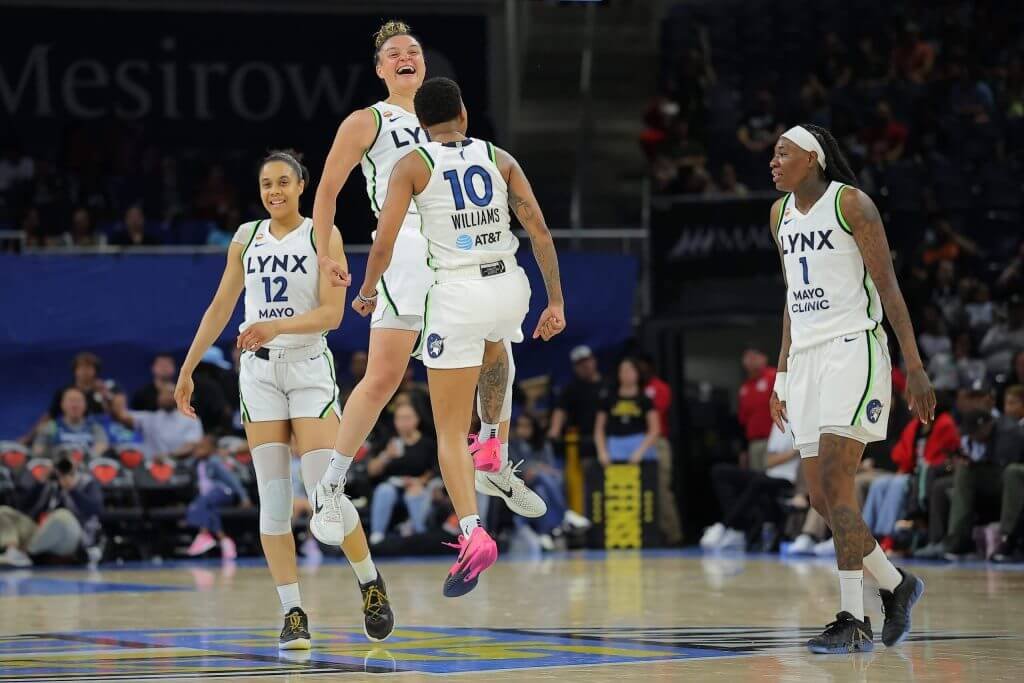
It remains mind-boggling that a team missing Napheesa Collier (and Carleton, and Jess Shepard, and Alanna Smith, and Natisha Hiedeman …) is sitting atop the WNBA standings. For all of the deserved love coming Olivia Miles and Natasha Howard’s way for their pick-and-roll partnership, the Lynx offense ranks eighth in the WNBA — exactly in the middle. Their league-leading defense (96.8 points allowed per 100 possessions) is the separating factor.
Advertisement
Coach Cheryl Reeve has been cooking up elite defenses for more than a decade, and this season’s squad already has its principles intact, despite an offensive surge around the league. What’s interesting about Minnesota’s defense is it isn’t fueled by turnovers or a low foul rate — the Lynx just force a lot of misses. Opponents are shooting 38.4 percent from the field and 27 percent on 3s. Minnesota is long and quick and rotates on a string, just as it did last season with drastically different personnel.
One player who seems destined to have played for the Lynx and Reeve is Nia Coffey, and not just because she was born and raised in Minneapolis. She seemingly apparates in the half court. With Coffey as the primary defender, opponents have made 8 of 47 field goals this season, which reads like a typo. She’s rarely out of position and usually gets a good contest on jumpers, even if she has to close out from the paint. There might not be a better shot-blocker on jumpers than Coffey.
Coffey starts at the four position but still picks up guards and centers. The only way to really beat her is if a big seals her in transition and scores over the top. It’ll be interesting to see how Coffey gets used when Collier returns since they play the same position, but Coffey has to be part of the rotation.
Dallas Wings
Alyssa Thomas is the premier point forward in the WNBA, but Shepard might be the heir apparent. The Wings are undefeated when Shepard posts at least five assists. For all the questions about how Dallas’ perimeter group would share the ball, it turns out running the offense through Shepard is the key to unlocking this roster’s potential. Shepard showed this level of playmaking as a rookie before tearing her ACL six games into the season. Now, she’s being allowed to run the show again to great effect.
Advertisement
Paige Bueckers and Azzi Fudd have many elite skills, but chief among them is their ability to move off the ball. Shepard takes care of the ball so well that it maximizes the team’s efficiency for her to set up the former UConn duo as well as her fellow Notre Dame alum Arike Ogunbowale. Shepard is also an excellent rebounder, and the grab-and-go element has given the Wings’ offense more flow.
Inverting the offense presents challenges for the opposing defense. They don’t want to put their five on the perimeter on Shepard because those players aren’t always accustomed to fighting through screens, and it eliminates the last line of rim protection. Las Vegas was unwilling to make A’ja Wilson Shepard’s primary defender in its loss to Dallas. But the result is a series of backdoor dimes and Shepard powering her way to the hoop against an undersized matchup when every other defender stays home.
One team trending down
Indiana Fever
Teams are officially duck hunting when they play the Indiana Fever. They’re seeking out Caitlin Clark, getting her involved in the action and isolating against her as much as possible. Veronica Burton and Kaitlyn Chen did it, and Carla Leite picked up the mantle the next time out. The Fever aren’t sending help when Clark gets attacked on drives because their defense’s goal is to prevent 3s (and they give up the fewest attempts in the WNBA). But that means Clark is on an island in the paint, and that can sometimes result in a layup line.
Advertisement
Clark hasn’t been as good in individual defense as she was the last two seasons. Per Synergy, her points allowed per possession has increased from 0.826 and 0.820 in 2024 and 2025, respectively, to 1.000 ppp this year. If opponents are challenging her because of her physical fitness, or the greater ease in earning foul calls in 2026, it’s working. The extra consequence is that it’s wearing Clark out for offense. Against Golden State and Portland, Clark shot 4 of 19 from the field and 2 of 8 on 3-pointers.
It’s a time-honored tradition for elite offensive guards to get hunted on defense; Kelsey Plum and Sabrina Ionescu have often been the recipients of such treatment, even deep into the playoffs. Sue Bird said on an NBC broadcast this week that the key is to get better by learning other players’ tendencies; Clark will never be an elite defender, but she has to use her IQ to become passable.
Rookie of the week
Chance Gray, Los Angeles Sparks
(Reminder: This isn’t the best rookie of the week, rather a player who caught my eye)
Advertisement
Los Angeles needed an infusion of perimeter ballhandling and creation this week after Kelsey Plum’s injury. Despite playing mostly on the wing as an Ohio State senior, Chance Gray has stepped into that opportunity. Gray knows her role in the Sparks’ offense is to get 3s up — she didn’t even attempt a shot inside the arc during the four-game road trip — but now that the 3s are going in, Gray is earning more minutes. In addition to making four triples in a split against Washington and Connecticut, Gray also helped bring the ball up to defray the responsibility from Erica Wheeler and Ariel Atkins during Plum’s absence. The clearest example of what L.A. hopes Gray can do is when she initiated a possession against the Sun, ran a two-player hand-off action with Cameron Brink and sank a 3-pointer when the defense got out of position.
Perhaps most importantly for the Sparks, Gray rates out as average defensively, per Synergy Sports, surrendering 19 points in her 21 possessions as the primary defender. Average is a win for this L.A. team — which entered Sunday’s games about five points per 100 worse than any other defense in the league — especially from a rookie.
Game to circle
Atlanta Dream at Indiana Fever
7 p.m. ET Thursday, Prime Video
It’s the first time these teams have met since their first-round playoff series in the 2025 postseason, which ended in an Indiana upset win despite the Fever’s rash of injuries. Anytime Rhyne Howard and Caitlin Clark match up, it’s good theater. Oh, and Angel Reese is also playing against Clark, though that particular pairing has lost a little juice. This also figures to be an important game for Commissioner’s Cup purposes between the defending Cup champions and the team currently possessing the best record in the Eastern Conference. Atlanta is playing much better than Indiana at the moment — just look at their respective performances against Portland last week — but it’s always challenging to go into Gainbridge Fieldhouse and pick up a win.
Advertisement
This article originally appeared in The Athletic.
Minnesota Lynx, New York Liberty, Seattle Storm, Los Angeles Sparks, Washington Mystics, Atlanta Dream, Chicago Sky, Connecticut Sun, Indiana Fever, Dallas Wings, Las Vegas Aces, Phoenix Mercury, Golden State Valkyries, Portland Fire, Toronto Tempo, WNBA
2026 The Athletic Media Company

