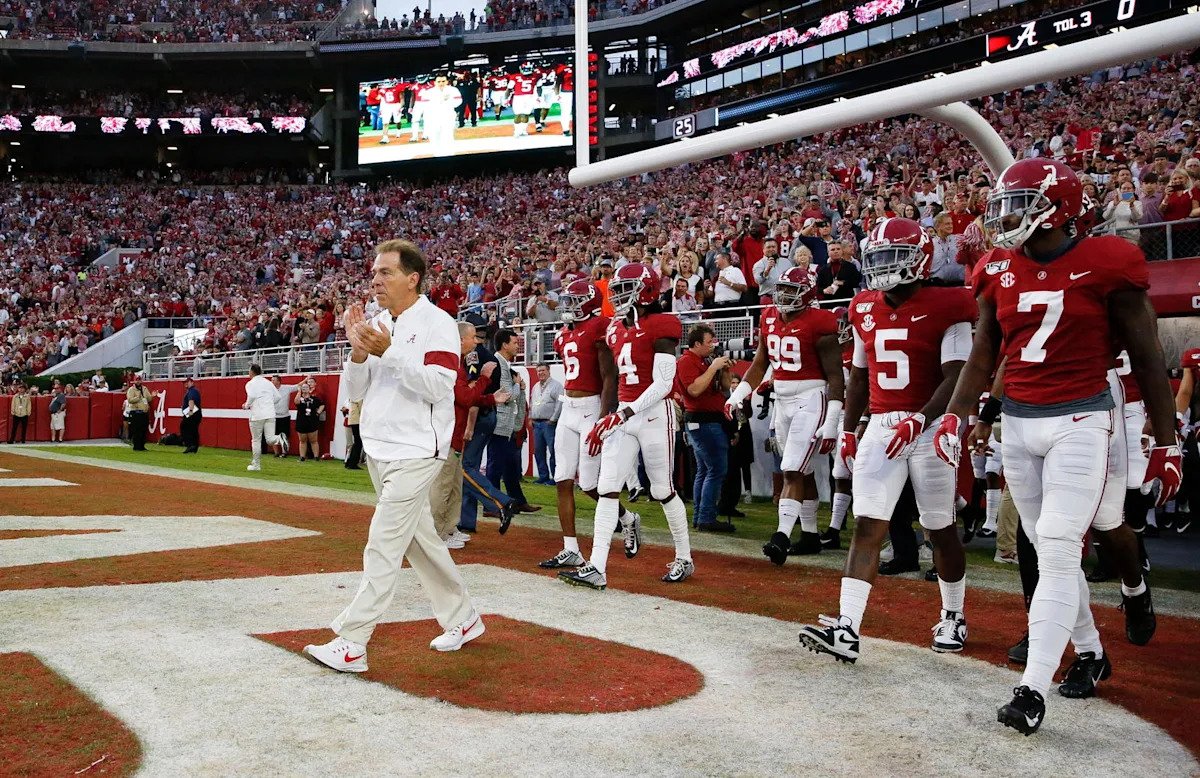
There was something deeply moving about reading Nick Saban’s character letter on behalf of former Alabama cornerback Terrion Arnold.
Not because it was shocking.
Not because it changed anyone’s opinion about an ongoing legal case.
Advertisement
But because it reminded me of something Alabama fans have known for nearly two decades. That letter wasn’t an exception.
It was Nick Saban.
As Arnold faces serious criminal charges, Saban chose to tell the court about the young man he came to know over more than six years. He wrote about welcoming Arnold into his home, watching him around his family, and never having reason, based on his own experiences, to question Arnold’s character, integrity, or respect for others. Whether someone agrees with Saban’s decision to write the letter isn’t really the point. The courts will determine the legal case. Saban simply shared what he personally witnessed.
And if you’ve followed Alabama football under Nick Saban, those words probably didn’t surprise you at all.
Advertisement
Because beneath the fiery coach, the relentless perfectionist, and the greatest winner college football has ever seen was a man who never believed coaching was only about football: it was always about people.
For years, the rest of the country saw the intensity. They saw the sideline explosions after a missed assignment, even with Alabama leading comfortably. They saw the national championships, the first-round NFL Draft picks, the press conferences, and “The Process.” They saw a coach who refused to settle, who demanded excellence every single day, and who looked like he expected perfection from everyone around him.
That image became Nick Saban. But it was never the complete picture.
Ask the people who actually played for him, and you’ll hear a different story.
Advertisement
You’ll hear about the conversations behind closed doors. You’ll hear about the meals at the Sabans’ home. You’ll hear about Coach and Miss Terry opening their doors to players who were hundreds of miles away from their own families. You’ll hear about the phone calls years after a player had left Alabama. You’ll hear about a coach who never stopped being “Coach.”
That’s what makes Saban different.
The public saw one side of him. His players experienced all of him.
I think one of the biggest misconceptions people have had about Nick Saban throughout his career is that he coached the way he did because he loved winning more than anything else.
Advertisement
Of course he wanted to win. Nobody reaches the level he did without an incredible competitive drive.
But I don’t believe winning was ever his greatest motivation. I believe helping young men become the best version of themselves was.
Winning was the byproduct. Football was the classroom. Life was always the lesson.
That perspective changes the way you look at everything Saban built in Tuscaloosa.
When an 18-year-old freshman walked into the football complex for the first time, Saban wasn’t simply evaluating arm strength, speed, or athletic ability. He was evaluating habits. He wanted to know how that young man responded to adversity. How he handled criticism. Whether he told the truth when he made a mistake. Whether he respected his teammates. Whether he showed up on time. Whether he took responsibility instead of making excuses.
Advertisement
Those aren’t football traits. Those are life traits.
Saban understood something that many people overlook. Football eventually ends for everyone. It doesn’t matter if you’re a walk-on who never sees the field or a first-round NFL Draft pick who plays for fifteen years. Eventually, the shoulder pads come off for the last time.
What remains is the person you’ve become.
That’s why “The Process” was never really about football.
People love to describe The Process as some magical formula for winning championships. In reality, it was far simpler, and far more meaningful.
The Process taught players to focus on what they could control.
Advertisement
Your effort. Your preparation. Your discipline. Your attitude. Your decisions.
One play at a time. One meeting at a time. One practice at a time. One day at a time.
Those lessons don’t disappear after graduation. They become the foundation for careers, marriages, parenthood, leadership, and life.
That’s why so many former Alabama players have said they didn’t fully appreciate Saban until they left.
When they reached the NFL, many realized they had already experienced the highest level of accountability imaginable. The demands didn’t surprise them because Alabama had already prepared them. More importantly, life didn’t surprise them as much either.
Advertisement
They had already learned that showing up matters. Doing the right thing matters. Keeping your word matters. Being accountable matters. Those lessons weren’t always comfortable. In fact, they rarely were.
Nick Saban never confused love with comfort.
That’s something our culture sometimes struggles to understand. Real love isn’t lowering expectations. Real love doesn’t ignore mistakes because confrontation is uncomfortable. Real love tells the truth. Real love corrects. Real love challenges people to become more than they believe they can be. That’s exactly how Saban coached.
He demanded excellence because he believed his players were capable of excellence.
Advertisement
He corrected mistakes because he believed they could do better. He refused to accept mediocrity because he refused to believe mediocrity was all they had to offer.
That isn’t cruelty. That’s belief.
Every parent who truly loves their child understands that principle. Every great teacher understands it. Every great mentor understands it.
The easiest thing in the world is to lower the standard. The hardest thing is to lovingly hold someone accountable while helping them reach it.
Nick Saban chose the harder path every single day.
That’s why his players respected him.
Respect isn’t built by making life easy. It’s built by consistency. By honesty. By fairness. By showing people that the standard applies equally to everyone.
Advertisement
It didn’t matter if you were a five-star recruit or a walk-on. It didn’t matter if you were projected to be a first-round draft pick or fighting just to make the travel roster. Everybody was expected to do things the right way. Everybody was expected to earn it. Nobody was bigger than the team. That culture didn’t happen by accident. It was built over years of consistency.
Of course, Nick Saban never built that culture alone. Anyone who has followed Alabama football knows how important Miss Terry has been to the program.
Former players have spoken countless times about what she meant to them. For many, she made Tuscaloosa feel like home. The Sabans welcomed players into their home for meals, holidays, and moments that had nothing to do with football. Those acts rarely made headlines because they weren’t meant to. They weren’t done for publicity. They were simply part of who the Sabans were.
Think about how many young men arrived at Alabama from across the country.
Advertisement
Some came from stable homes. Others came from incredibly difficult circumstances. Some had never been away from their families. Some carried burdens that fans will never know about. To those young men, having adults who genuinely cared about them beyond what they could contribute on Saturdays mattered.
It still matters.
That’s one reason so many former players continue returning to Tuscaloosa years after their eligibility ends.
Nobody requires them to come back. Nobody makes them stop by the football facility. Nobody tells them to bring their wives, children, or parents to visit Coach and Miss Terry. They come because they want to. They come because Alabama became more than the place where they played football. It became family.
Advertisement
Relationships like that cannot be manufactured. They cannot be recruited. They certainly cannot be sustained for nearly two decades if they aren’t genuine. They’re earned.
One conversation at a time. One difficult lesson at a time. One act of kindness at a time. One relationship at a time.
That’s why Saban’s letter for Terrion Arnold resonated with so many people.
Whether readers ultimately agree with his decision to write it or not, the letter reflected the same values Saban has demonstrated throughout his career: loyalty, compassion, accountability, and a willingness to stand by the young men he has mentored while still respecting the legal process.
Advertisement
He didn’t declare the outcome of the case. He shared his own experience. That’s what mentors do. They speak truthfully about what they’ve seen.
Sometimes those stories end in championships. Sometimes they end in heartbreak. When you spend decades investing in hundreds of young men, you eventually experience both. That’s part of loving people.
You celebrate when they succeed. You hurt when they struggle. You remain hopeful when life takes unexpected turns. I think that’s why Nick Saban’s influence extends far beyond wins and losses.
Yes, he built one of the greatest dynasties in the history of sports.
Advertisement
Yes, he won more championships than almost anyone thought possible.
Yes, he developed an incredible number of NFL players.
Those accomplishments deserve every bit of recognition they’ve received.
But championships alone don’t explain why former players still call him years after they’ve left campus. They don’t explain why so many former players return to Tuscaloosa whenever they can. They don’t explain why countless players continue referring to him simply as “Coach,” even after becoming stars in their own right.
That kind of relationship is built on something deeper than football. It’s built on trust. It’s built on investment. It’s built on love expressed through accountability.
Advertisement
That’s the Nick Saban many fans never fully saw.
They saw the intensity. His players experienced the compassion behind it. They saw the demanding coach. His players experienced the mentor who believed they could become more than they imagined. They saw the greatest football coach of his generation. His players experienced someone who wanted them to become great husbands, fathers, leaders, teammates, and men.
To me, that’s the true measure of Nick Saban’s legacy.
Someday, another coach may win more games. Someone else may raise more championship trophies. Records have a way of falling, and banners can eventually be matched. But there will never be a statistic that measures what Nick Saban accomplished in the lives of the young men he coached.
Advertisement
There will never be a box score that captures every difficult conversation he had with a struggling player. There will never be a trophy for every life changed because one coach refused to let a young man settle for less than his potential. There will never be a championship ring that represents the fathers, husbands, coaches, business leaders, pastors, mentors, and servants who still carry lessons they first learned inside Alabama’s football program.
Those victories don’t show up in media guides. They don’t appear in record books. They aren’t celebrated with confetti or championship parades.
But they may be the most important victories of all.
When people talk about Nick Saban fifty years from now, they’ll remember the championships. They’ll remember the dynasty. They’ll remember the unforgettable Saturdays inside Bryant-Denny Stadium. They’ll remember the greatest coach college football has ever seen.
Advertisement
But I hope they remember something even greater.
I hope they remember a man who understood that football was never the destination. It was the vehicle. A vehicle to teach discipline. To teach responsibility. To teach accountability. To teach resilience. To teach servant leadership. To teach sacrifice. To teach that true success isn’t measured by what you accomplish, but by who you become. And maybe most of all, it was a vehicle to teach young men that someone believed in them enough to demand their very best.
That’s what real coaching looks like. That’s what real leadership looks like.
And maybe that’s why Nick Saban’s greatest legacy will never be measured by the number of trophies sitting inside a display case.
Advertisement
His greatest legacy isn’t etched into championship trophies or preserved inside record books.
It walks among us every single day.
It wears wedding rings.
It rocks babies to sleep.
It tucks children into bed at night.
It coaches Little League teams.
It leads locker rooms, boardrooms, churches, classrooms, businesses, and communities.
It serves others long after the final whistle has blown.
It lives in fathers who learned accountability.
In husbands who learned sacrifice.
In leaders who discovered that discipline isn’t punishment, it’s preparation.
In men who learned that character matters more than talent, integrity outlasts ability, and excellence is a daily choice.
Advertisement
Long after the roar of Bryant-Denny Stadium fades into history… long after the confetti has been swept away… long after the championship trophies have collected dust… that legacy will still be alive.
Because championships built Nick Saban’s résumé.
But changing lives built his legacy.
And I believe, with all my heart, that was the victory that will always matter most to him.

