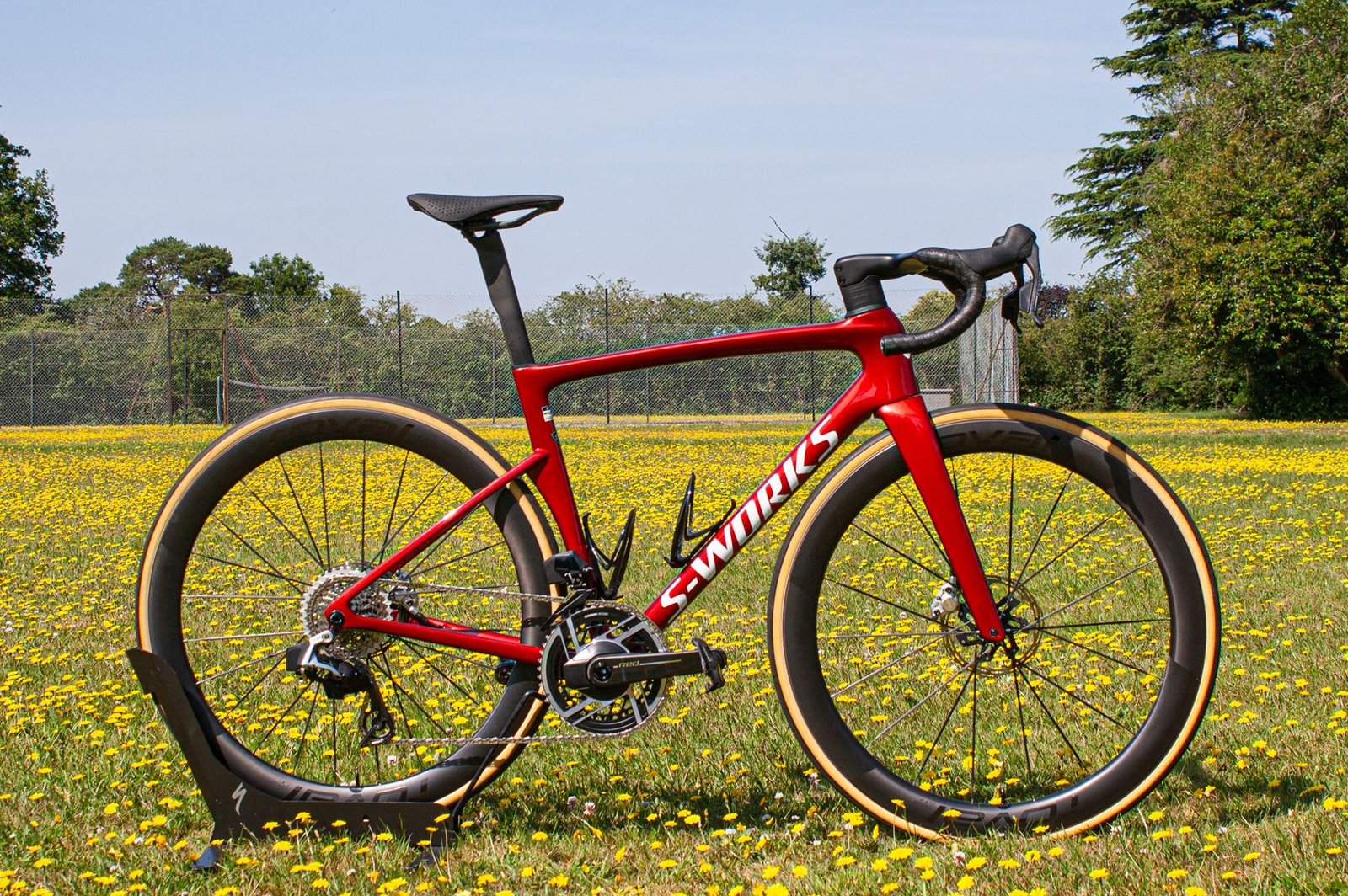
After months of speculation, Specialized has officially dropped the covers off its flagship do-it-all S-Works Tarmac SL9 road bike, just in time for the Tour de France.
The redesign hasn’t been the brand’s best-kept secret, with leaked images surfacing online and a blacked-out version spotted in the wild at the Tour Auvergne-Rhône-Alpes.
Specialized is touting the new S-Works Tarmac SL9 as “the fastest road bike ever made”. A bold claim indeed, especially given the frame looks – to the eye – almost identical to its predecessor.

However, the brand says it’s the result of an entirely new approach to optimisation. Rather than basing the claim on isolated wind tunnel data, it instead used a physics-based simulation output that predicts racing time over specific real-world courses, using a collection of measured inputs from aerodynamics and rider power to environmental conditions and more.
Specialized is calling this its ‘Time to Finish’ metric, and it’s the first time we’ve seen a bike brand take the concept of computational race simulation – used by WorldTour teams to optimise set-ups and tactics – and use it to inform engineering.
In this instance, the brand has benchmarked the SL9 over various races, from Monuments to Grand Tour stages. In one of its simulations, Specialized claims Demi Vollering would have crossed the line some 14 seconds faster than she did on her SL8 at the 2024 Tour de France Femmes stage up Alpe d’Huez, and ultimately won the General Classification by 10 seconds.

The ‘Speed Sniffer’ headtube is now narrower thanks to the rerouting of the rear brake cable along the right side of the steerer
(Image credit: Aaron Borrill)
In testing, the US brand used a mannequin with moving legs (dubbed the Moving Leg Mannequin) to analyse how a rider in motion affects airflow across the bike, a step up from frame-only or half-mannequin tests carried out elsewhere. While the result looks largely the same as before – a subtle overhaul, if you will – every tube shape has reportedly been redesigned at the brand’s Morgan Hill Innovation Center.
The re-sculpting created a bike that’s claimed to be four watts faster – using Specialized’s ‘Moving Leg Mannequin’ at 45km/h – than the previous model, and lighter; the claimed frame weight for the S-Works SL9 is just 687 grams, with complete builds of 6.2-6.5kg possible depending on wheels and cockpits (there’s a choice of Rapide and Aplinist).
As before, every size from 44-61cm gets a size-specific layup to ensure stiffness, compliance, and handling are consistent across the range.
Let’s get into the details.

Like before, the Tarmac can fit tyres up to 32mm
(Image credit: Aaron Borrill)
The more things change, the more they stay the same
While the S-Works Tarmac SL9 looks a lot like the SL8, there are a few ways to tell them apart.
For starters, the ‘Speed Sniffer’ headtube, introduced with the SL8, is now narrower thanks to the rerouting of the rear brake cable along the right side of the steerer. While the new S-Works Tarmac SL9 utilises the same headset bearings and hardware as the outgoing SL8, the slimmer headtube means the design team had to get creative with the internal plumbing of the brake hoses. To get around this, the steerer tube is slightly offset to the left so that the hoses can pass through the right side without added friction and interference to the steering.
Specialized says the slimmer, hourglass shape makes for a 10 per cent reduction in the SL9’s frontal area. There’s also a steerer stop to prevent the rear crown from making contact with the downtube.
The fork appears much deeper than before, with the legs now ‘twisted’ outwards to better guide airflow along the frame and reduce drag across the front of the bike. Both the head tube and fork are designed to work with a dropped downtube, featuring a reduced gap between the fork, head tube, and front tyre to reduce drag.

A slimmer, hourglass-shaped headtube makes for a 10 per cent reduction in the SL9’s frontal area
(Image credit: Aaron Borrill)
There’s also a redesigned seatpost that resulted from additional Moving Leg Mannequin analysis. During these tests, it was shown that as a rider pedals, their legs accelerate airflow into the space between their thighs and the frame, which then strikes the seatpost. To improve airflow in this zone, Specialized has created a deeper yet thinner post.
Dubbed the ‘Win Fin’, the seat tube and rear triangle junction has been reimagined and inspired by breakaway riders who ditch their second bottle for improved aerodynamics. Specialized adjusted the design through this real-world configuration, and says it saves 0.5 watts.
Specialized says the redesigned, optimised tube shapes eliminate unnecessary carbon layers, which explains the drop in the frame’s weight. As for the Fact 12r layup, each ply is reportedly designed to help the SL9 respond positively under load, thereby allowing fine-tuning across the bike, balancing stiffness and compliance to match those of the SL8.
What about the geometry?

(Image credit: Specialized)
As before, seven frame sizes are available, with the geometry numbers nearly identical to those of the outgoing model across the sizing chart. The only exception the 54cm, where an increased fork offset (44 to 47mm) and a 0.5-degree reduction in the head tube angle (73 degrees to 72.5 degrees) were implemented to increase toe clearance with the front wheel.
Other than that, the trail and chainstay numbers remain the same, but there are subtle differences in reach and stack, headtube length, and wheelbase measurements.

Dubbed the ‘Win Fin’, the seat tube and rear triangle junction has been reimagined and inspired by breakaway riders who ditch their second bottle for improved aerodynamics
(Image credit: Aaron Borrill)
Specialized S-Works Tarmac SL9 – first ride impressions
Having spent six months on a long-term Specialized S-Works Tarmac SL8, I was pretty excited to get my leg over the new model and test the new claims for myself. I was invited to Specialized UK’s headquarters in Dorking to sample the bike on UK roads, but more importantly, roads I use to test most of the bikes I review for Cycling Weekly.
With frame angles pretty much unchanged over the previous model, the new S-Works Tarmac SL9, unsurprisingly, feels a lot like the model it replaces – it’s very direct and responsive to pedal inputs and possesses the same well-balanced handling characteristics and precise steering as before. It’s this sense of familiarity that will help current owners quickly adjust to the new platform and transfer their bike-fit measurements without fuss.
While Specialized was quick to dazzle me with all the improvements and marketing glitter regarding ride quality, and with claims that it’s a faster bike than before at speeds upwards of 45km/h, I approached this bike with no expectations and assessed it as objectively as possible. Having spent a lot of time on its chief adversary, the Cannondale SuperSix Evo, I was eager to see how the S-Works Tarmac SL9 stacked up on the same roads.
Ride quality is always a personal thing and can vary with rider weight and tyre pressure, but the S-Works Tarmac SL9 remains buttery smooth without sacrificing detail or feel. My test bike came fitted with 30mm Specialized Cotton TLR tyres set up tubeless, which delivered a superbly cosseting ride quality and grip levels. Like before, the Tarmac can fit tyres up to 32mm with 4mm of clearance, but that’s based on rim width and pressures.

The taller final drive ratio means you shouldn’t spin out like a rabid hamster on the descents either
(Image credit: Specialized)
With a full SRAM Red AXS groupset and 50/37T, 10-33T drivetrain assembly, my test bike tipped the scales at 6.89kg without pedals. That’s more than light enough for the average rider and ideal for the lumpy terrain that snakes around the Surrey Hills.
Climbing is unsurprisingly easygoing, and despite the larger-than-usual gearing (most SRAM Red and Force AXS-specced bikes come with 48/35T, 10-33T gearing), I didn’t feel the need to use the small ring on any of the climbs – this included Combe Lane (7.1% average grdient), Box Hill (5% average gradient) and Newlands Corner (4.5% average gradient). Having a taller final drive ratio means you shouldn’t spin out like a rabid hamster on the descents either.
In terms of outright speed, the S-Works Tarmac SL9 sure feels quick. While it’s impossible to quantify whether it is, in fact, four watts faster than its predecessor, it certainly holds momentum incredibly well, and the 50-10T means you can carry more speed over rolling terrain. Once it reaches speeds of 40km/h and above, like many of its rivals, it doesn’t require much effort to keep it moving, and the sensation of speed and the sound from the tyres provoke you to ride it harder and faster.
At speeds typical of the average rider, however, and we’re talking 25-30km/h here, it doesn’t feel any different to the SL8 and perhaps most riders would be better off not upgrading to an S-Works Tarmac SL9 and rather waiting for the ‘more affordable’ sub-S-Works level grades to launch. After all, Specialized is pitching this bike at the WorldTour rider, where average race speeds are as high as 46km/h, and that four-watt improvement actually matters.
Either way, Specialized has refined the recipe rather than tampered with it, and created one of the most complete bikes in the pro peloton. It’s super smooth, rich in communication and feedback, and descends as well as it climbs. Is it the best all-round bike on the market? Well, that’s tough to call after just 70km on the bike, but it sure has all the markings of a segment leader.
Bring on the group test!

The new Specialized S-Works Tarmac SL9 utilises a 50/37T, 10-33T drivertrain
(Image credit: Aaron Borrill)
Build and pricing
As expected, the Specialized S-Works Tarmac SL9 is available in two high-end build options: SRAM Red AXS and Shimano Dura-Ace Di2, which differ slightly in pricing.
SRAM Red AXS-equipped bikes come in at £11,999 / $14,000 / €13,999 and feature 50/37T, 10-33T chainsets complete with a power meter. Most of the components come from Specialized’s in-house component arm, Roval, and gain Rapide CLX III wheels, a Rapide cockpit, Ceramic Speed bearings, and an S-Works Power with Mirror saddle.
Shimano Dura-Ace Di2 builds utilise the same finishing kit, wheels, cockpit, and saddle, and cost the same as the SRAM Red AXS version in the United Kingdom and Europe (£11,999 / €13,999), but $500 less for the American market – a small saving that is quite significant at this level.
If you want to merely swap over the components on your current bike, Specialized offers a frameset-only option at £5,249 / $5,800.
While there’s no news on the balance of the Tarmac SL9 range, like the new Crux lineup, we expect Specialized to roll out its new S-Level and Expert models in the coming months.

