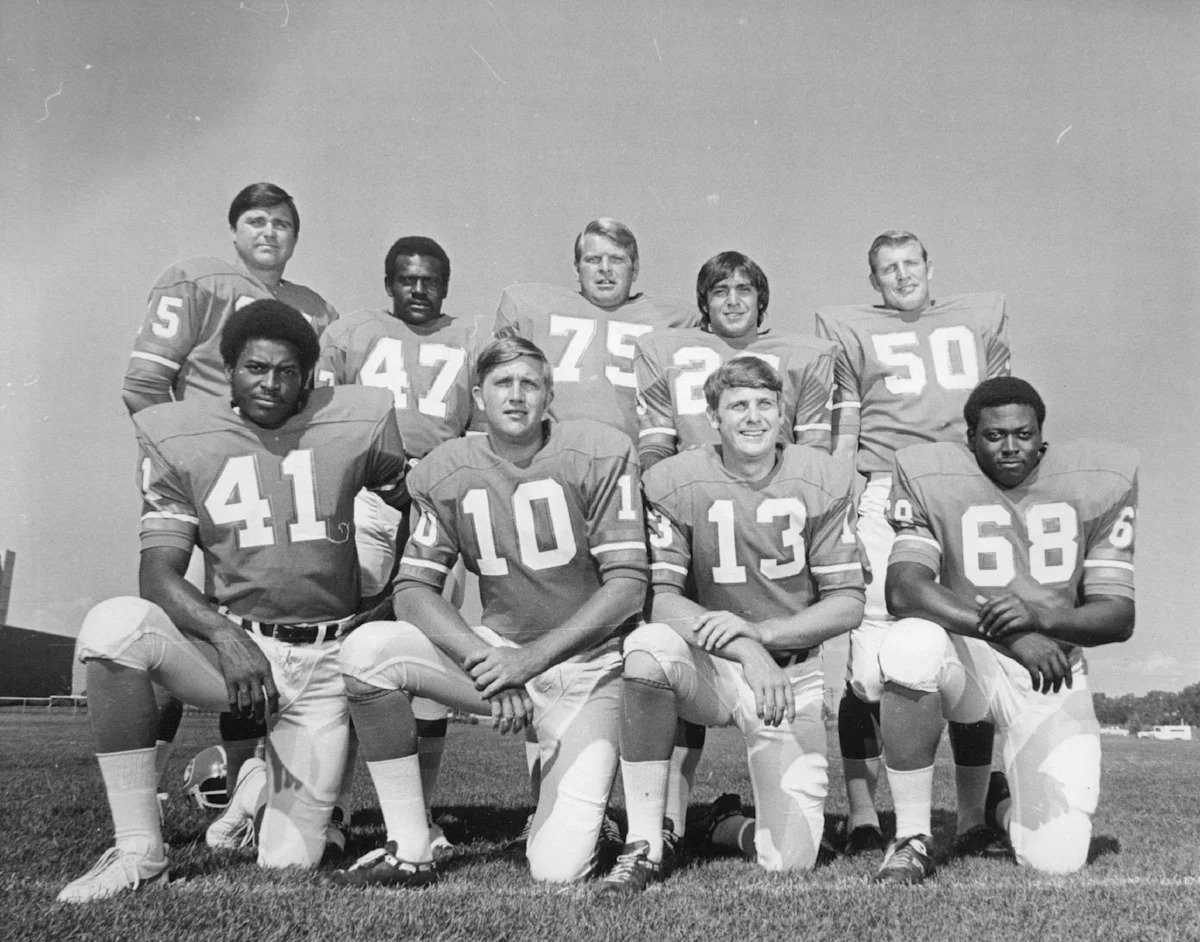
The Cleveland Browns are a tale of two halves. From 1946 to 1995, the franchise captured eight pro football titles, tied with the New York Football Giants for the third most behind the Green Bay Packers (13) and Chicago Bears (9).
The Browns hold the record for most consecutive appearances in the league championship game with 10 straight, winning seven titles.
Advertisement
RELATED: WR GARY COLLINS INTERVIEW
Cleveland merged into the NFL for the 1950 season. The NFL commissioner, Bert Bell, had stated that the NFL’s worst team could defeat its league’s champion any day of the week. “Their league” was the rival entity, the All-America Football Conference. In their first NFL game, the Browns destroyed the reigning NFL champions, the Philadelphia Eagles. At season’s end, Cleveland defeated the Los Angeles Rams for their first NFL title.
The first half of the Browns history was also one of the best teams in the league in the 1980s, going to three AFC Championship Games, losing them all. Under Marty Schottenheimer, Cleveland went to the playoffs all four years he was installed as head coach.
Bill Belichick got the Browns back to the playoffs in 1994 with an 11-5-0 record. The “Pro Football Issue” of Sports Illustrated predicted that the Browns and the Dallas Cowboys would play in the following Super Bowl. Instead, Cleveland announced plans to relocate to Baltimore.
So, for the second half, after the new Browns came on scene in 1999, there is an endless line of starting quarterbacks, head coaches, GMs, losing seasons, and only a few playoff appearances.
Advertisement
The last championship for the Browns was in 1964. Roger Shoals was a second-year offensive tackle on that roster.
Blanton Collier had been Paul Brown’s offensive mind since the team began in 1946. Collier left Cleveland from 1954 to 1961 to become the head coach at the University of Kentucky, then returned to the Browns for the 1962 season. Cleveland finished 7-6-1, their fourth straight year to miss the playoffs. Browns owner Art Modell then fired Brown from his head coaching position, and moved him to the team’s Vice President. Next, he moved Collier to head coach.
Shoals (6’-4”, 260 pounds) played college sports at the University of Maryland after a short stint in the Army. In football, he was a two-time All-Atlantic Coast Conference selection, plus he was also a two-time ACC heavyweight wrestling champion.
He grew up in Norwalk, Connecticut, and attended Norwalk High School, where he played football and intramural volleyball. As was the custom in those days, Shoals was a two-way lineman for the Green and White who was named First Team All-State and was voted a high school All-American in his senior year.

After a standout collegiate career at Maryland, he was drafted by the Dallas Texans of the American Football League and the Browns of the NFL. Shoals spent his first two seasons in Cleveland, then was traded to the Detroit Lions for six years, and finally was traded to the Denver Broncos for a single season. In his nine-year career, Shoals played in 104 NFL games with 71 starts at both left and right offensive tackle.
Advertisement
In Shoals’ rookie season, the first under new head coach Collier, Cleveland posted a 10-4-0 record, one game from winning the Eastern Conference title. In those days, the two divisions were called “conferences.” The winner of each conference played in the NFL Championship Game for the league title. The two second-place clubs played in “the Playoff Bowl” for third place, which was an extra game payday.
For 1964, Cleveland captured the Eastern Conference crown with a 10-3-1 record, one game better than the St. Louis Cardinals’ 9-3-2. Meanwhile, the Baltimore Colts dominated the league as they cruised to a 12-2-0 season. After an opening day loss, the Colts destroyed the remainder of their schedule. They led the NFL in scoring and, on defense, in fewest points allowed. Their roster was comprised of seven future Hall of Famers plus their Hall of Fame head coach, Don Shula.
On offense: QB Johnny Unitas, RB Lenny Moore, FB Tom Matte, WRs Alex Hawkins and Raymond Berry, TE John Mackey, OGs Aelx Sandusky and Jim Parker, plus OT Bob Vogel. On defense: DT Billy Ray Smith, DEs Gino Marchetti and Lou Michaels, LB Steve Stonebreaker, S Jim Welch, and CB Bobby Boyd.
Cleveland was pitted against the offensive juggernaut of the Colts, who were 17-point favorites in the title match. The wind chill that day was 34 degrees at kickoff, with 15 MPH winds. After a 0-0 halftime score, the Browns won the 1964 NFL Championship Game 27-0 at home in front of 79,554 patrons. Cleveland Municipal Stadium only held 78,000 seats.
Editor’s note: Shoals is #73, and shown running the 40 at the :45 mark in the movie, “Paper Lion.” He weighs in at the 3:23 mark. He lines up at left tackle in all scrimmage scenes.
Advertisement
Shoals developed serious knee, shoulder, back, and ankle injuries. After retiring from football, Roger worked 30 years at Gould Paper, where he became vice president of sales and, at the same time, invested as a part-owner of Kutztown Auto Company, a Cadillac and Buick dealership. He played himself in the 1968 movie Paper Lion about writer George Plimpton trying out for a roster spot with Detroit.

He and his wife, Jean, married in 1954 and live in Gladwyne, PA. The couple had two children, Mike and Hollie.
He was part of the financial settlement in 2013 between the NFL and its players. When the NFL started investigating CTE and the long-term effects it had on players, Shoals’ brain was to be examined for chronic traumatic encephalopathy at the Boston University CTE Center.
Advertisement
As a player, Shoals was known as a tough player who had a nasty streak. He was consistent and could run, block, and tackle with a hard work ethic. Off the field, he had a generous spirit.
Dawgs by Nature staff writer Barry Shuck interviewed Shoals in the spring of 2025. The transcription of the interview has been sitting in a digital recorder ever since. Until now. Sadly, Shoals passed away on June 30, 2025, of complications from pneumonia, at the age of 86. This is his last interview.
Shuck: After going to Norwalk High School in Connecticut, you went to Greenbrier Military School before you ended up at the University of Maryland. Why that decision?
Shoals: Academics. I didn’t have the grades. It wasn’t mine or my father’s decision; it was really Maryland’s decision. I finished up and got good grades. Then Maryland would accept me for my college years.
Advertisement
Shuck: At Maryland, you were the ACC heavyweight wrestling champion in 1960 and 1961. What is odd is that you didn’t wrestle in high school. What did that sport teach you about playing the offensive line?
Shoals: My soon-to-be wife, Jean, worked on campus for the guy who maintained all the buildings. I had to hang around every day during the spring for her to get out of work. So instead of standing around, I went out for wrestling. It helped me tremendously because there are moves in there, and wrestling is the same moves that are in our offensive line, like hand play and footwork.
Shuck: You were drafted by both the Browns of the NFL and the Dallas Texans of the American Football League (AFL). What kind of contract did both teams offer?
Shoals: The Texans didn’t pursue me at all, whereas the Browns came right up forward and told me that they wanted me to play and so forth. The Texans knew that I was in negotiations with the Browns, and they asked if I was satisfied with their offer, and I told them I was. So, they didn’t want to start a bidding war. I ended up getting a $15,000 contract and a $5,000 bonus from head coach Blanton Collier. Paul Brown had left the Browns the season before, so this was the first year he was gone.
Advertisement
Shuck: What was your first Browns training camp like?
Shoals: It was pretty tough. Nothing like college. And that’s when I was very young to be in a professional training camp, like 20 years old. I had been named an All-American at Maryland, but these guys were on another level. But you learn, and you play, and you eventually catch on. Back then, most rookies didn’t play except on special teams, so you had to be a team for a year or so before they would send you out.
Shuck: 1963 was the first season that Blanton Collier became the head coach. How was he concerning running an offense?
Shoals: He was a tactician. And a really good coach and a fine man. We had a good season that year, and it was a veteran group. Some of the veterans talked about Paul Brown some, but that went away quickly. Blanton was a teacher. He knew what it took to run an effective offense. He was also hard of hearing. A lot of people didn’t know he couldn’t hear very well, especially in a room full of people. He had wonderful teaching skills. And he knew how to get as much as he could out of a player.
Shuck: You were aware of Jim Brown all your life, and now you were blocking for him. Was he tough on his offensive linemen?
Shoals: What do you mean, tough? He would set you up by running behind you, then allowing the lane to open by how I would move my man. I could block my man the way it was drawn up, but if my defender made it difficult for me to move him out of a lane, Jim would adjust and find the hole that did open up instead. He’s a great running back along with Ernie Green and Charley Scales. Jim never said a word in the huddle. He didn’t chew you out if you missed a block.
Advertisement
Shuck: What was the biggest difference between blocking in college and blocking in the NFL?
Shoals: Oh my God. Totally different. With the Browns, you use your hands and arms to block. You don’t do that in college. You use your body more, and you use your shoulder. The name of the game in the offensive line is pass blocking. If you can pass block, you can play the game. Pass blocking is nothing but pretty straight retreat, retreat, retreat.
Shuck: The unwritten rule in pro sports during those days was that rookies hardly played. In your rookie year, you played in just two games. Tell me about being inserted.
Shoals: Oh, I was scared to death. My first game was against the (Baltimore) Colts, and I played against the great Gino Marchetti. Our quarterback, Frank Ryan, was sick, and now Nino is our quarterback, who was a good player on his own. What helped against a great pass rusher like Marchetti is a good running game. And we had one of the best in the league with Jim Brown, Ernie, and Charley. All those guys were pretty hot running. I just had to scoot Marchetti over a little bit to get one of those guys through.
Advertisement
Editor’s note: “Nino” referred to backup QB Jim Ninowski
Shuck: In 1963, Cleveland began 6-0-0 and won three of their last four games to finish 10-4-0, but missed the playoffs by one game. That one loss was to the 5-8-1 Detroit Lions, 38-10. How good was that Browns team that year, despite not going to the championship game?
Shoals: Gary Collins came into his own that year, who was their Number 1 draft pick the year before. The offense was better from the 1962 team and made fewer mistakes. It came down to the Giants and us in the final two games. We had split our games during the season, so it could have ended in a tie for the division. They won their final two, and we won one and lost badly to the Lions. We were a much better team than the Lions, but we played poorly. It was really cold and windy in Detroit, and we had five turnovers. What that year did was lay the groundwork for the league championship the following year.
Shuck: The Browns ended up in the “Playoff Bowl.” Wasn’t that a game for third place in the league? Was it hated by NFL players?
Shoals: Being a rookie, that first year I was on the taxi squad part of the year and on the roster for other games. At the time, I was the third tackle behind Dick Schafrath and John Brown. The players never liked this idea because it meant you could lose two games in a row. The coaches went along with it because they had to. And back then, no matter what type of game, you played all your starters and played to win. They didn’t sit players. It was an extra paycheck, but I was on the taxi squad at the time and didn’t make the trip.
Editor’s note: Shoals’ (#75) touchdown is the first play on this clip
Advertisement
Shuck: In Week 12 of the 1964 season, you recovered a fumble in the end zone against the Philadelphia Eagles for a touchdown. Tell me about that play. Oh, do you still have that ball?
Shoals: I was playing on special teams. It was my second year with the Browns and was a home game late in the season. It was the opening kickoff, and the return man got hit pretty hard on the 14-yard line. Players from both teams were scrambling to get the ball, and it goes into the end zone. And somebody hits it towards the back of the end zone, about to go out of bounds as I am entering the end zone. I stepped over one player and dove for the ball before it went out. Back then, you couldn’t keep the ball. That was the thing back then. A player would be fined for keeping a ball. But I scored a touchdown in the NFL. That is awkward as an offensive lineman.
Shuck: In the 1964 NFL Championship Game, the Baltimore Colts were 17-point favorites and had seven future Hall of Famers on their roster. It seemed that all the Browns had was Jimmy Brown. Leading up to the game, what was the atmosphere like the week of that game?
Shoals: The atmosphere during practice week was that Blanton Collier ran some very serious practices with no screwing around. Everyone was focused. You did your class work, you worked hard on the practice field and then we jumped on the Colts real good.
Advertisement
Shuck: That game was in Cleveland in December. The wind coming off Lake Erie must have been almost 20 MPH, while the temperature at game time was 34 degrees. The Browns won the toss. What did your team choose, and why did that make a difference?
Shoals: If you had a good offensive team, your team chooses to get the ball. You go right after the other team’s defense and try to put up the first points. It’s a statement. That did make a difference because no matter what, the Colts didn’t come out and dominate us like they did all of the other teams all year. I know today every team wants the second-half kickoff, but back then, you wanted to score first and let the other team know it’s going to be a long game for your defense. The wind wasn’t really a factor, although it was the typical winds coming off the lake.

Shuck: The Colts were a huge offensive team, scoring the most points in the league that year. QB Johnny Unitas was the NFL MVP. He led in nine passing categories. RB Lenny Moore led the league in rushing TDs and total TDs. Yet, the halftime score was 0-0. What was the key to that first half?
Shoals: For one, the crowd was overflowing. People were standing at the back of the end zone. Our defense that day did a really good job. The Colts couldn’t get their running game going all game. And players like Gino Marchetti weren’t getting into our offensive backfield.
Advertisement
Shuck: What do you remember most about that game in which the Browns scored 27 unanswered points to win 27-0?
Shoals: One of our linebackers, Vince Costello, played great. Bill Glass and Jim Kanicki had sacks, and Walter Beach and Costello intercepted Unitas as the Colts were about to score several times. The offense just got clicking with Jim Brown controlling the clock late in the game and getting our offense into position to score. I think Lou Groza kicked two or three field goals. Gary Collins had a career game with three touchdown catches. We came to play.

Shuck: How often do you wear your 1964 NFL Championship ring?
Shoals: I wear it continually. I didn’t get a school ring, so I wear this ring.
Advertisement
Shuck: Are you wearing it during this interview?
Shoals: Yeah, I got it on right now.
Shuck: Early on, the Browns went to the championship game 10 years in a row and won seven. 1964 was their last pro football title. You were part of that. That’s a long time since Cleveland won anything.
Shoals: I hate to say this. But Art Modell was not a good owner. He didn’t do things right, like contracts. You play hard for a team, and then all of a sudden, I was traded to the Lions. I couldn’t believe the difference in (Lions owner) Mr. Ford and Art Modell. What a difference. Ford ran a first-class ship. There were issues with Modell as far as travel and the entire operation. You would think that a player would be called down and told in person if he was being traded. I was out to dinner in Connecticut with my wife, and get a phone call, and I was told I was traded. It was during the offseason, but to learn that the playing career you worked so hard on, and that’s how I find out? Going to the Lions.
Advertisement
Shuck: Did you have an offseason job?
Shoals: Every player did. You had to. The money to play was better than most, but it didn’t keep you going for a full year. I worked in New York City in a sales position. And I worked in it till I just retired last year. I worked at Stein Hall during every offseason and on Mondays during the season. It’s a chemical adhesive company, et cetera, situation. I was lucky my father was part of that organization. In the offseason, players would look for work, and I went to work for them. You’re not dealing with these phone books that you deal with today, with being paid millions to play the same game. I did switch to a different company, but in the same arena. I retired from Gould Paper.

Shuck: You played your best football with Detroit, where you became a starter and played 74 games, but played in only one playoff game after going 10-4-0 in 1970. Playing there, did it feel like you finally found a home?
Shoals: I was behind some really good tackles with Cleveland. I was at the point where I needed to compete for a starting position and become the starter. I liked Detroit once I got there, although it was a shock to be sent away from the only team I had known and worked and won a championship with those teammates. I got to enjoy that for only a few months. You realize that loyalty isn’t enough. It’s a business decision. You never know when they’re going to trade somebody. But I was able to start at tackle and play a lot of football. I started right away for the Lions. You never feel at home when you’re in that game, and it’s going to beat your ass. But you work harder the next week and learn what other players’ tendencies are. It felt better starting each week than playing here and there.
Advertisement
Shuck: During the 1960s, was it really a huge war with the AFL against the NFL?
Shoals: It was newsworthy all the time. The AFL signed a lot of NFL players, and they signed a lot of top college players. And when they found out your contract was up, they offered more money than the NFL. I saw a lot of veterans leave and sign with AFL teams. One thing it did was raise everyone’s contracts. All you had to say was that one or two AFL teams had offers.

Shuck: The AFL-NFL merger came in 1970. Shortly afterwards, you were traded again, from Detroit to the Denver Broncos. Not many players get traded twice in their career.
Shoals: I didn’t like it because I was happy with the Lions and started a lot of games. But if you don’t like it, the other choice is to get out. The game was good to me. It’s just unfortunate for a man to get settled and then get shuffled around.
Advertisement
Shuck: Excluding money, how is the NFL different today than when you played?
Shoals: I don’t know if there are many differences except for money. These guys make the millions. I saw a player sign a two-year contract for $18 million. That’s $9 million for a season. In my time, that would have paid every player on a single team in the league, plus all of our coaches and our trainer. And he was a defensive player who will probably only play 62% of the defensive plays. $9 million for 62% on defense? The money is what’s different.

Shuck: What was the most you earned playing pro football?
Shoals: The most I ever made was $60 grand. Back then, the rookies made the least, and the longer you played, the more money you were paid. I can’t imagine what it’s like to get that salary. But imagine getting $60 million for a multi-year deal, and for Christ’s sake, you’re getting over $1 million a game. That means your children will never have to work, and your children’s children will never have to worry about money.
Advertisement
Shuck: What is your fondest moment of being a Cleveland Brown?
Shoals: No question about it, the day we won that World Championship.
Last Interviews
The 1964 Browns championship team had 40 players and six coaches. All of the coaches have passed away, and 17 players are left.
DBN staff writer Barry Shuck has now interviewed three former Browns who passed away later, including this one with Roger Shoals:

