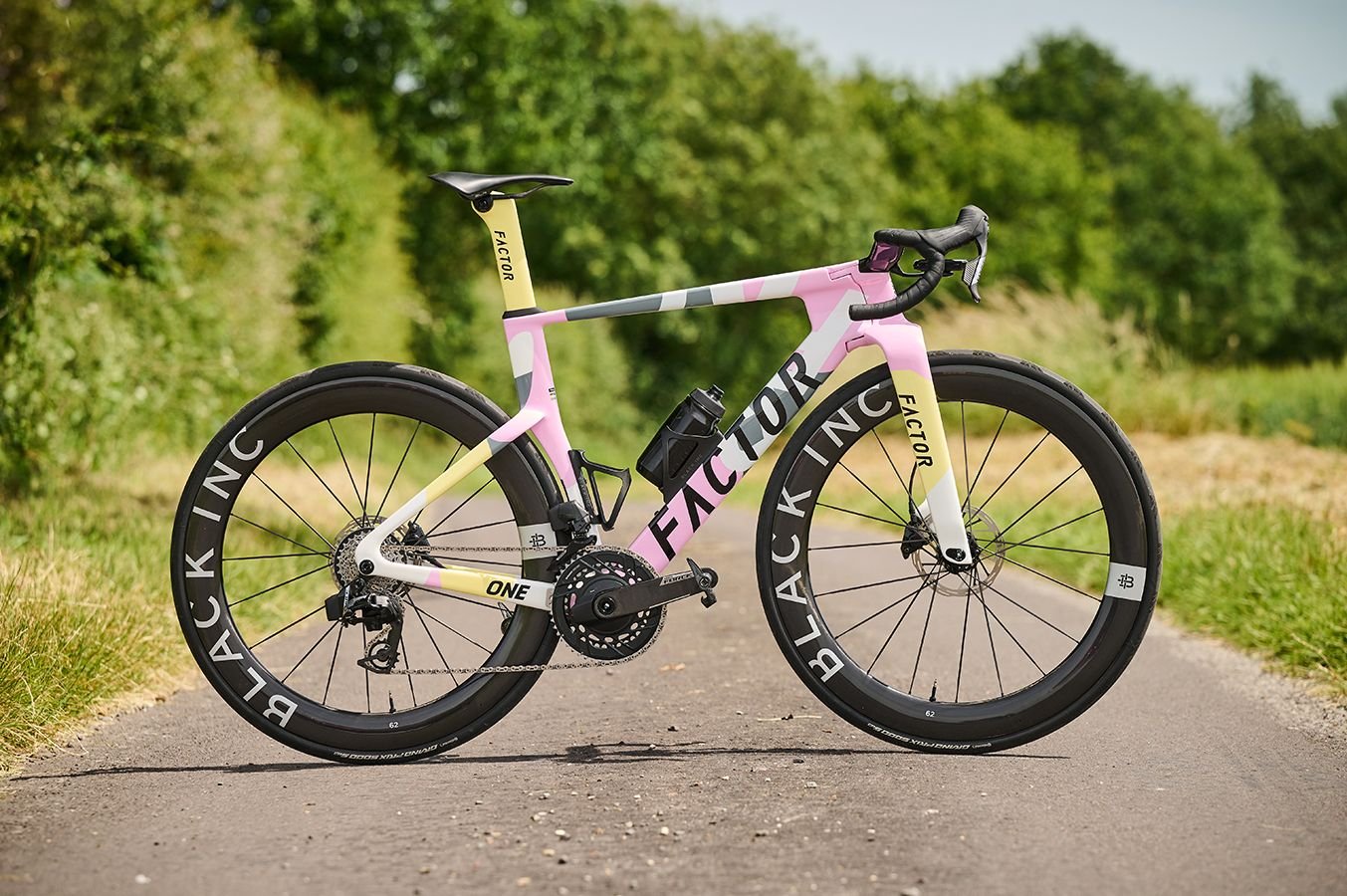
The Factor One is quite unlike the cookie-cutter designs that dominate the contemporary road bike recipe, many of which look conservatively tame in comparison. It doesn’t pretend to be anything other than a tool designed to scythe through the air and unapologetically keeps with the company’s radical design philosophy and Formula One-rooted history. Strip back the layers, however, and there’s an incredible story to be told about how it came to be and its forward-thinking geometry, not least how it rides and performs in the real world. It’s absolutely bonkers-fast.
Factor as a company is not new to creating machines of this nature – both the Vis Vires and Aston Martin One-77 bikes pushed the boundaries of design, aerodynamics, and integration and still look contemporary in today’s landscape. While the Factor One draws many parallels with those two bikes, the company’s ultimate goal was to push the design team’s restless creativity to the absolute limit and build the fastest UCI-legal road frame ever – something that the brand claims to have achieved.
Our friends at Cyclingnews corroborated Factor’s claims in their independent bike-only evaluations at the Silverstone Sports Engineering Hub. When tested with a rider, the Factor One effectively tied with the Cervelo S5.

With over 1,300km of saddle time, we’ve put together the most comprehensive test of the Factor One to date. It sure feels as fast as Factor claims, but what does that mean to the average rider, and are you better off with a regular aero bike?

The One has an outrageously narrow leading edge when viewed front-on
(Image credit: Richard Butcher)
Technical details
The Factor One’s visuals echo its speedy intentions with a blueprint designed to provoke rather than conform to UCI rules, some of which were relaxed in 2024. This allowed Factor’s head of engineering, Graham Shrive, and his design team to rethink how the fork and downtube intersect, resulting in a clever overlap and a deeper, forward-set fork configuration. Even though the ruleset was updated again for 2026 with a new law that caps the internal fork width at 115mm, the Factor One still falls within the safe zones. The result is one of the most extraordinary-looking front ends in modern bicycle design and something no other manufacturer has ever dared to explore.
The One has an outrageously narrow leading edge when viewed front-on, and the wide-set fork, forward-set chin fairing system, and super-deep headtube resemble those of a time-trial bike. The bayonet fork configuration not only ensures the steering axis remains in its traditional position but also pushes the front end out, reducing the effective stem length by 20mm. The long top tube, combined with the steeper 76-degree seat tube angle, places the rider forward relative to the bottom bracket.

If the Blush theme doesn’t tickle your fancy, there are three other options, including Silverstone (grey and cyan), Nimbus Grey (basically the Blush theme but in greyscale)
(Image credit: Richard Butcher)
On all my test rides, cyclists and non-cyclists alike were drawn to the Factor One in droves, often guffawing with delight at its unique facade and neapolitan ice-cream-like hue Factor calls ‘Blush’ – it really is a playful colourway, no riding incognito here. If the Blush theme doesn’t tickle your fancy, there are three other options, including Silverstone (grey and cyan), Nimbus Grey (basically the Blush theme but in greyscale), and Onyx Black. I foresee the latter being the most popular colour among buyers, but the bold blue of the Bugatti Factor One is also a pretty awesome shade, albeit an outrageously expensive one…
The numbers are as radical as the bike looks and are fairly consistent across all five frame sizes (47, 52, 54, 56, 58cm). The 43mm fork rake, together with the steep 73-degree head angle, results in a 58mm trail figure – ideal for quick, reactive steering. The rear end is categorised by particularly short 405mm chainstays, while a sub-metre (988cm) wheelbase rounds out the headline numbers on our size 54cm test bike. Despite these progressive angles, the One is easy to set up.
Factor reckons many riders are already adopting forward-biased riding positions, categorised by slammed saddles, narrow handlebars, inline seatposts, shorter cranks and longer reach from massive stems. To counter the taller saddle heights that result from shorter cranks, Factor adjusted the bottom bracket drop to lower the centre of gravity and retain stability, ensuring the front-to-rear weight balance remained neutral.

The stock gearing of 48/35T, 10-33T lets lets down the package
(Image credit: Richard Butcher)
Specifications
The stock gearing, however, lets down the package – in this instance, a 48/35T, 10-33T gearing assembly which is the same across both Force and Red AXS groupsets. Despite the relatively small chainrings, I didn’t feel negatively impacted or held back at any point during the test period – even on long, fast descents. Furthermore, the 48-10T offers a marginally lower gear ratio of 4.8 when compared to the 52-11T of Shimano Dura-Ace or Ultegra Di2 groupsets, both of which are pegged at 4.72. That said, the front mech is adjustable and can accommodate a maximum chainring of 68T in one-by and 60/42T in a two-by configuration. Factor is aware that chainring sizing is an issue and will shortly offer larger options.
Several parts are handled by Factor’s in-house components division, Black Inc, including the 62mm-deep wheels, which are wrapped in 28mm Continental GP5000 S TR tyres, the brace of Black Inc aero bottle cages and the matching computer mount. The standard gullwing integrated bar system is also a Black Inc creation and quite a unique-looking system. Sizes are designated as 1, 2, 3, 4, and 5, corresponding to stem equivalents of 110-150mm, with three high-rise options that provide an additional 20mm of stack. For reference, our test bike uses a fully slammed 38cm handlebar configuration matched to a 120mm effective stem length.
That said, a range of handlebar widths, spacers and effective stem lengths is also available, including a ‘Hi Rize’ configuration available in sizes 1, 2, and 3 (110-130mm effective stem lengths), ensuring a better fit for a wider range of riders. There are also two seatpost options (inline and offset). The offset post fitted to our Factor One test bike equates to zero setback on a bike such as the Ostro VAM, pushing the rider more forward towards the bottom bracket in ‘standard’ trim.

The Factor One should be reserved exclusively for the habitat it was designed to tame: road races, time trials and circuit events
(Image credit: Richard Butcher)
Performance
To fully appreciate the Factor One, you’ll need a solid understanding of weight distribution and grip, and the confidence to push it to the limits it was designed to reach. It’s got ride quality that some might describe as harsh, even unforgiving at times, but the upshot is a bike that’s full of feel and communication, something often lacking in modern aero bikes, which tend to prioritise comfort over precision. Much of this comes down to the oversized tubing and carbon layup, which make for an incredibly stiff frame and front end – comfort is not part of the package.
This is a bike that feels very much like a stripped-out track-day car, and in the same way you’d limit driving it to do your groceries owing to the lack of creature comforts and driver aids, the Factor One should be reserved exclusively for the habitat it was designed to tame: road races, time trials and circuit events.
It’s unbelievably agile with a direct and razor-sharp front end. The gullwing handlebar elevates this sensation with no discernible flex during sprinting and out-of-the-saddle attacks. The ‘stemless’ bar is fixed directly to the fork structure, a full 20mm ahead of the steerer axis, delivering incredibly precise steering. Keeping it at 40km/h requires very little effort, and once it inches past 50km/h, it becomes a game of how fast it can reel in the horizon line. I tested the One in a few time trials at varying distances, and the bike felt stable and as fast as a time-trial bike, limited only by my position. In fact, Factor told us that it will shortly be offering a time-trial cockpit for the One and that it tested within a few watts of its dedicated Hanzo time-trial bike.

The One is unbelievably agile with a direct and razor-sharp front end
(Image credit: Richard Butcher)
While it’s pretty stable overall, it can be a handful at times, especially if you’re a nervous descender and typically struggle in crosswinds. The surface area of the frame and wide-set fork can catch gusts – but it’s a matter of weighing the front end by using the drops to help keep it planted and tracking accurately. In ideal conditions, it’s a precision tool that can be positioned and set up for every corner, allowing you to carry speed and avoid unnecessary braking. Choose your line, weight your outside leg, rail the apex and repeat. It’s super-intuitive and so much fun to ride at the limit. While you can unlock extra grip and maybe even a smidgeon more comfort with wider 30-32mm tyres, the stock Continental rubber (at 55psi front/rear) paired well with the Black Inc 62 wheels and measured slightly wider than the claimed 28mm.
And what of its climbing ability? Well, the Factor One does climb better than expected. At 7.9kg, it’s not the lightest bike around, but weight was never the focus of the project. Instead, you’ll need some tactical nous to cheat the terrain – as the Factor One can effortlessly flatten most rolling terrain with very little input, granted you keep the speed high. It’s only when traversing double-digit, punchy topography that you will need to work a little harder to overcome gravity.

The gullwing handlebar has no discernible flex during sprinting and out-of-the-saddle attacks
(Image credit: Richard Butcher)
Value
The Factor One is a superbly designed and engineered machine for the rider or racer who wants a deep-rooted, symbiotic connection with their bike. The experience is not as muted as a regular race bike – the steering is more precise, and it requires concentration and confidence to ride at the limit. The frame is also notably stiff but not to the detriment of the overall ride experience.
In terms of rivals, the Ridley Noah Fast 3.0, Cervelo S5 and even the Argon 18 Nitrogen are close competitors with a similar user case, but lose out marginally to the One’s precision and unfettered sense of purity. This alone will either endear it to riders or send them in the opposite direction – as will the £11,309 / $12,199 / €13,399 sticker price, which is on the upper end of the pricing spectrum in this SRAM Force build. Add Red AXS or Shimano Dura-Ace Di2, and it gets even more costly.
During the entirety of the test period and with many other bikes in for evaluation, the Factor One was the bike I kept reaching for and the one I’d always find myself looking at from across the room. This is the effect it has on people – bystanders and riders alike. The expressions and excitement etched across the faces of those seeing Factor One for the first time demonstrate why we desperately need more companies that create and challenge the status quo rather than settle for mediocrity.
Am I sad to give it back? Yes. Do I want one? Of course. Do I have space? No, but I’ll make some. It’s the fastest and most entertaining bike I’ve ridden this year.

Keeping it at 40km/h requires very little effort, and once it inches past 50km/h, it becomes a game of how fast it can reel in the horizon line
(Image credit: Richard Butcher)
Tech spec
- Price: £11,309 / $12,199 / €13,399
- Brand: Factor
- Frame: TeXtreme, Toray, Nippon Graphite with Pan-Based Fibre
- Fork: One Wide Stance Fork
- Weight: 7.9kg (actual, 54cm)
- Sizes: 47, 52, 54, 56, 58cm
- Levers: SRAM Force AXS
- Brakes: SRAM Force AXS, 160/140mm front/rear
- Rear derailleur: SRAM Force AXS
- Front derailleur: SRAM Force AXS
- Crankset: SRAM Force AXS 48/35T
- Bottom bracket: SRAM Dub Press-fit
- Cassette: SRAM Force AXS 10-33T
- Chain: SRAM Flattop, 12-speed
- Wheels: Black Inc 62mm
- Tyres: Continental GP5000 S TR 28mm
- Bar/stem: Factor Integrated Barstem, 38cm
- Seatpost: Factor 30mm setback
- Saddle: Selle Italia SLR Elite

