CHARLOTTE — You can usually count on James Franklin to say the thing you would expect James Franklin to say and do the thing you would expect James Franklin to do.
Among the many college coaches who have turned an autopilot persona into tens of millions of dollars in career earnings, nobody has perfected the art of clean soundbites and zero risks like Franklin at Penn State.
Advertisement
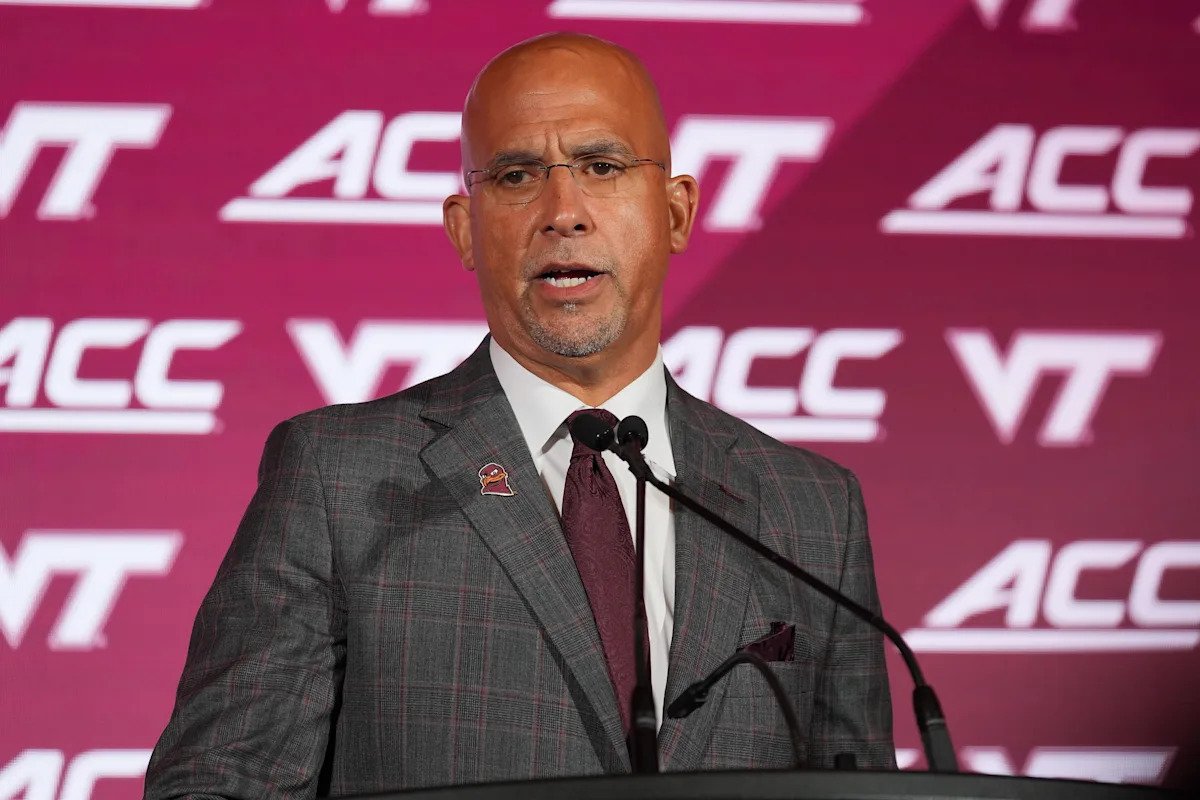
So it was no surprise that Franklin’s debut at ACC football media days, now wearing a paisley-patterned maroon tie instead of Penn State blue, felt like a concert of his greatest hits. When he’s talking about the culture of the offseason program or the newfound millions Virginia Tech is pouring into athletics or why he decided to jump right back into coaching after his dismissal last fall, you could imagine Franklin giving the exact same speech in any school’s colors. If you pay the man to sell Coca-Cola, he’ll sell Coca-Cola. If you pay him to sell Pepsi, he’ll convince you Pepsi is the greatest drink ever invented.
There is, however, one topic Franklin can’t explain with quite as much confidence. Even for a coach who has made a career out of projecting certainty, there is no blueprint for one of the biggest decisions of his current chapter.
When he talks about hiring Brent Pry as his defensive coordinator – yes, the same Brent Pry that Virginia Tech fired as head coach last year with a career record of 16-24 – even Franklin can’t sandpaper over what’s obvious.
“The reality of walking back in that building and walking past the head coach’s office, or I call him because I want to talk about something and I’m sitting in his [old] office,” Franklin said. “If you don’t have a real relationship and a tremendous history … I couldn’t do it. It shows his humility. It shows his love for Virginia Tech. But I think it also talks about our relationship.”
Advertisement
The personal dynamics that led to such an unusual arrangement are obvious. Jim Pry, Brent’s father, was Franklin’s offensive coordinator as a DII quarterback in the early 1990s. When Franklin got his first head coaching job at Vanderbilt, Pry was his most trusted assistant. At Penn State, Pry led defenses that were regularly ranked among the top 10 in the country.
Their 30-year history has not merely been fruitful professionally, it’s built on genuine friendship and trust.
And still, the awkwardness in this reunion at this school is undeniable.
“If we were [taking] one of these other jobs, he was coming with me,” Franklin said. “And when I said, ‘Hey, if I take the Virginia Tech job, you got any defensive coordinators you’d recommend,” he’s like, ‘Well, me.’
Advertisement
“Then it was like, OK, let’s talk through this in detail, what it’s going to look like, what it’s going to mean and how we’re going to do it. Then you say we want to do this and you get into the contract, which is kind of messy. You’re trying to work through all those things and you’ve got to have real hard conversations on the front end.”
There’s nothing unique about a coach getting fired and taking a job the next year as an assistant to rehabilitate their reputation. Lane Kiffin, Steve Sarkisian and Manny Diaz are among the current power conference head coaches who parlayed a coordinator stint into a second opportunity.
But taking a demotion at the school that just fired you? It’s unheard of — and for good reason.
When coaching tenures go wrong, especially at a school with Virginia Tech’s passion, the unpleasantness radiates to every part of life. In a small town like Blacksburg, there’s nowhere to escape.
Advertisement
When most coaches get fired, they want to get out of town as fast as possible — and the fan base is happy to help them pack. By the end of Pry’s tenure, it was so ugly that the school had to make the change a mere three games into last season.
It says a lot about Pry’s lack of ego that he would even consider coming back. He might be the only coach in the country that could pull it off.
“I wasn’t really shocked,” all-ACC defensive lineman Kemari Copeland said, “I know his love for Virginia Tech and it’s a good thing [for the players] because we’ve been around him. If he were to go somewhere like Arkansas, he’d have to get to know the players and learn a whole other culture. I think it’s an advantage for us.”
Whether it’s a good idea in this environment, though, remains to be seen. At a different school, Pry would be a big name with a good coordinator reputation. At Virginia Tech, every problem on defense will be framed by familiarity with his warts as a head coach.
Advertisement
That’s an unpredictable and potentially volatile dynamic. There’s practically no precedent for it anywhere else. While there’s a long track record on the football side of Franklin’s relationship with Pry to suggest it was the right move, there’s a human nature component that’s completely out of his control.
“I know he can do a phenomenal job, but there’s going to be other issues that come up,” Franklin said. “I want to sit down and talk with him again because you get through the initial wave and there’s still some other things. There’s going to be some differences for him and his family throughout the year that I want to make sure I’m aware of and that I’m being thoughtful about for him.”
Advertisement
“I think the best thing that happened is when he walked back in and I introduced him in front of the team as defensive coordinator, the whole room gave him a standing ovation. I could not have written a better script because I think that allowed him to hit the ground running, too.”
Most college football observers believe Franklin’s arrival at Virginia Tech marks a real opportunity to revive one of the sport’s dormant powers. With two major donations totaling nearly $100 million since Franklin was hired, he has been given the resources to compete in the ACC and been granted a reservoir of trust that dried up by the end of his tenure at Penn State.
With the unspoiled goodwill of a brand new fan base, any other coordinator hire would have been popular and noncontroversial. Bringing Pry back to the place where his name is associated with immense failure speaks to what Franklin thinks of him as a defensive coach and a surprising tolerance for public relations risk.
Over his 15 years as a head coach, Franklin has perfected the art of driving the narrative around his program and staying relentlessly on message. But the way college football fandom works, it’s unavoidable that Pry’s performance will dominate the conversation to an uncomfortable degree.
Coaching tenures don’t usually rise and fall on a single decision, but Franklin can’t afford to get that one wrong.

