NEW YORK — The boos were deafening.
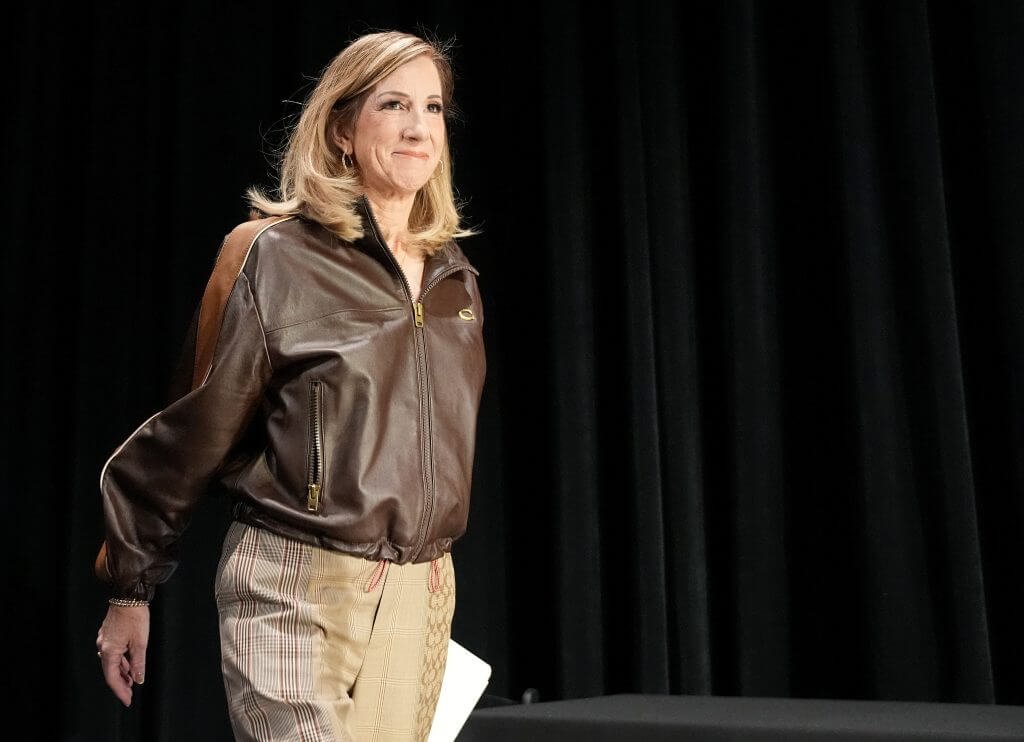
WNBA commissioner Cathy Engelbert was at center court inside Barclays Center. The New York Liberty had just beaten the Las Vegas Aces in the in-season tournament named after her job title, and as she took the mic to congratulate the team and announce the MVP, her voice was drowned out almost entirely.
Advertisement
It wasn’t the first time Engelbert was greeted with this level of public disdain. Over the last 12 months, the reception Engelbert has received has grown increasingly hostile, dating back to last year’s All-Star game in Indianapolis, when fans chanted “pay them” as she attempted to deliver her post-game speech. She was heckled again during the 2025 WNBA Finals trophy ceremony.
Since becoming commissioner in 2019, Engelbert has led the WNBA into its most successful era. She brokered two transformational collective bargaining agreements, guided the league through an unprecedented pandemic season in 2020, and helped facilitate the sale of the Atlanta Dream from an owner, Kelly Loeffler, who opposed the league’s public support for the Black Lives Matter movement.
The growth of the league has been astronomical — a new media rights deal valued at $2.2 billion at the time has grown to $3 billion, according to reports. The league has expanded to 15 teams and will reach 18 by 2030, with expansion fees that have lined the pockets of the existing owners. Record-breaking viewership and attendance have led to historic revenue targets.
On paper, Engelbert is the most successful leader in the WNBA’s 30-year history. Yet, as the WNBA descends upon Chicago for All-Star weekend, Engelbert is reaching an inflection point in her tenure.
Advertisement
While there’s seemingly no shortage of players and other team employees willing to complain publicly about day-to-day decision-making within the league, Engelbert’s overall job security remains too hot for most to handle. While The Athletic spoke to a dozen sources around the league for this story, almost all refused to comment for publication, even anonymously. What they did do was provide a holistic view of the situation that Engelbert — and the WNBA — now finds itself in.
“If we’re going to make a move we should make a move,” said one high-ranking team official, speaking anonymously to protect existing relationships. “If not, we need some leadership.”
NBA commissioner Adam Silver appointed Engelbert in 2019, giving her the commissioner title no previous WNBA permanent leader had possessed. It was a testament to her CV, highlighted by a stint as the CEO of Deloitte, a multinational business consulting firm.
But the WNBA’s board of governors’ lack of involvement regarding Engelbert’s hiring has led to the question of who, exactly, she reports to. Throughout her tenure, there have been moments that point to Silver’s explicit involvement in business decisions, a number of them occurring in the last year.
Advertisement
During NBA All-Star weekend earlier this year, Silver acknowledged that while he hadn’t been at the bargaining table in the contentious WNBA CBA negotiations, he was playing a role behind the scenes. More recently, he was reportedly involved in the disciplinary process of Phoenix Mercury forward Alyssa Thomas after a now-infamous play involving her and Fever guard Caitlin Clark. Asked at CNBC’s Game Plan Summit if he encouraged Engelbert to suspend Thomas, Silver sidestepped the question. “I’m not going to comment on that, because I don’t think it’s fair to Caitlin — and to Cathy Engelbert either. That’s not the real issue here.”
At least twice in the past five months, Silver was asked about Engelbert’s job performance. Both times he praised the work she’s done but was noncommittal about her future. “Cathy continues to do a strong job building that league and we’ll have ongoing discussions about (her future),” Silver said earlier this month.
One of the biggest pain points that has come up among sources around the league is Engelbert’s communication style. People have expressed reservations about her interpersonal dynamics. The WNBA’s biggest stakeholders, the players, have reinforced those opinions.
The WNBA is widely considered a player-driven league. Athletes in this league consistently speak out against everything from poor operational standards within certain organizations to leadership’s missteps. There is arguably no greater example of the players’ power than in 2020 when members of the Atlanta Dream wore T-shirts endorsing then-Democratic candidate Raphael Warnock who at the time was running against Loeffler. In the final days of his campaign, Warnock shared a video to social media encouraging people to “get out and vote,” featuring several WNBA stars including three-time WNBA champion Diana Taurasi and WNBPA secretary Elizabeth Williams.
Advertisement
WNBA players’ power over the league itself is illustrated regularly by the fans themselves, who routinely demonstrate they put players before the team on social media and in their public response to everything from league business to roster construction. In New York, for example, fans led a raucous “We want Laney” chant in support of Liberty forward Betnijah Laney-Hamilton, who has seen her role significantly limited this season.
In recent years, Engelbert’s communication style has been criticized and magnified by these players who aren’t afraid to air their grievances publicly.
While many players say they’ve never had a relationship with Engelbert, the level of strain went mainstream last year when one of the league’s biggest stars, Napheesa Collier, called out Engelbert during her exit interview. In addition to saying the WNBA has the “worst leadership in the world,” Collier aired a private conversation she had with Engelbert at Unrivaled in 2025. She claimed Engelbert told her “only losers complain about the refs.” When Collier asked about the WNBA’s young stars who were driving revenue, she said Engelbert responded by saying Clark should be “grateful she makes $16 million off the court, because without the platform that the WNBA gives her, she wouldn’t make anything.”
Engelbert later denied having made those comments, but the damage was already done.
Advertisement
Players around the league, past and present, sided with Collier. Three-time WNBA Champion Candace Parker said she got a text from Silver congratulating her on the birth of her third child and that she receives a Christmas gift every year from him. In addition, she said when she retired, Silver congratulated her on her Hall of Fame career.
She never heard from Engelbert.
This points to another area of lapse from Engelbert: her efforts to bridge the past to the present. She was noticeably absent from the WNBA’s 30th anniversary game between the Los Angeles Sparks and the New York Liberty on June 21, choosing instead to be at the final round of the U.S. Open (she sits on the USGA’s executive board). She was also absent from the 2026 Women’s Basketball Hall of Fame induction ceremony, which included Parker, Lynx coach Cheryl Reeve, WNBA champion Elena Delle Donne and Isabelle Fijalkowski, a member of the Cleveland Rockers during the WNBA’s first season.
Arguably the biggest feather in Engelbert’s commissioner cap is the fact she presided over the negotiations that gave way to the league’s first million-dollar player contract, and did so without losing a single game. The 17-month-long process, which culminated with eight marathon bargaining sessions, points to the fact that Engelbert and the WNBA owners she speaks for were not easily sold on the idea of paying players seven-figure salaries. But despite her contributions to getting players richer salaries than they’ve ever seen in the WNBA, her relationships with them have appeared to only marginally improve.
Advertisement
WNBPA vice president and New York Liberty forward Breanna Stewart said since the CBA was completed, there is mutual respect, but there isn’t much of a personal relationship. Stewart’s Liberty teammate, Sabrina Ionescu, said she doesn’t have a relationship with Engelbert, but speaks to Silver often.
That strained relationship was spotlighted this week when Ionescu said she was never officially invited to participate in the WNBA’s 3-point contest. Lynx guard Kayla McBride also called out the league for what she believed to be a half-hearted attempt to get her to participate.
“Continuing to show up, build good relationships with players, have good open communication line,” Ionescu said when asked what she’d like to see from Engelbert moving forward. “There’s always more that can be done from both sides. It’s never going to be pretty all the time, but I definitely think building relationships, having better relationships with multiple players who have been part of this league is definitely something that can always improve.”
While such decisions have cost her in the court of public opinion, it remains unclear to what degree it has influenced her standing with those she ultimately reports to, including the NBA. When Silver appointed Engelbert over seven years ago, he said, “Cathy is a world-class business leader with a deep connection to women’s basketball, which makes her the ideal person to lead the WNBA into its next phase of growth.”
Advertisement
This was roughly five months after Silver told the Associated Press the league was losing an average of “$10 million every year we’ve operated.” His emphasis on the WNBA’s bottom line has become more apparent over the course of her tenure.
In 2022, Engelbert made what was outwardly viewed at the time as a stabilizing business decision when she led a capital raise that resulted in a 16 percent stake in the league selling for $75 million to a group of investors that includes several WNBA owners, Nike, Swin Cash and Pau Gasol. That sale made the WNBA’s ownership structure more convoluted — with 42 percent of the league belonging to NBA owners, another 42 percent to WNBA owners and 16 percent to the investors — but was viewed as necessary and a win at the time.
The $75 million was said to be deployed for brand elevation, marketing and the globalization of the league according to the WNBA’s release at the time. But in the years since, this business decision has come under heavy scrutiny because of the rapid rise in team valuations. The possibility of buying the equity back has been discussed by the league’s Board of Governors, according to multiple sources with direct knowledge of the league’s business. But doing so would cost multiples of the original sale price.
By 2030, the WNBA will welcome three new teams, all of which will operate under dual NBA/WNBA ownership. Including the expansion Golden State Valkyries, the sale of the Connecticut Sun to Houston Rockets owner Tillman Fertitta and Mark Walter’s purchase of the Los Angeles Lakers, the WNBA will have 11 teams operating under a dual ownership structure. The first-year Portland Fire and Toronto Tempo also share ownership ties with the NBA. The WNBA’s ownership structure conflates the separation of the two leagues’ commissioners, begging the question of whether the current governance structure clips the wings of Engelbert or any person who could potentially replace her.
Advertisement
“No commissioner will truly succeed until the role and governance changes,” the same high-ranking team official said.
This article originally appeared in The Athletic.
WNBA
2026 The Athletic Media Company

