American Men’s Swim Team Has Chance to Build Momentum at Pan Pacs
The latest showdown between the two superpower nations in women’s swimming, the United States and Australia, will take place at the Pan Pacific Championships. The men’s competition, however, will be short on swimmers who have dominated their respective events in recent years.
Of the 17 individual races contested at last year’s World Championships, European swimmers won gold in 10. China’s Qin Haiyang, Tunisia’s Ahmed Jaouadi and South Africa’s Pieter Coetze combined to win five further golds; all are eligible for Pan Pacs but not yet committed to the meet. Further, Australian 50 freestyle world champion and world-record holder Cam McEvoy will skip meet. McEvoy and teammate Kyle Chalmers, who anchored the Aussies to gold in the 400 free relay at the 2025 Worlds, will focus on the Commonwealth Games. That leaves Luca Urlando, the American world champion in the 200 fly, as the lone reigning champion set to compete.
However, the meet will provide the best glimpse into the status of the U.S. men’s team that has struggled to reach its usual medal output in consecutive international competitions. American swimmers won just six individual medals at the Paris Olympics, a world-record-breaking performance from Bobby Finke in the 1500 freestyle on the final day ensuring the men would not be blanked in the gold-medal count. Same story at last year’s World Championships, with Urlando’s gold plus five additional medals.
The absence of the European stars who reign over the sport will the American men a chance to collect some medals and build momentum for 2027 and 2028 while simultaneously trying to post times competitive with those recorded at the European Championships in Paris. The team has shown particularly strong potential in freestyle, individual medley and butterfly.
Luke Hobson — Photo Courtesy: Emily Cameron
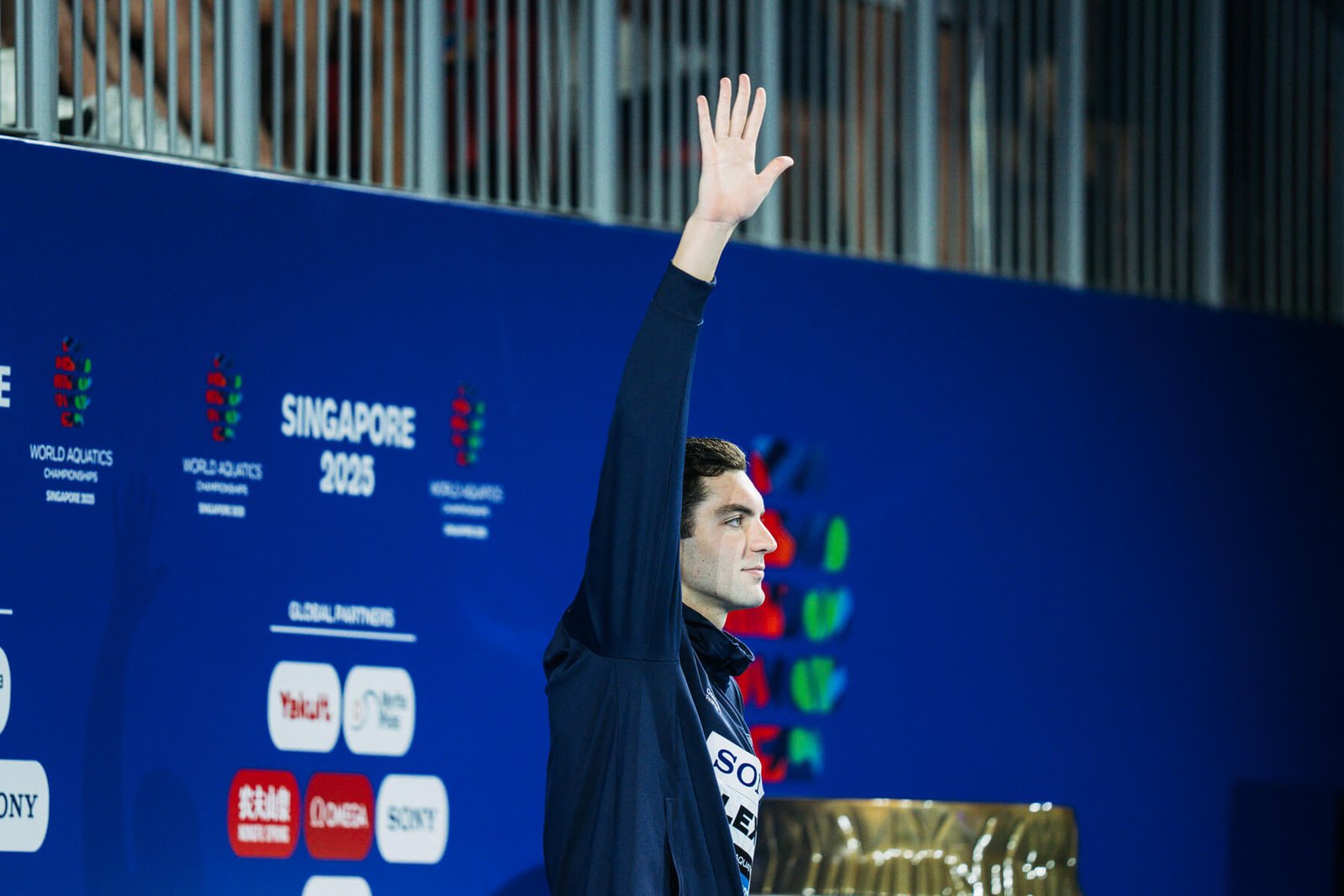
The freestylers accounted for four of the six medals last year in Singapore: Jack Alexy took silver in the 100 free and bronze in the 50 free while Luke Hobson finished second the 200 free and Bobby Finke salvaged a rough meet with 1500 bronze. Alexy and Hobson should be the class of their respective event at Pan Pacs, but the test will be whether they approach or surpass the times David Popovici manages at the European Championships. The calculus in the 100 becomes somewhat different based on the status of Pan Zhanle, the world-record holder from China either racing at Pan Pacs or saving up for the Asian Games later on.
Whether or not Jaouadi competes, Finke will have his hands full with Sam Short, the 22-year-old Australian coming off best times at the Australian Trials earlier this year. Short will race at Pan Pacs shortly after the Commonwealth Games, where he will have another chance to fire off elite performances. When all the meets finish, the times from Irvine compared to those from Jaouadi, Dan Wiffen and the contingent of German distances stars will determine the world’s best for 2026.
Alexy, Hobson and Finke cover all freestyle events except the 400, the weakest overall event for the United States for the last decade. Kieran Smith will try to build on his 2025 breakout and perhaps challenge the American record, while the best hopes might be a pair of teenagers not qualified for this year’s meet, Luka Mijatovic and Ryan Erisman. Thus, their times from U.S. Nationals will come into play when assessing American strength in the event this year.
Shaine Casas should shine for the Americans in the 200 IM as he tries to to follow up his silver-medal-winning performance of 1:54.30 at last year’s Worlds. Casas will not come close to Leon Marchand, but he will try to surpass the best marks of rivals such as Hubert Kos and Duncan Scott to secure his status as second-best in the event.
In the 400 IM, Finke and Carson Foster finished 2025 ranked second and third in the world, respectively, and they will go up against Japan’s contingent led by Tomoyuki Matsushita, who clocked 4:06.93 in the event in March, and also including teenagers Asaki Nishikawa and Yumeki Kojima. Finke has never raced the 400 IM internationally, but he might finally be able to fit it into his schedule at this meet since it falls on the second day, after the 800 and before the 1500.
Urlando was the American butterfly standout with his world title last year, but the best hope for American men in the stroke is surely Ilya Kharun, who will not race at Pan Pacs after switching his sports nationality from Canada to the United States. Kharun will compete earlier at U.S. Nationals, and his times across all three butterfly races should shake up the global order as he becomes eligible well before the 2027 World Championships. For this meet, though, the Americans will depend on some combination of Urlando, Foster, Casas, Thomas Heilman, Dare Rose and Michael Andrew.
Van Mathias — Photo Courtesy: Peter H. Bick
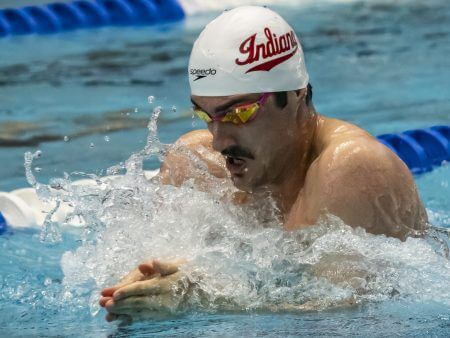
The breaststroke contingent might have a new star in Van Mathias, who snuck onto the Pan Pacs team with some late-summer fireworks in the 50 breast last year. He has backed that up with American records in both the 50 and 100 earlier in 2026, and Mathias could put himself in contention for the top times in the world. Moreover, Campbell McKean could take another step forward following his emergence in 2025 and a solid freshman season at Texas. As for the 200 breast, Josh Matheny and AJ Pouch could have an upward climb for a medal against a deep Japanese group led by world-junior-record holder Shin Ohashi and Tokyo Olympic champion Zac Stubblety-Cook of Australia.
Backstroke is another big question mark. Quintin McCarty made the Worlds final in the 50 back last year while 200 specialists Jack Aikins and Keaton Jones both shined at U.S. Nationals before falling flat while dealing with illness at Worlds. For the 100, the American team welcomes Will Modglin and Daniel Diehl to the senior-level team after both clocked 52s at the 2025 World University Games. No Ryan Murphy this time, but his 52.80 at last month’s Indianapolis Pro Series was a strong sign for the men’s medley relay in the coming years.
The American men should be favored in all three relays, especially with Australia missing Chalmers in the 400 free relay. Alexy, Patrick Sammon and Chris Guiliano form an elite sprinting backbone, likely with enough firepower to lead the world rankings. The 800 free relay will also have a chance to hold the No. 1 spot with Hobson as the standout and Guiliano, Sammon, Maurer, Foster, Gabriel Jett and Henry McFadden as options. The medley, on the other hand, will have a challenge pursuing the times from Russia, France and Italy at the European Championships with uncertainty on the backstroke and butterfly legs.
In contrast to the well-established, world-ranking-dominating ways of the U.S. women, the men have plenty of work to do over the next month between U.S. Nationals and Pan Pacs to show improvement as the buildup to the Los Angeles Olympics reaches its halfway point.

