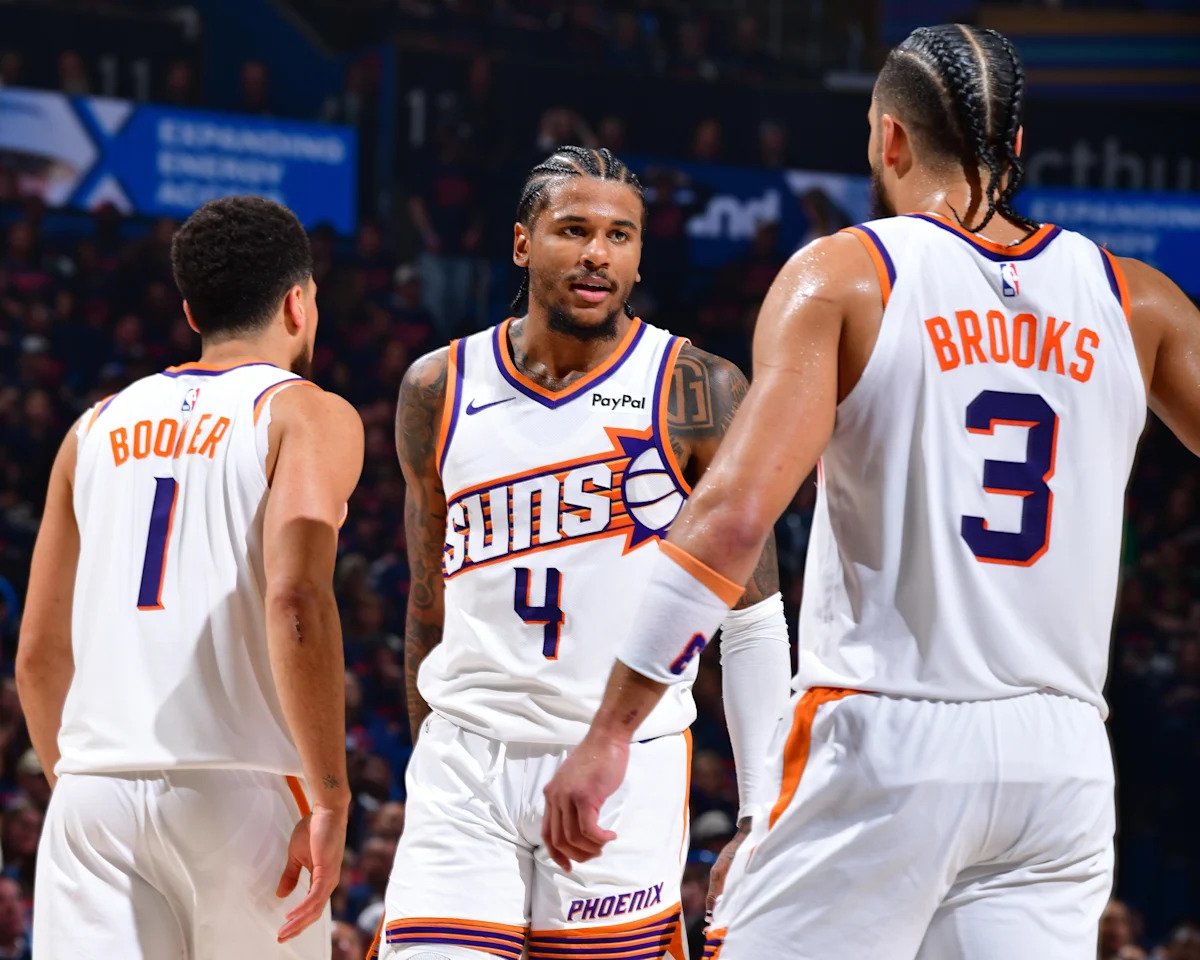
The vibes in Phoenix are good, and the way the organization has navigated its cap sheet to field a competitive team, despite the disadvantages of limited controllable draft capital and $23.2 million in dead cap, deserves applause. Why? Look at the Milwaukee Bucks.
I’ve made this case before, and we’ve continued to watch it play out. The Bucks essentially became the Phoenix Suns of the Eastern Conference. Granted, they won a championship, so many of the aggressive decisions they made can be justified. But they also leveraged a significant portion of their future in an effort to remain competitive, and eventually the bill came due.
Advertisement
They sent out multiple draft picks to acquire Jrue Holiday, then gave up even more to land Damian Lillard. Later, much like the Suns did with Bradley Beal, they waived and stretched Lillard’s contract. Now look at where they are. They’ve finally committed to moving on from Giannis Antetokounmpo and entered a rebuild because they could no longer sustain a competitive roster around their superstar.
You can already see the aftermath. You can see what they ultimately received for a player many would consider more valuable than Devin Booker, given that Giannis owns two league MVP awards. Their roster lacks direction, and after signing Gary Trent Jr. to a four-year, $64 million contract, they have some questionable deals on the books as well.
I say all of that to remind you that what the Suns are doing is genuinely impressive given the restrictions they face. Phoenix has chosen a different path. Rather than continuing to mortgage the future in pursuit of one more swing, the organization has focused on creating flexibility, maintaining competitiveness, and building an identity that gives its young players an opportunity to develop while the team continues trying to win.
When I look up and down the roster, I’m impressed with the depth. I’m impressed with the flexibility and the lineup optionality the team possesses. Jordan Ott has plenty of different combinations to work with next season, and each can produce a different result. If you want a defensive lineup, the Suns have hard-nosed defenders. If you want to lean into perimeter offense, they have shooters available. Again, given the canvas the Suns have to paint on, one created by their own doing, they’ve done a good job putting together a roster that has an opportunity to remain competitive while also embracing a youth movement.
Advertisement
But part of me can’t help but wonder, what if? What if the Suns didn’t have $23.2 million in dead cap sitting on their books? That’s enough money to add another significant player to this roster. This front office could really cook if it had more funds available. When you consider that the team is hard-capped at the second apron, and there’s only about $5.2 million separating its current payroll of roughly $216.8 million from the $222 million second apron, it naturally makes you wonder what this roster could have looked like without those dead cap charges.
So I thought it’d be interesting to put together a list of players whose salaries fall between roughly $22 million and $26.8 million, the range Phoenix realistically could have afforded if not for the dead cap created by Bradley Beal’s $19.2 million, Nassir Little’s $3.1 million, and EJ Liddell’s $707,000. What type of player could the Suns have added if that money were actually available?
-
Johs Giddey — $25.0 million
-
Fred VanVellet $25.0 million
-
De’Andre Hunter — $24.9 million
That is a healthy list of talented names right in the range of what exists between the Suns’ available cap space plus their dead cap space. Obviously, this is all hypothetical. These players wouldn’t simply appear on the Suns roster at their current salaries. Acquiring any one of them would require trades, salary matching, and a variety of other roster mechanics. None of it is particularly realistic. But still, if that dead cap didn’t exist (and knowing that if they didn’t waive Bradley Beal, he’d still be on the last year of his deal with the Suns right now, and therefore they could not have the depth they currently possess), you can’t help but wonder.
The goal here isn’t to make you feel worse about the dead cap. It’s twofold. First, it’s to illustrate the caliber of player the Suns effectively don’t have because of financial decisions made in previous years. More importantly, it’s to highlight how impressive this roster construction really is. Even without another player in that salary slot, Phoenix has assembled a roster that feels cohesive, deep, and flexible.
Advertisement
It also serves as a reminder that a championship may still be outside the realm of possibility because that money simply isn’t on the floor. There’s a duality to all of this. You can appreciate the work the front office has done while also recognizing it still might not be enough because the organization continues paying for the sins of the past.
Even with that reality, I’d much rather be where the Phoenix Suns are today than where we’ve watched Milwaukee end up.
The Bucks had a superstar and continually gambled away future assets to build around him because they felt they had to. Giannis might not have been direct about his desires, but the team navigated in every effort to make him as happy as possible. Their reward is Tyler Herro, Jaime Jaquez Jr, and a pair of lottery picks this past draft that may or may not hit (although Burries looks legit).
Advertisement
Devin Booker has allowed the Suns to navigate differently. The organization has worked the fringes, built a culture, and focused on creating sustainable competitiveness. Throughout all of it, Booker hasn’t played psychological games about whether he’s staying or leaving. We never saw him publicly say one thing while allowing a different message to leak from his camp. He’s remained steadfast in his belief that he wants to be here, trusting the organization to build a competitive team around him.
At this point, maintaining a semblance of competitiveness is the most important thing for Phoenix. It doesn’t benefit the Suns to bottom out. They don’t control their own draft picks, so there is no reward for losing. The only path forward is to build the organization culturally, creating an environment that is prepared to capitalize on opportunities when they eventually present themselves.
Yes, it’s unfortunate the Suns don’t have another $26 million player on this roster. That kind of talent would absolutely raise the ceiling. But given the circumstances, I’m comfortable with where they are.

