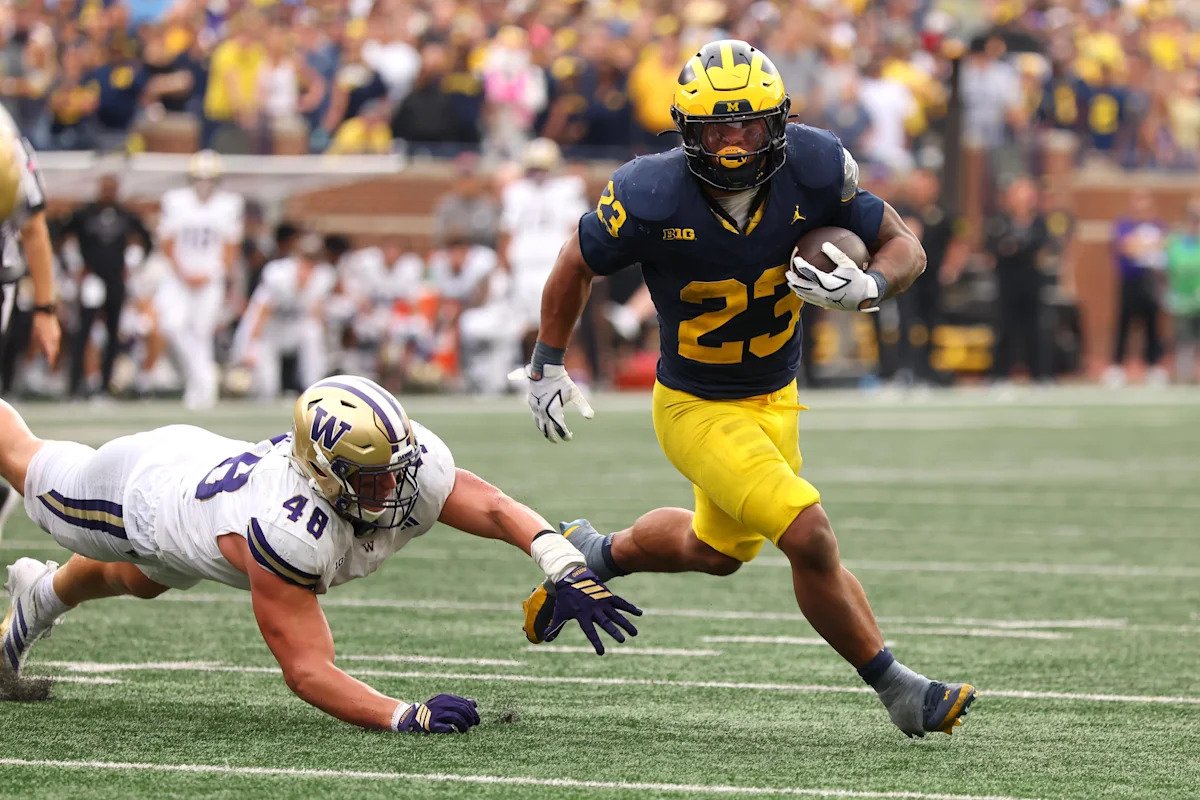
Michigan’s offense is undergoing some changes once again. Under new head coach Kyle Whittingham, the Wolverines will also have a new offensive coordinator in Jason Beck, now making it four straight seasons with a different offensive coordinator for the program.
Throughout all the changes, the identity has largely been the same — a run-centric scheme that relies on the dominance of the offensive line to methodically move down the field. In 2026, Michigan will likely have more of a spread-style system, but the run game will still be a big part of the offense. Not only that, but 2026 has the chance to be the best year on the ground for Michigan since 2022.
Advertisement
A big reason for this optimism is the three-headed monster of star running back Jordan Marshall, five-star freshman Savion Hiter and quarterback Bryce Underwood, the latter of whom wasn’t given enough freedom to make plays on the ground last year.
While there might be some trepidation about how productive the offense can be by leaning into the run game, I’d argue it’s the best way for Michigan to make good use of its personnel with its running back, quarterback and offensive line that was much better in the run game than in pass protection a year ago. Not only that, but allowing Underwood more freedom on the ground instead of forcing him to purely be a pocket passer should take pressure off him while still allowing him to show how good of an overall player he can be. And don’t worry, Andrew Marsh and all the pass-catchers will still get plenty of opportunities as well.
Earlier this offseason, I wrote about how I expect Michigan’s offense to mirror what we saw from Ohio State in the Urban Meyer era of the 2010’s. Those offenses were always among the best in the country by leaning into the run game while operating out of the spread. Quarterbacks J.T. Barrett and Braxton Miller, and running backs like Ezekiel Elliot, Mike Weber, and J.K. Dobbins put up monster rushing totals every year, while wide receivers like Michael Thomas, K.J. Hill, Parris Campbell, Terry McLaurin and Curtis Samuel were able to thrive with plenty of room to roam downfield.
So how productive could we see Michigan be on the ground this season between what’s supposed to be its three leading rushers? To find out, let’s start by taking a look at how Michigan’s top three rushers from last season (Underwood, Marshall and Justice Haynes) compared to Jason Beck’s last two offenses, Utah in 2025 and New Mexico and 2024. Also, we’ll take a look at the same numbers from Ohio State’s 2017, a rushing attack that could resemble what Michigan has in 2026, with a veteran running back (Mike Weber), a freshman five-star (J.K. Dobbins) and a dual-threat quarterback (J.T. Barrett).
Advertisement
The table below shows the rushing attempts and yardage totals for each team’s top three rushers during the respective seasons we mentioned, as well as the team’s total rushing yards per game and points per game.
What stands out is Michigan didn’t have the efficiency between its top three rushers compared to these other teams, but that’s largely because Michigan didn’t spread the field and didn’t pose much of a threat through the air. Opposing defenses could sell out to stop the run and not have to worry much about getting burned on a pass play over the top. Defenses shouldn’t have that benefit this season against a group of Michigan pass-catchers that’s much more well-rounded and will require being accounted for.
Neither Devon Dampier or J.T. Barrett are elite passers, but their spread-style systems allowed them to use their rushing abilities to the fullest and take advantage of the opportunities they were afforded to throw the ball since their pass-catchers had more room to work. For Underwood in 2026, this would mean he doesn’t need to be some elite gunslinger — he just has to be slightly more efficient through the air to keep defenses honest, something that seems like a good bet with better pass-catchers in 2026.
Advertisement
As for how many rushing yards the Wolverines could have this season and how they could be allocated, I think the 2024 New Mexico stats would be a good target with 2017 Ohio State being a loftier goal. If Marshall, Hiter and Underwood were to combine for 376 attempts in 13 games this season, it would probably look something like Marshall getting roughly 14 carries per game (182 for the year). If he kept his same efficiency from 2025 (6.2 yards per carry), he’d come close to 1,200 yards. Not bad for the lead back in a committee.
That leaves 194 attempts for Hiter and Underwood and a need for them to combine for about 1,400 yards to reach New Mexico’s total from 2024. Between the two of them, they could probably get there with close to 100 attempts each assuming they’re able to land somewhere between 5-6 yards per carry. Again, that’s not that far out of the realm of possibility given the strength of Michigan’s offensive line in the run game.
If I had to guess, I’d say this roughly means about 800 yards for Hiter and 600 for Underwood, but again, that’s only if Beck is more committed to the quarterback run game than Michigan was last year. Based on his history with running quarterbacks like Dampier, Taysom Hill and Bryce Perkins, it seems like he will be.
Of course all this math is based on the assumption the situation is the same in every game Michigan plays and the numbers are staying pretty constant. These are all just averages; some games will be dominated by Marshall, some by Hiter and some by Underwood. Maybe there’s an injury and someone like Bryson Kuzdzal gets some carries as well.
Advertisement
Regardless, it’s clear Michigan has the horses to be much more productive in the run game this season if it continues to lean into it. Last year’s step back wasn’t a cause for concern about the quality of the players themselves, but rather a symptom of an offensive system that wasn’t going to be productive because of how much defenses could sell out to stop the run.
With more room to work, better wide receivers to account for and more reps from a talented run-blocking offensive line, the ground game could return to its vintage form in 2026 with big production from multiple guys.

