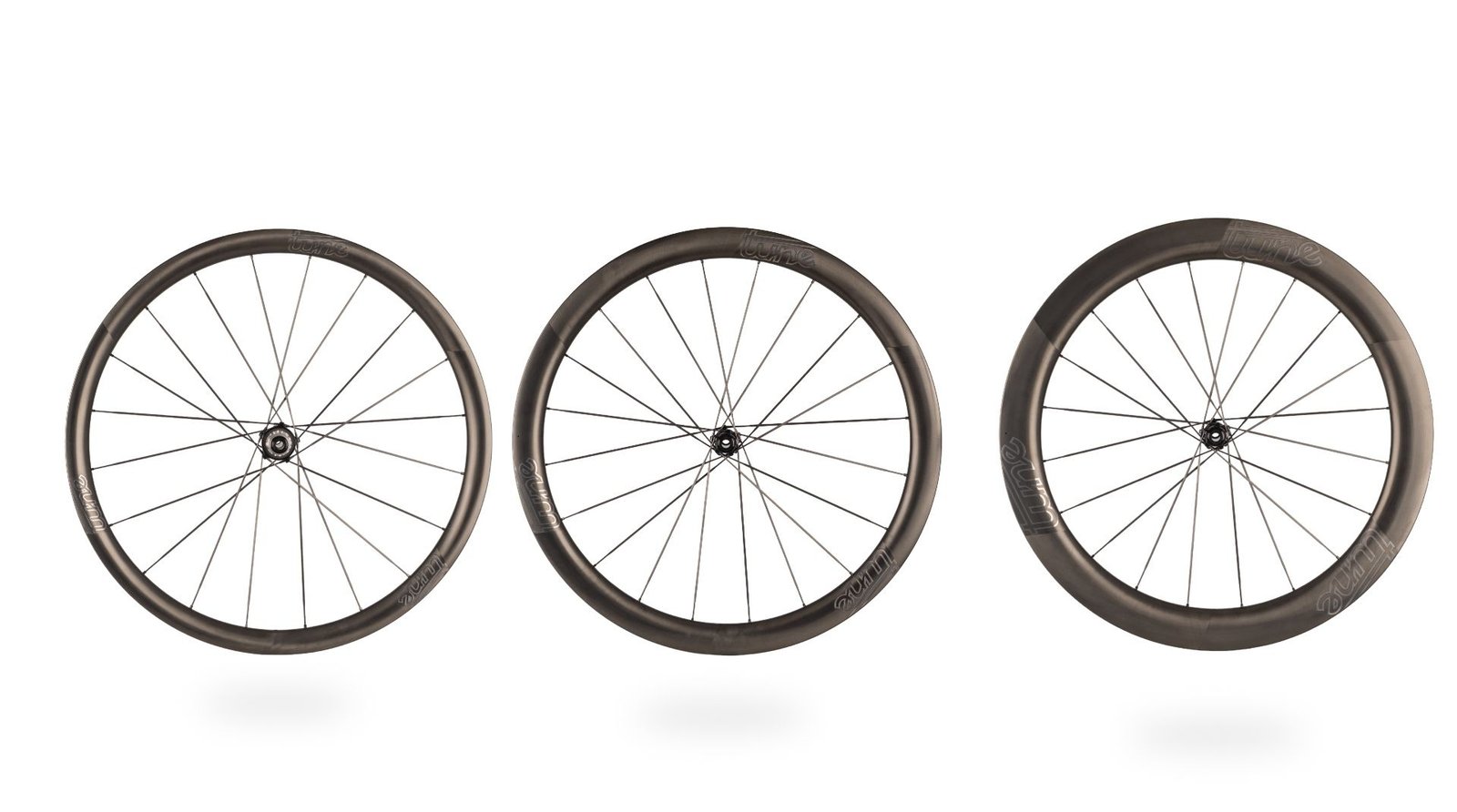
Tune is expanding the Nano platform with six new road wheelsets: Nano Road 35, 45, and 60, plus the Nano CS Road 35, 45, and 60.
The new Nano CS Road wheelsets feature Tune’s newly patented carbon-spoke hub technology, enabling carbon-spoke wheel builds with a much wider range of rim designs than previously, while also claiming weight reduction and increased robustness.
Building on the Tune Yokto wheels, this new dual lineup extends the brand’s road-market offering and underlines its push to compete at the sharp end of the best road bike wheels.
Latest Videos FromCycling Weekly
The new dual lineup features carbon rims in 35mm, 45mm and 60mm depths, with either 24 stainless steel Sapim spokes on the Nano Road or 20 high-modulus carbon-fibre spokes on the Nano CS Road.
While the hookless debate continues, albeit in a more subdued form, Tune has firmly planted its flag in the camp of tradition, with a hooked bead across the entire Nano range. By retaining the hooked profile, Tune says the wheels can be used with both standard tubeless systems and traditional clincher tyres with inner tubes. It also accommodates higher inflation pressures, removing compatibility restrictions around tyre brands and construction styles.
The internal rim bed is wide enough to support modern, high-volume road tyres, helping optimise the tyre footprint for lower rolling resistance and improved cornering grip.
(Image credit: Tune)
While versatility appears central to the Nano range’s design, the Nano CS models are a claimed engineering first, with the spoke system at its heart.
Traditional steel spokes are relatively compliant; they tolerate slight deformation during wheel building. Carbon spokes, by contrast, are far less forgiving. Despite their low weight and high stiffness, forcing them to sit at an offset angle introduces stresses that can lead to fracture.
This creates a wheel-building challenge: keeping carbon spokes perfectly aligned typically requires a custom hub design for each rim depth and profile, a prohibitively expensive solution. Tune says the Nano CS addresses this with a patented ball-milled socket. Instead of forcing the carbon spoke into a fixed slot, Tune says that the spoke head can swivel to align naturally with the rim, reducing stress and the risk of spoke failure.
Balancing aero and stiffness is a fine act, and Tune says it concluded that with the deeper 45mm and 60mm rims, the balance is struck with a symmetrical rim; but when it comes to the Tune Nano CS 35, it transpired that stiffness gains from asymmetric front and rear rims were more important than the aero gains.
That same focus on efficiency carries through to the rear hub, where power transfer is handled by Tune’s proprietary Poetry freehub mechanism. In its standard configuration, the system offers 69 points of engagement, up from 40 on the Tune Yokto 4550 wheelset.

(Image credit: Tune)
For riders still demanding quicker engagement, the internal pawl system can be upgraded to double the engagement points to 138, and the hubs upgraded from the standard Enduro premium steel bearings to Enduro XD-15 ceramic bearings.
But all that titivating will cost you. The current starting prices for the Nano Road wheelset are £1,960/ $2,610/ €2,290, and the Nano Road CS wheelset is £2,390/ $3,200/ €2,790.
Pop in ceramic bearings and the wheelsets jump an additional £540/ $720/ €630. It’s a perspective-giving price tag that makes you question whether you need ceramic bearings in your wheels altogether.
While the Nano Road and Nano Road CS share the same UCI-certified rim, albeit with different spoke counts, both come with a 24mm internal width and 32mm external width, tailored for 28mm to 45mm tyres.
The Nano Road tips the scales at 1,280g for 35mm-deep rims, 1,340g for 45mm-deep rims, and 1,440g for 60mm-deep rims.
Opting for the carbon-spoked Nano CS variant, however, sees a significant reduction in mass, shaving off approximately 100g to reach a featherweight 1,180g for the 35mm depth, 1,250g for the 45mm, and 1,350g for the deep-section 60mm wheels (all weights cited within a 3% tolerance and are claimed).
Obviously, any swap-outs will change these numbers, but so marginally so that you probably wouldn’t even nudge the kitchen scales.

