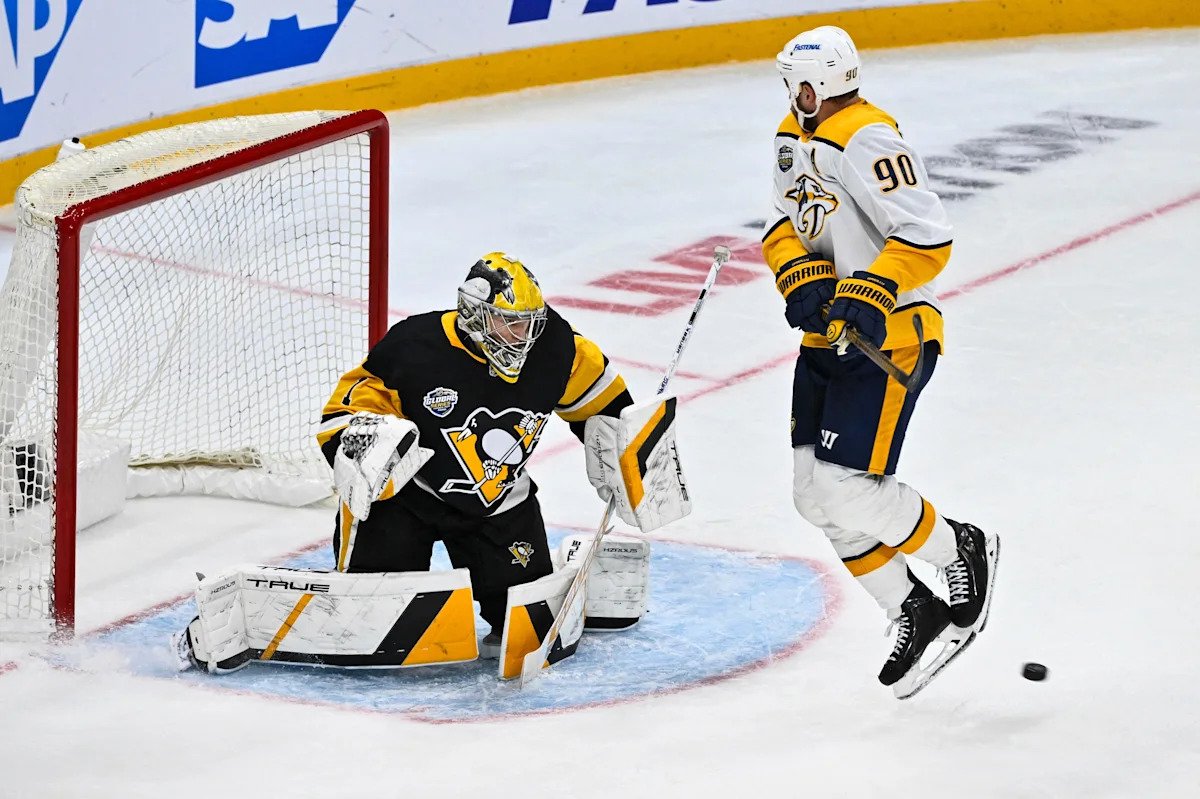
The old joke that you could rename the sport of hockey goalie has some truth to it. With quality goaltending, the sky is the limit. With poor play in net, a team is basically cooked.
Last summer we looked into the changing situation in the crease for the Penguins for 2025-26. The big news was that Alex Nedeljkovic was out, having been traded to San Jose. By and large, that was an opportunity for improvement since Nedeljkovic’s metrics were poor. In was the unknown of Arturs Silovs.
Back at NST, looking at 5v5 save percentage, setting a sample of 875 minutes from last year allows 64 goalies to qualify, which adds up in theory to each of the 32 teams having a starter+backup. Nedeljkovic ranked tied-46th out of the 62 with a .902 save%, Jarry was tied-51st with .900. This is an area for primed for potential regression. Given team strength and goalie skill, you wouldn’t expect the Pens to get a .920+ 5v5 performance in the upcoming season. But if one/both can nudge up towards and past the .910% mark, there will be a noticeable change within the games themselves for the Penguins receiving the type of goaltending that should hold them in games — in theory long enough for the strength of their team to score them into wins.
In this area, the Penguins didn’t do much better in 2025-26. Stuart Skinner ended up 45th with a .900 5v5 save%. Silovs was down in 51st at .893%. The traded Tristan Jarry was just above him at .894%. Overall the Penguins finished 20th with a .901% 5v5 save percentage, due to the splits in the sample for Jarry and Skinner playing part of the season with Edmonton.
Advertisement
In all, an obvious conclusion to draw is that the Pittsburgh defense is too porous to support a strong statistical goaltender output in terms of save percentage. There likely is some truth to that, though perhaps not as an easy answer to completely paint over the situation. Per Natural Stat Tricks, the Pens finished 23rd in 5v5 scoring chances and high danger scoring chances allowed, yet they finished 14th in 5v5 HD save%. For that reason, Skinner and Jarry both did well in Goals Saved Above Average metrics, despite low save percentages.
Along those lines, NST tracked an expected 5v5 goals allowed of nearly 183 — and the Pens only gave up 173 5v5 goals, to indicate that positive input from the netminders.
That makes projecting 2026-27 in net a real challenge. By some measures, the Penguins goalies bailed the team out a little bit more than expectations. By about any stat, the defense allowed an above-average amount of shots and chances along the way to make it difficult for their last line of defense.
Given the lack of upgrades to the blueline, and general bent of a team that is going to lean towards trading chances and cheat for offense given the nature of the players on the roster and seeing how it worked last year with Dan Muse behind the bench, by this summer there’s a little reason to expect a huge goalie performance in 2026-27. For better or worse, the Penguins are going to open up the tempo and attempt to outscore teams. A casualty of that will likely be in the statistics for their goalies.
Advertisement
Half of the goalies in the league the past two years had a .906% 5v5 save percentage or better, but even if Sergei Murashov is a big hit, he likely won’t figure to be in that grouping next year. The style, scheme, strengths and weaknesses of the club aren’t designed to have a goaltender flourish individually.
There could be some reason to hope – Silovs’ best games were in the playoffs at the end of the year and he wasn’t even 100% during it after dealing with a late-season knee injury. He could be better next season than he was last year – and as we wrote last month, Silovs had better be since he now is the most veteran and experienced goalie currently in the organization, despite the fact he was still considered a rookie by NHL standards in 2025-26.
Murashov gives hope of the complete unknown at the NHL level, buoyed by an excellent AHL season last year. He certainly has the talent and athleticism to give it his all. Based on the last two years of goalie performances, it just probably won’t end up with a sterling GAA or save percentage on his stat-sheet to evaluate his performance. The Penguins aren’t going to ask or provide the path for him to excel in that area, but they can offer a lot of firepower to help out-score their team issues defending, if they can only get a goalie to keep them in games when times are tough. Silovs showed that in flashes in Games 4-6 of the playoffs last season, Pittsburgh will need to see more of that from him and some rookie magic in order to have a solid season and fight back to the playoffs again in 2026-27.
Last year’s hypothetical was phrased that “what if the Penguins get better goaltending next season” and directed towards the even strength save percentage. They didn’t get much better goaltending in that department, but overall did get enough GSAA out of their trio of goalies to have a better overall season in 2025-26 than they did in 2024-25. The challenge looking ahead in some ways will be to replicate that and give their team a chance.
Advertisement
At the best of times, predicting goaltending output can be a guessing game, part of the fun looking ahead to next year is seeing any number of realistic scenarios for what a completely new duo (and possibly trio if Joel Blomqvist has something to say about it) perform for the Penguins moving forward.

