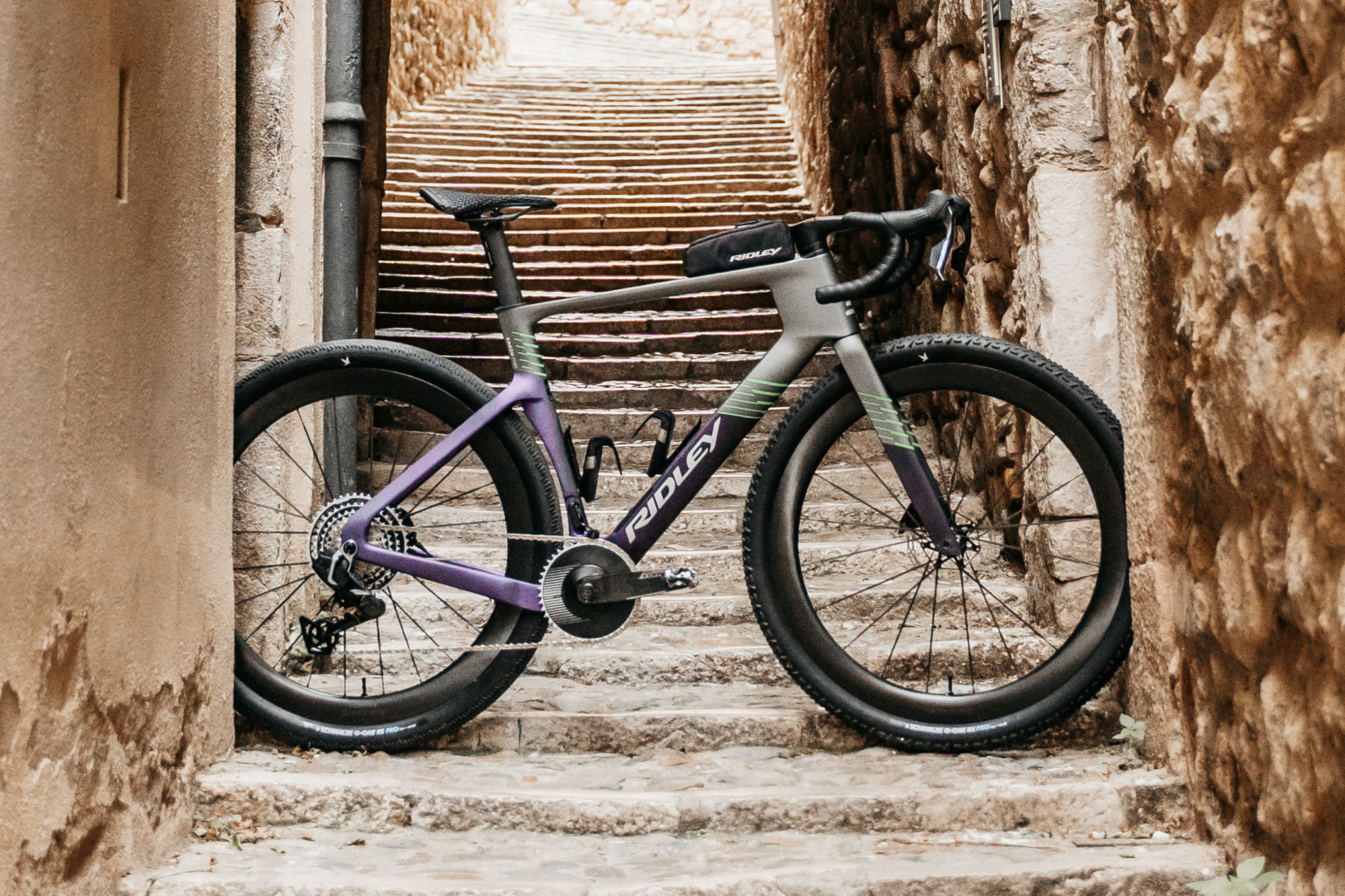
The biggest development in gravel racing over the past couple of years has been the adoption of wide tyres. Make that seriously wide. Looking to best address the issue of suspension losses which zap racing speeds over challenging terrain, elite racers began to experiment with high-volume mountain bike tyres run at extremely low pressures. It seemed to work.
Fast forward to today and it’s accepted wisdom that this approach is the best route to lowering rolling resistance while also improving comfort and increasing grip. And who doesn’t want to be faster and more comfortable? But to allow for such voluminous rubber, frames have had to adapt. A case in point is the new Kanzo Fast 2.0 from Ridley. When the Belgian gravel race bike was first released in 2020 tyre clearance was 42mm, the second iteration has seen this expanded to 58mm.
(Image credit: Ridley)
By going wider, the Kanzo Fast 2.0 has also become more adaptable. While it can now run 29 × 2.3in MTB tyres, it also means that riders can fit a range of tyre widths to meet their needs. For example, when faced with muddy conditions a narrower tyre can be used to create more clearance for dirt and debris, while still being wide enough to reap the benefits discussed above.
Latest Videos FromCycling Weekly

(Image credit: Ridley)
While this whopping tyre clearance will garner plenty of headlines, it’s not the only story. The aforementioned original Kanzo Fast was something of an outlier. As an early example of a dedicated gravel race bike, it had more in common with a WorldTour rig than it did with the majority of the adventured-focussed gravel bikes that had become so popular. And the 2.0 edition continues this theme, with aerodynamic efficiency front and centre.

(Image credit: Ridley)
To achieve this, Ridley looked to its Noah Fast race bike, using its validated aero technology to help make the Kanzo Fast, well, faster. Typically wide tyres have created an aerodynamic disadvantage, but Ridley has sought to counterbalance this added drag by designing tube profiles accordingly. A quick look at the new frameset reveals an exceptionally deep head tube and an oversized down tube, despite the frame being claimed to be 150 grams lighter than its predecessor.

(Image credit: Ridley)
The bottom bracket has been lowered to compensate for the wide tyres and the increase in wheel diameter they bring. The fork rake is also designed to accommodate the larger wheel radius, aiming to keep the 2.0 as agile as the original Kanzo Fast. In addition, by limiting the bike to electronic 1x groupsets only (with up to a 56T chainring), the designers have been able to keep the chainstays short – 425mm – to aid responsiveness.

(Image credit: Ridley)
Naturally, a race bike needs to be fast with a rider on board, and Ridley has opted for a steeper seat tube angle to create a more forward and aerodynamically beneficial position. This is paired with the new integrated Nimbus Pro cockpit, designed to enable riders to enjoy an aero position while also offering the option to adopt something wider when greater control is required.
In Ridley’s Aero Performance Lab, all the tweaks appear to have paid dividends. It says that its tests show that the new frame has reduced the gap between a 38mm tyre and 55mm tyre to just 6 watts, a number low enough to be easily mitigated by the holistic benefits of wider tyres over rough terrain.

(Image credit: Ridley)
With identical wheels and tyres (Forza Skiron wheels and 38mm Vittoria Terreno Dry tyres) Ridley says 2.0 bests the original Kanzo Fast by 13 watts with a rider present compared to just 2 watts in a bike-only test. This seemingly validates the design approach that chose not to view aerodynamic performance in isolation, instead creating a gravel race bike for the real world, one where setups vary based on the terrain ahead, as riders seek to balance aero gains with improved rolling performance.
As for the wheels, the Forza Skiron RS have been designed specifically for gravel racing and feature 50mm-deep hookless rims with a 27mm internal width. Carbon spokes help to keep the build suitably light, with a claimed weight of 1,350g for the pair.

Thomas De Gendt rode the Kanzo Fast 2.0 during The Trakka.
(Image credit: Ridley)
Given the length and remoteness of many of today’s gravel races, a degree of self-sufficiency is required. To help, the Kanzo Fast 2.0 comes with some internal frame storage that includes two padded pouches and integrated top tube mounts. There’s also compatibility with a bespoke mudguard system, designed in conjunction with Curana, that increases the bike’s versatility.
The Ridley Kanzo Fast 2.0 is available in sizes XS, S, M and L. It’s currently offered in three complete builds:
SRAM Red XPLR 1×13, with DT Swiss GRC1400 Dicut wheels and 4ZA Nimbus Pro cockpit, with a price tag of €11,699.
SRAM Force XPLR 1×13, with Forza Skiron RS wheels and 4ZA Nimbus Pro cockpit, priced at €6,999.
SRAM Rival XPLR 1×13, with Forza Skiron CG40 wheels and Forza Cirrus Pro cockpit, which retails at €5,499.
The frameset can also be purchased separately for €4,499.

