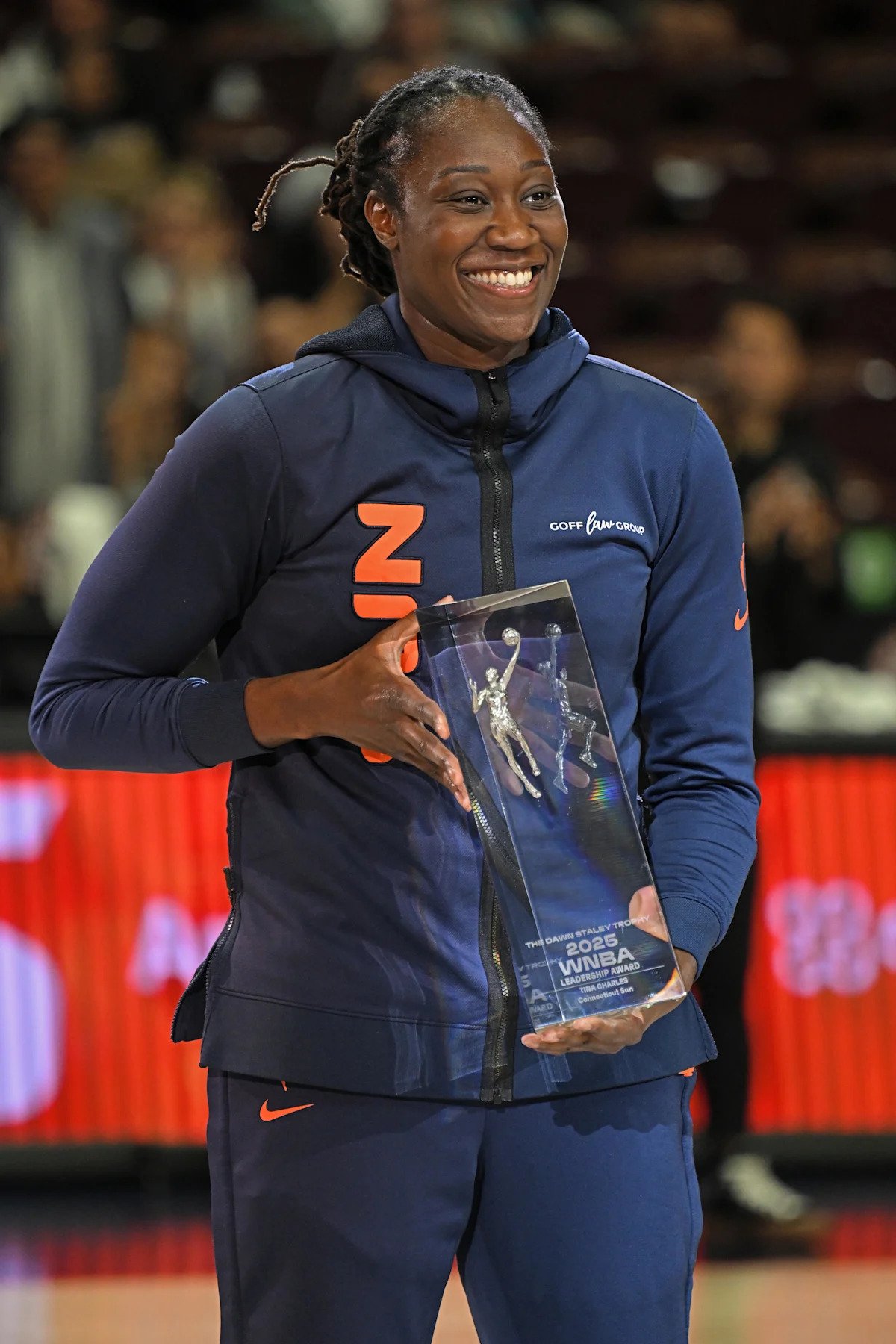
Monday morning began with Tina Charles announcing that she was retiring from the WNBA after 14 seasons.
She goes out as the league’s all-time leader in field goals scored (3,364), rebounds (4,262), double-doubles (201) and second in total points (8,396).
On the court, Charles was dominant and consistent.
Advertisement
She was the 2010 Rookie of the Year, 2012 WNBA MVP and was an eight-time All-Star. Along the way, she played for the Connecticut Sun, New York Liberty, Washington Mystics, Phoenix Mercury, Seattle Storm, and Atlanta Dream.
Off the court, she made a larger impact, advancing social justice and community involvement.
In 2013, Charles started the Hopey’s Heart Foundation in honor of her aunt, Maureen “Hopey” Vaz, who died from organ failure in 2013. They work with schools and community groups to install Automated External Defibrillators (AEDs) to prevent sudden cardiac arrest.
In 2016, Charles, who was playing for the Liberty, stood alongside Maya Moore in calling for change following the police murders of Alton Sterling and Philando Castile, along with the killing of five police officers in Dallas. That call for racial justice and police reform came one month before San Francisco 49ers backup quarterback Colin Kaepernick took a knee during the national anthem.
Advertisement
Four years later, Charles, much like everyone else, heard of the police killings of George Floyd and Breonna Taylor, as well as the murder of Ahmad Arbery, in the midst of the COVID-19 pandemic. With business as usual disrupted, Charles joined in the accelerated demand for racial justice.
She ultimately didn’t play in the 2020 season with the Washington Mystics due to injuries, but used that recovery time to advocate for equality and promote voting in that year’s election.
Charles recognized the power in the vote, saying, “The same outpouring we have to protest, we have to make the same effort in voting—that is what we control.”
Advertisement
That same year, Charles put out an essay in The Players’ Tribune, titled “Change Beyond Surface,” where she discussed how she empathized with the Black women, men, girls and boys killed by law enforcement after living with the burden of what it’s like to be Black in America. Charles wrote:
My experience absolutely pales in comparison with what they went through.
But what they likely felt—not being able to do something so simple, so human, as to control their own breathing—I don’t know … it just registers with me and cuts even deeper.
I’ve also realized that, while I was able to get immediate medical attention when my asthma attack happened during a game, when I take off that uniform, I’m no different from any other African-American who could be subjected to racism at any time. And the more I’ve been able to spend some time thinking and reading and learning about what’s going on in this country—what’s been going on in this country for a loooooong time—the more convinced I am that I need to be a part of making sure change happens as soon as possible.
In 2025, Charles received the WNBA’s Dawn Staley Community Leadership Award for the second time in her career for her sustained advocacy work; she first was awarded the honor in 2012.
Before announcing her retirement, Charles had one more score to settle.
When the WNBA and the WNBPA agreed to their landmark CBA deal in March, it was Charles who put the cherry on top of the sundae. She ensured that, if a retired player passed away, their player recognition benefits would go directly to their beneficiaries.
In keeping with a celebrated tradition of athlete activism, Tina Charles came onto the stage great, but exited stage right greater.

