Lisa Bluder had a captivated audience, and she had a point she wanted to make.
On the floor at Carver-Hawkeye Arena stood her former player Caitlin Clark, on hand to watch her No. 22 Iowa jersey be hoisted to the rafters, fittingly on Feb. 2 (or “2-2”), 2025. A few feet away sat the USC women’s basketball team, including budding superstar JuJu Watkins. Secondary-market tickets had reached $650 for spots in nosebleed sections, and more than 1.1 million people watched from home.
Advertisement
Bluder, the winningest coach in Big Ten women’s basketball history who retired after taking Iowa to consecutive national title games, looked at Clark and told the crowd why it was wise for networks and companies to invest in women’s sports.
“It’s not only the right thing to do,” Bluder said, “but it’s the smart thing to do.”
Women’s basketball soared in popularity as Clark set the NCAA scoring record at Iowa. In the two years since Clark left for the WNBA, the Big Ten has kept its momentum and expanded its reach, with television ratings and attendance remaining strong. While other leagues have mirrored that growth — particularly the SEC — the Big Ten’s focus and willingness to change keeps it at the cutting edge, and for those directly involved, the ascension serves as a starting point, not a destination.
“It’s a really special time,” UCLA women’s basketball coach Cori Close said, “but without vision, people perish. None of us want this to be a moment; we want it to be a movement that continues to grow and is sustainable. We need strategy, vision, teamwork and I want the Big Ten to lead the way in that.”
Advertisement
At the Big Ten office, capitalizing means reshaping the league’s inventory and creating special events that place its best programs, environments and star athletes into key television windows. It’s taking what was a good product and making it great.
“The growth has been unbelievable,” USC women’s basketball coach Lindsay Gottlieb said. “Just continuing to value women’s basketball as the entity and the force that we are, never putting limits on what these women are capable of, not putting limits on their value to a university, their value to TV stations.”
The growth is not exclusive to just one sport. Since the 2021-22 school year, women’s basketball ratings are up 38 percent and women’s volleyball are up 37 percent on Big Ten Network. Soccer (62 percent), gymnastics (39 percent) and softball (27 percent) follow a similar trend. The league has added event and feature coverage on BTN, including weekly highlight shows and daily segments. In a four-year period, the total number of live women’s sporting events shown on BTN has grown 24 percent from 196 in 2021-22 to 243 in 2025-26.
“I think it has shown in women’s basketball, shown in women’s sports, people are going to watch it if you put it on,” Maryland women’s basketball coach Brenda Frese said.
Advertisement
Volleyball’s spike
Women’s volleyball has lacked a Caitlin Clark-like superstar, but perhaps no sport has enjoyed more organic growth. Last fall’s NCAA Tournament on ABC/ESPN was the most watched in history, and four matches surpassed 1 million viewers. And nowhere does the sport garner more support than Nebraska.
For a decade, Nebraska volleyball was the conference’s only women’s team in any sport to generate an annual profit. In 2023, the Huskers shifted a home match to the football stadium and set a global women’s sports attendance record by drawing 92,003 fans. Nebraska sells out at home and regularly on the road.
“You saw what the Memorial Stadium match did for volleyball,” said Nebraska coach Dani Busboom Kelly, who was coaching at Louisville at the time. “There’s people all over the world that started taking notice when they saw that event.”
Advertisement
BTN has increased its total volleyball telecasts by 44 percent in a four-year period, and 1.66 million watched Minnesota play Wisconsin on Fox following a Vikings-Packers football game in 2024.
For Grace McNamara, the Big Ten’s senior director of television administration who oversees volleyball, the confluence of interest and prowess has led to wide-ranging conversations about how to increase visibility.
“(Big Ten commissioner Tony Petitti) has really kind of pushed our staff and schools to create more of these types of events that we own and operate and control as the conference,” McNamara said.
This year, those efforts came together to create a postseason conference tournament. Big Ten officials and volleyball coaches had regularly discussed the merits of joining the SEC as a power conference with a postseason tournament, but the talks always ended in a stalemate. After some turnover in the league’s coaching ranks, McNamara approached the group following the 2025 season with a plan to start a postseason tournament in 2027, complete with a five-year analysis of how a tournament would impact the teams based on competitive metrics.
Advertisement
“I can’t think of a topic that’s been more highly debated,” McNamara said. “So it was funny that the coaches, some of which had originally been against it, immediately this year were like, ‘All right, let’s do it in ’26 if you guys can figure it out.’”
The coaches’ approval sent the league scrambling a bit. To accommodate the 15-team format but not place a burden on the teams heading soon after to the NCAA Tournament, the league trimmed its regular-season schedule from 20 matches to a true round-robin of 17. The tournament concludes the Wednesday before Thanksgiving, and Fox is likely to broadcast the championship, which takes place in Fishers, Ind.
The tournament is just one change for the upcoming season drafting off increased interest in volleyball. The Big Ten and SEC also agreed to a 30-match crossover challenge, airing on the leagues’ media rights partners and involving all 34 teams, that will conclude with two matches at Chicago’s Wrigley Field on Sunday, Sept. 6, airing on Fox. Nebraska will play former conference rival Missouri, and 2024 NCAA champion Penn State will face 2025 runner-up Kentucky.
Busboom Kelly initially thought playing at Wrigley was risky because of the weather, but “it’s just a really unique and fun way to showcase our sport.”
Advertisement
“There’s going to be a lot of people watching that, and I think that is what the Big Ten wants, and what our sport needs,” Busboom Kelly said. “The growth has been exponential, and it’s been fast, and you looked five years ago we weren’t getting these opportunities. Now there’s multiple games on big networks, whether it’s ABC, NBC, Fox. It’s not just one program, either.”
Basketball ‘as healthy as it’s ever been’
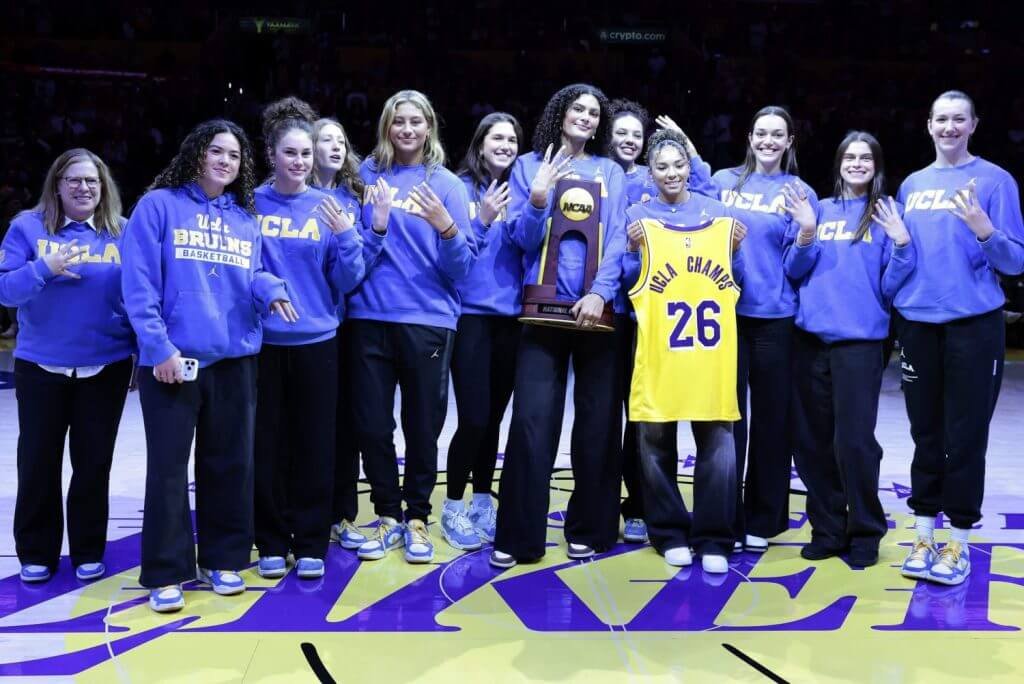
UCLA finished 37-1, throttled South Carolina by 28 points to claim the school’s first women’s basketball national championship and set a record with five WNBA first-round selections. Close has plenty of reasons to celebrate, but she’s also thinking bigger picture.
“We have all this popularity,” Close said. “Viewership is up, engagement is up, NIL money is up, the WNBA popularity is up. How do we monetize that? How do we get corporate sponsors to realize women’s basketball is one of the best investments we can make?”
Advertisement
Some of those answers have already arrived. Ally Financial this year met its pledge to strike a 50-50 ad spend balance between men’s and women’s sports. Athletes like Clark and Watkins have featured in national advertising campaigns for State Farm and others.
Based on viewership, women’s sports seem like a safe investment. ESPN’s per-game viewership average for the NCAA Tournament was its best in 17 years, and 9.9 million tuned in for the UCLA-South Carolina final. Fox’s regular-season ratings were the second-highest in network history, and FS1’s were the best in network history.
Attendance for the Big Ten’s 18 women’s basketball programs has risen 72 percent collectively over the past four years.
“The state of women’s basketball, where it is right now, is as healthy as it’s ever been, in terms of attendance, in terms of viewership, in terms of the media coverage, in terms of investment,” said Megan Kahn, the Big Ten’s vice president for women’s basketball.
Advertisement
With most campuses juggling crowded arena schedules, positioning women’s basketball programs to secure the spotlight must be intentional.
“It’s weeks and weeks and weeks of planning and strategic mapping of trying to position the highest-quality matchups in those premier TV windows,” Kahn said. “And also trying to make sure it looks good on TV, right? I don’t want to put a game on TV with a half-empty arena.”
Kahn has seen the biggest jump in interest when it comes to nonconference games. This year, Maryland will open the season in Paris against South Carolina. Iowa has scheduled a two-game series against UConn. Other neutral-site games that never reached television now result in appearance fees for the schools, NIL revenue for the athletes and networks battling for rights.
“The first two years (I was here), people just didn’t care,” said Kahn, who joined the Big Ten in 2021. “Now, it’s totally different.”
Advertisement
The superstar effect
Watkins sat out last season with a torn ACL, but it didn’t stop fans from flocking to her at opposing arenas. People stretched all the way to the top of Michigan’s Crisler Arena seeking her autograph, Gottlieb said.
“Women’s sports are driven by star power, and to see it in real time is pretty impressive,” Gottlieb said. “I’m really acutely aware of the opportunity and where we sit in that landscape, and we want to push the whole thing forward as much as we can, not just for our program, but for the whole sport.”
“Even though I’m their rival, I will celebrate that, because it’s good for our sport,” Close said. “It’s going to bring in just what Caitlin did.”
Advertisement
On many campuses, female athletes have greater social media followings than male athletes, which has allowed them to promote themselves, their sports and business partners in a strategic way. UCLA Olympic gymnast Jordan Chiles packed plenty of arenas, and Minnesota’s women’s gymnastics squad became national darlings with a Final Four appearance. UCLA slugger Megan Grant and Nebraska’s Jordy Frahm became must-see athletes while leading their softball teams to the Women’s College World Series.
Kylie Feuerbach, a former starting guard at Iowa who was Clark’s roommate for three seasons, signed a multi-year agreement to promote the Chicago White Sox. She wore White Sox gear in Iowa City and displayed it on social media, where she has more than 120,000 followers.
“There’s just so many opportunities that get opened up because of these NIL deals,” she said.
“It’s just pretty amazing that not only can our women playing sports get the viewership, but we can monetize because of our talents,” Busboom Kelly said. “I don’t think people thought that would happen as quickly as it has, and it is pretty unbelievable.”
Advertisement
Close said it has led to “creative engagement” and needs to force schools’ multimedia rights holders to adapt in promoting women’s sports.
“We don’t want to be a Title IX box that’s checked,” Close said. “We want to be an investment worth the return and worth investing in.”
The league office, UCLA and USC have discussed staging a basketball event at SoFi Stadium, but the particulars are still uncertain. Should it be a league-only event or involve nonconference opponents? Should it include men’s basketball teams or strictly for the women?
“We just need to wait for a couple of things to align,” Kahn said.
Advertisement
The women’s basketball tournament heads to Las Vegas this year, and Kahn said, “there’s a couple other global things going on.” USC has discussed scheduling opportunities along the Pacific Rim, Gottlieb said.
Close has proposed placing a court in the middle of UCLA’s quad for an event similar to when Iowa staged an exhibition game at Kinnick Stadium in 2023. Although the league doesn’t officially sponsor women’s hockey, it worked with Wisconsin and Ohio State when they competed at Wrigley as part of the 2025 Frozen Confines event.
In sharpening its strategy geared toward continual growth in women’s sports, the Big Ten will consider every idea that comes its way.
“We are always looking to elevate the profile of women’s sports,” McNamara said.
Advertisement
This article originally appeared in The Athletic.
USC Trojans, Indiana Hoosiers, Rutgers Scarlet Knights, Nebraska Cornhuskers, Minnesota Golden Gophers, Michigan State Spartans, Maryland Terrapins, Penn State Lady Lions, Ohio State Buckeyes, UCLA Bruins, Purdue Boilermakers, Washington Huskies, Oregon Ducks, Illinois Fighting Illini, Iowa Hawkeyes, Wisconsin Badgers, Northwestern Wildcats, Michigan Wolverines, Sports Business, Women’s College Basketball, College Sports
2026 The Athletic Media Company

