It is Day 69 of our 100-day countdown to kickoff. We are looking back at the 100 most iconic games in Dallas Cowboys history. The countdown will leads us right up to the opening game of 2026. Our look back doesn’t depend on just one criteria for our rankings. We take into consideration things like how big the game was for the organization, how memorable the game was, games that had unusual events take place, games that are a part of NFL lore, Cowboys firsts, and games where the Cowboys just plain dominated. Variety is the spice of life and we have all different kind of Cowboys games to review. At the bottom, we’ll link each day of the countdown so you can go back and check out any you missed.
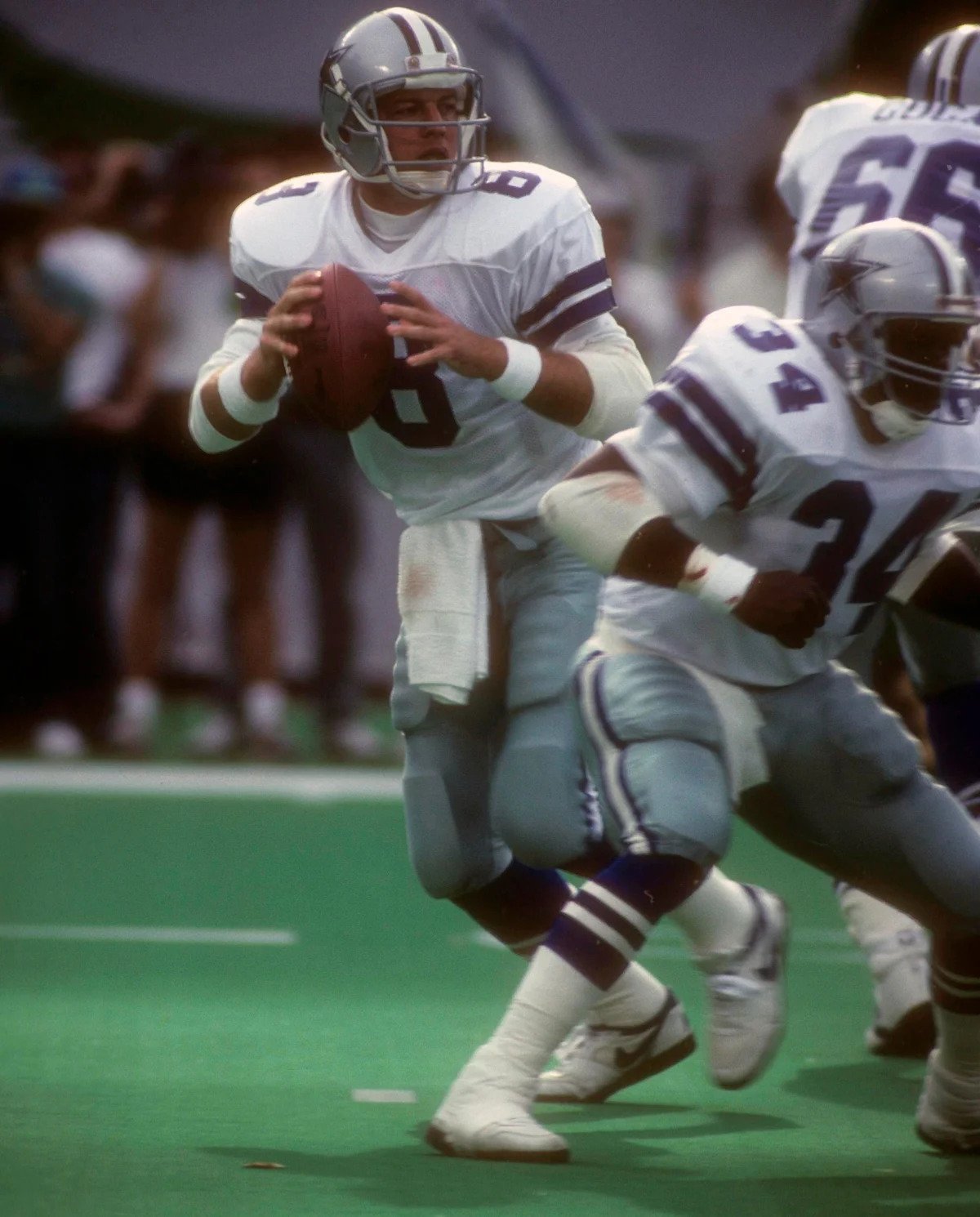
This is Day 69 of our 100-day countdown to kickoff, when we revisit a game that does not look enormous on the surface but matters deeply in the Cowboys’ franchise arc. Dallas opened the 1990 season at home against the San Diego Chargers, one year removed from the absolute misery of a 1-15 season. Troy Aikman had gone 0-11 as a rookie starter in 1989, Jimmy Johnson was still trying to prove the rebuild had direction, and the Cowboys were desperate for any sign that the future was arriving. On this September afternoon at Texas Stadium, a new era begins, and no one knew at the time how monumental and historic this era would become in NFL lore.
Advertisement
Sunday, September 9, 1990 — 4:00 p.m. ET
Texas Stadium, Irving, Texas
Final Score: Dallas Cowboys 17, San Diego Chargers 14
The Cowboys struck first with the kind of opening drive a young team badly needed. Aikman led Dallas down the field and finished it with a 28-yard touchdown pass to Dennis McKinnon, giving the Cowboys a 7-0 lead. San Diego answered in the first quarter when Mark Vlasic hit Craig McEwen for a 14-yard touchdown, then moved ahead in the second quarter on a one-yard Marion Butts run. At halftime, Dallas trailed 14-7.
For much of the second half, the game felt like one Dallas might let slip away. Aikman was sacked five times and threw an interception, the offense struggled to produce sustained scoring drives, and the Chargers had chances to build on the lead. But the Cowboys defense hung in. Issiac Holt intercepted Vlasic, San Diego missed a field goal opportunity, and Dallas eventually cut the deficit to 14-10 on Ken Willis’ 31-yard field goal in the fourth quarter.
Advertisement
Then came the mistake that changed the game. With just over five minutes remaining, San Diego faced fourth-and-6 near midfield and tried a fake punt. The ball went to linebacker Gary Plummer, but Bill Bates and Danny Stubbs stopped him after only two yards. The Cowboys suddenly had the ball, the crowd had life, and Aikman had the kind of late-game chance he had so rarely been given during his brutal rookie season.
Dallas made the Chargers pay. Tommie Agee converted a critical fourth-and-2 with a 16-yard run, and Aikman later hit Kelvin Martin for 24 yards down to the one-yard line. With 1:58 left, Aikman sneaked into the end zone for the winning touchdown. The Chargers’ final possession went nowhere, and Dallas had a 17-14 win that felt much bigger than Week 1 usually does.
Aikman finished 13-of-29 for 193 yards, one touchdown, one interception, and the game-winning rushing score. Agee led Dallas with 59 rushing yards, Kelvin Martin caught five passes for 78 yards, and rookie Emmitt Smith made his NFL debut with two carries for two yards. Michael Irvin, still working back from the 1989 knee injury that had interrupted his early career, was not yet a factor in this game, but the pieces of what would become the Triplets era were finally in the building.
This game belongs on the countdown because it was one of the first visible steps out of the darkness. The dynasty was on the horizon and this was where it all started. After a 1-15 season and a year of taking punishment, the Cowboys finally gave their young quarterback a late lead and watched him finish the job. That is how eras begin, not always with fireworks, but with proof.
Interesting Facts About the Game
The win snapped a 14-game home losing streak for the Cowboys. Dallas had not won at Texas Stadium since September 25, 1988, against Atlanta.
Advertisement
Countdown To Kickoff by day:
100, 99, 98, 97, 96, 95, 94, 93, 92, 91, 90, 89, 88, 87, 86, 85, 84, 83, 82, 81, 80, 79, 78, 77, 76, 75, 74, 73, 72, 71, 70

