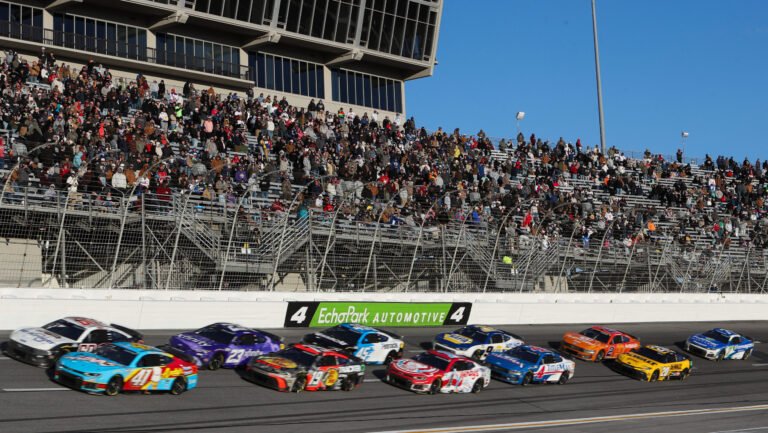
For decades, NASCAR fans knew it simply as Atlanta Motor Speedway. Today, it’s EchoPark Speedway, but while the name has changed, the Georgia track remains one of the sport’s most iconic and unpredictable venues.
This weekend, the NASCAR Cup Series, O’Reilly Auto Parts Series and Craftsman Truck Series return to the 1.54-mile oval in Hampton, Georgia, where drafting packs, late-race passes and dramatic finishes have become the norm since the track’s massive reconfiguration ahead of the 2022 season.
Advertisement
Whether you’re watching your first race at EchoPark Speedway or have followed NASCAR for years, here’s everything you need to know before the green flag waves.
Where Is EchoPark Speedway?
EchoPark Speedway sits on an 850-acre property in Hampton, Georgia, roughly 20 miles south of downtown Atlanta.
The facility opened in 1960 as Atlanta International Raceway before becoming Atlanta Motor Speedway in 1990 following Speedway Motorsports’ purchase of the property. In June 2025, the historic venue received another new identity when it was renamed EchoPark Speedway as part of a seven-year naming rights agreement with EchoPark Automotive.
Advertisement
Although the branding changed, the track itself remained the same NASCAR staple that has hosted Cup Series races for more than six decades.
Why EchoPark Speedway Is Unlike Almost Every Other NASCAR Track
On paper, EchoPark Speedway doesn’t look dramatically different from other intermediate tracks. It measures 1.54 miles, just slightly longer than the traditional mile-and-a-half ovals.
In reality, it races nothing like them.
Ahead of the 2022 season, Speedway Motorsports completed one of the most significant track redesigns in modern NASCAR history. The corners were narrowed and banking increased from 24 degrees to 28 degrees, transforming the racing style into something much closer to Daytona and Talladega than the old Atlanta layout.
Advertisement
Drivers now spend much of the race packed together in large drafting groups, often running two, three and even four wide for extended stretches. Instead of spreading out over long green-flag runs, the field remains tightly bunched, creating constant opportunities for passes and equally constant opportunities for trouble.
That combination has quickly made EchoPark Speedway one of NASCAR’s most unpredictable stops.
Why Every Finish Feels Like a Last-Lap Shootout
The statistics since the reconfiguration explain why fans rarely leave early.
Seven of the last eight Cup races at EchoPark Speedway have seen the winning pass come during the final two laps. Four of those races were decided by a pass on the final lap itself, proving that leading with a handful of laps remaining is no guarantee of victory.
Advertisement
Daniel Suárez delivered perhaps the most memorable finish in 2024 when he edged Ryan Blaney and Kyle Busch by just 0.003 seconds, one of the closest finishes in NASCAR Cup Series history. That same race produced only a 0.007-second margin separating first through third.
The lesson has become clear: at EchoPark Speedway, timing the winning move often matters more than leading the most laps.
Strategy Matters as Much as Speed
The racing isn’t the only challenge.
EchoPark Speedway features NASCAR’s longest pit road at approximately 3,900 feet, adding another wrinkle to every race. Since the pit road extension was introduced, speeding penalties have become a frequent storyline, and one mistake entering or exiting pit road can erase an otherwise dominant afternoon.
Advertisement
Late-race strategy has become just as important. Every winner since the 2022 reconfiguration has made the decisive final pit stop by taking either two tires or fuel only, sacrificing fresh rubber for valuable track position.
Crew chiefs often face difficult decisions in the closing laps, knowing that restarting near the front can be more valuable than having the fastest car.
Big Crashes Have Become Part of the Story
The same drafting style that creates thrilling finishes also creates enormous risk.
Every Cup race at the reconfigured EchoPark Speedway has featured at least 16 cars involved in accidents, and the last three races saw 28, 36 and 29 cars collected in various incidents.
Advertisement
With the field racing inches apart at nearly 190 mph, one small mistake can quickly trigger a chain reaction involving much of the pack.
It’s one reason drivers often describe EchoPark Speedway as mentally exhausting despite its relatively short length.
A Track Filled With NASCAR History
Long before the recent drafting era, the facility had already earned a permanent place in NASCAR history.
Fireball Roberts won the inaugural Cup race in 1960 after the track was constructed for approximately $1.8 million.
The venue later became home to one of NASCAR’s most memorable championship battles in 1992. Alan Kulwicki claimed the Cup Series title over hometown favorite Bill Elliott by leading one more lap during the season finale, one of the closest championship finishes the sport has ever produced.
Advertisement
EchoPark Speedway also remains home to one of NASCAR’s oldest qualifying records. In November 1997, Geoff Bodine recorded a blistering 197.478 mph lap, which still stands as the fastest qualifying lap ever recorded for a non-restrictor plate Cup race.
There Are Plenty of Surprises Beyond the Racing Surface
EchoPark Speedway offers more than just racing.
The property includes Tara Place, a nine-story condominium complex overlooking the track, along with a road course configuration that combines portions of the oval with the infield.
One of the venue’s most unusual landmarks sits beyond Turn 1, where the historic Mount Pleasant Methodist Episcopal Church Cemetery remains preserved. Dating back to the mid-1800s, the cemetery predates the speedway by more than a century and continues to be maintained today, creating one of the most unique sights anywhere on the NASCAR schedule.
Advertisement
The facility also hosts concerts, car shows, festivals and other major events throughout the year when stock cars aren’t on the racing surface.
Why EchoPark Speedway Has Become One of NASCAR’s Best Weekends
Few tracks on the NASCAR calendar have reinvented themselves as successfully as EchoPark Speedway.
The name may have changed from Atlanta Motor Speedway, but the venue has become one of the sport’s signature stops thanks to its combination of superspeedway-style drafting, unpredictable strategy and photo-finish endings.
Every trip to Hampton carries the feeling that anything can happen until the checkered flag falls. Based on the track’s recent history, that’s exactly what fans should expect again this weekend.

