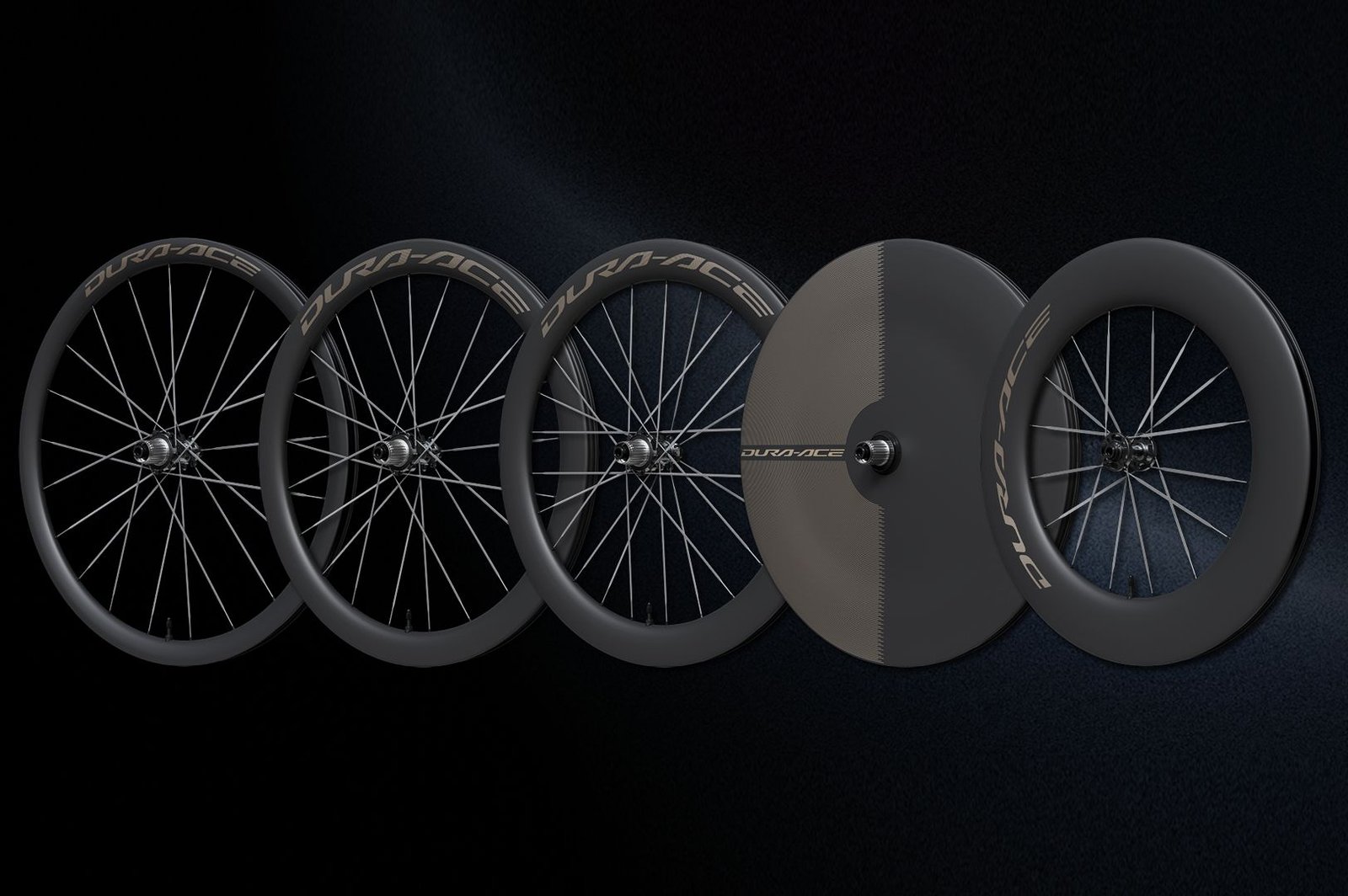
Shimano has officially unveiled its new Dura-Ace wheel lineup that the WorldTour teams it sponsors have been racing as prototypes – something we spotted at Opening Weekend already. Mathieu van der Poel and his Alpecin-Premier Tech teammates have ridden the wheels in competition and training over the past year, including at the Tour de France, as part of Shimano’s development process.
The new WH-RH9370 series is lighter by up to 220g per wheelset thanks to carbon spokes and produces as much as 2.7 watts less aerodynamic resistance than before, according to the Japanese brand.
Alpecin-Premier Tech has been using the wheels for the past year as part of the development process
(Image credit: Aaron Borrill)
Shimano has also broadened the hooked internal rim from 21mm to 23mm to better support the wider 28-30c tubeless tyres its pro teams ride.
Latest Videos FromCycling Weekly
Shimano’s best road bike wheels continue to use the company’s adjustable and repairable cup-and-cone hubs, to which it has added replaceable bearing cups.
The Dura-Ace road wheel range includes three rim depths: 36mm, 50mm and 60mm. All cost £2,299.98/ $2,970 per wheelset. The time-trial range consists of a 99mm-deep front wheel (£1,199.99/ $1,595) and rear disc wheel (£2,299.99/ $3,030). Shimano says they will be available to consumers from September.

The wheels are 220g lighter thanks to carbon spokes and produces as much as 2.7 watts less aerodynamic resistance
(Image credit: Shimano)
Weight savings
Shimano says a reduction in weight compared to the outgoing R9270 series improves climbing and acceleration with no detriment to stability or longevity. Most of the savings will have come from the move from steel to carbon spokes, which are a couple of grams lighter per spoke as well as being much stiffer and stronger.
Shimano has also credited improved rim layups and overall engineering efficiencies. It claims to have saved 180g from the C36 climbing wheelset, 159g from the mid-depth C50 and 220g from the deeper section C60. These reductions close the gap between Shimano’s wheels and high-performance options from the likes of Scope, Cadex and Roval.

Rim depths span 36-, 50 and 60mm
(Image credit: Shimano)
Optimised for wider tyres
The new 23mm-wide internal rim is said to put wider tyres into a more stable and aerodynamic shape, while the external rim width manages speed and stability in crosswinds. Shimano says it adjusts the profile of the front and rear rims to their depth.
However, the purported improvements in aerodynamic efficiency are modest. At 48km/h (30mph) on 30c tyres, Shimano says the new wheels can save up to 2.7 watts.
It adds that it developed the wheels with computational fluid dynamics and certified their performance at wind angles riders are likely to face on the road.

The hub use the company’s adjustable and repairable cup-and-cone hubs, now with replaceable bearing cups
(Image credit: Shimano)
Tailored carbon spokes
Shimano has designed two kinds of carbon spokes, both with hidden nipples to lower drag, to deliver its objectives for each wheelset.
- Super Aero: 5.2mm x 0.8mm
- Aero: 4mm x 1.1mm
Like any other wheel builder, it tailors the spoke type, count and configuration to the wheel’s intended use.
For example, the C36 has 18 front and 21 rear Aero spokes to favour low weight and reactivity while the C60 has 21 front and 24 rear Aero spokes to prioritise lateral stiffness in sprints. The C99 front TT rim drops down to 16 Super Aero spokes to minimise drag.

Mathieu van der Poel field-testing the new WH-RH9370 series wheels
(Image credit: Shimano)
Updated cup-and-cone bearing system
Shimano’s removal of cup-and-cone bearings from its latest XTR mountain bike wheels disappointed fans of fully serviceable hubs. Unlike the now-more common cartridge bearings – which have to be binned when enclosed ball bearings, races and seals wear out – a mechanic can disassemble, clean and regrease cup-and-cone bearings and replace individual parts.
Shimano has maintained cup-and-cone bearings in the RH9370 series, it reckons the long-term serviceability, adjustable torque and smoother rotation are better than before.
It says its comparative testing found lower friction in cup-and-cone hubs than cartridge alternatives. To two wheels, it applied 500N of vertical force, simulating the rider and bike weight, 200N of pedaling force, and 500N of clamping force from the thru-axle. The new cup-and-cone bearings displayed 30% less rotational torque than standard cartridge bearings, according to Shimano. But it didn’t explain how this translates into performance on the road.
In addition, Shimano has introduced replaceable bearing cups. The outgoing wheelset suffered from water ingress at the front bearings, which caused them to corrode and the internal surfaces to pit, requiring a whole new hub shell or wheel. It also claims to have improved the hubs’ waterproofing.
What about the rest of Dura-Ace?
Shimano hasn’t announced more details on the prototype SPD-SL pedals that caused Alpecin-Premier Tech strife at Paris-Roubaix. After puncturing in the Carrefour de L’Arbre, Mathieu van der Poel was unable to clip into the pedals of his teammate Jasper Philipsen‘s bike, fitted with the prototypes. This seemed to indicate that the new pedals use different cleats to the existing Dura-Ace R9100 platform Van der Poel was riding. Nor is there any word on the anticipated update to the Shimano Dura-Ace Di2 groupset.

