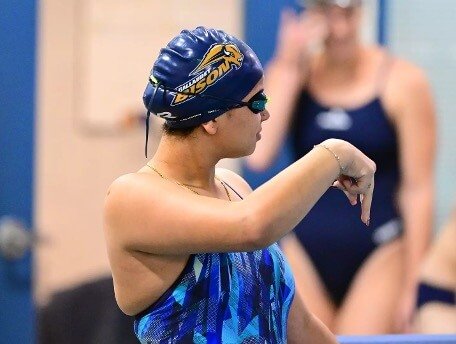
Gallaudet University Breaking Barriers in Deaf Swimming
For Stephanie Danner, swim practice was always a gift.
Spending time at the local pool with her brothers was a constant joy, gallivanting in the summer sun. Swim practice was always something to look forward to, an opportunity to improve a skill she cared deeply about. Danner thrived, and enjoyed the sport she loved. And yet, one thing was missing: Danner was deaf, and struggled to understand her coach and her teammates.
“My team was incredible, and learned ASL (American Sign Language) so they could speak with me,” she said. “But I would miss parts (of sets), and often have to work on teaching teammates ASL to communicate.”
Danner’s struggle is one not unfamiliar within the deaf swimming community. But it’s one that she, among many other swimmers, has found a solution to: competing at Gallaudet University, the nation’s only predominantly deaf college with a swim team.
Located in Washington, D.C, Gallaudet boasts both a men’s and a women’s team, competing in the Atlantic East Conference. Head Coach Brian Bennett, who is also deaf, explained that the team offers an opportunity both to learn, and grow as a swimmer, for a group that often gets left behind.
“We find that without direct communication access, these swimmers miss out on the ability to build on their skills, to understand verbal commands and why they are important,” Bennett said via an interpreter. “They miss out on a lot of information.”
Bennett competed for the school back in 2003. For him, the opportunity to aid his community is one he feels strongly about.
“On average, it’s probably just one or two (deaf) swimmers around the entire U.S. who continue to compete after college, and there are only two entirely deaf high schools with teams, in Texas and Florida,” Bennet said. “The numbers show we’re at a strong disadvantage, and that has led to my passion.”
That passion is much appreciated, from all involved in the program. Current junior Alex Wilding stressed that Bennett’s commitment to the team motivates his swimmers.
“He supports us fully, both in school and in the pool,” Wilding said. “He really wants us to succeed.”
A Rich History
Courtesy: Gallaudet University
Under Bennett, Gallaudet has made massive strides. But the school’s commitment to its athletes, and the sport, stems from long before the coach arrived.
The program, which began on the men’s side in the early 1960s, and the women’s side in the early 1970s, hit a stride in the early 2000s. Gallaudet won multiple conference championships in the North Eastern Athletic Conference (NEAC) in that period, under coaches Bill Snape and Larry Curran.
“A lot of it for us was simply putting together a team that had real energy for swimming, and then building from there,” Snape said. He acknowledged that his teams didn’t quite have big numbers in terms of participation, but made up for it in terms of effort.
“Sometimes you’d be recruiting very inexperienced swimmers, and just offering to teach them,” Snape said. “It was more about that energy level we were able to bring.”
Bennett admitted he has similarly had to strain in terms of recruiting. To him, this style of recruiting has created a bit of a talent gap for the program. Some swimmers are working on being competitive and winning races, while others are still learning the basic skills of the sport.
To the coach, it goes back to continuing to be an advocate for hearing-impaired athletes in the sport. Bennett looks to help these swimmers “fill gaps” that may have occurred in their swim experience in their youth.
“On a hearing team, there’s so much talking going on, with key terms and information, that these kids miss out on key information and fail to master these skills,” he said. “I might even spend more time on a beginner swimmer than an advanced swimmer, just so that I can make sure they’re able to fill in what they missed out on.”
Wilding started out at Gallaudet as one of those swimmers, only swimming recreationally in the past. He found the experience of learning the sport at Gallaudet to be a smooth and enjoyable introduction.
“This is a sport I’ve really grown to enjoy,” he said. “I’ve been able to become so much more confident in my skills.”
Wilding pointed much of the credit for that development back to Bennett.
“He helps us in the pool, and supports us through school,” he said. “That’s someone who really wants us to succeed.”
New Technology Helps Turn the Tables
Gallaudet’s development as a team in the pool has been an achievement on its own. But throughout the process, the team has also turned into an advocate for all of deaf swimming.
Back in 2017, under Curran, the program proposed to the NCAA a reaction-light system, which would remove one of the largest disadvantages for deaf swimmers: the start. A green light would flash on the block when swimmers were supposed to leave, rather than relying on hand signals.
“So much of our mindset was about ensuring these swimmers were treated fairly,” Snape, who helped work with the team on the petition, said. “We put so much work into that, which made it a great metaphor for our own team, as we worked hard and saw success.”
The groundbreaking change was approved a year later, and is now used by the program at many of its meets, including the conference championships.
The reaction lights aren’t the only technology the Bison use to make the sport easier for their swimmers. The team installed LumaLanes at their pool, which allow swimmers to track intervals during practice. A light on the bottom of the pool flashes when swimmers have to leave during an interval. It also helps them pace, through the light moving at the interval they’re attempting to hit. If a swimmer is moving faster than the light, they are above pace, and behind it, they are off.
“We’ve been really successful in making a more accessible environment for our deaf swimmers,” Bennett said. “We’re really creating opportunities (for our athletes).”
Contributing to the Community
Gallaudet has helped deaf athletes make massive strides in the sport. But according to Snape, there’s still a lot of room for improvement, in terms of how the swimmers are treated.
“Deaf swimming is at a unique disadvantage in America,” he said. The coach explained that deaf athletes are not subsidized, as they do not fit under the Paralympic structure.
“Unlike in some other countries, where deaf swimming is subsidized, it’s hard to get money to support,” he said.
Gallaudet doesn’t struggle with these same problems, per Bennett. The coach expressed a belief that the program is well-supported by the university, and adequately funded. However, he stressed that the school still looks to help deaf swimming in America in another way: by providing opportunities for the deaf to learn how to swim.
Gallaudet hosts a swim school at its pool, with ASL-fluent students serving as instructors. Bennett cited it as an opportunity to give back to the community.
“Being able to give them a chance (to be involved in swimming) is so important,” he said. Many swimmers, he said, are not involved in the sport due to a fear that stems from parental figures.
“So many parents never envision their kids being a part of a swim team, because they don’t want their child to feel left out in an environment that is not exactly inclusive toward them,” he said.
“We don’t want them to miss out on the opportunity, by ‘taking the easy way out.’”
The coach pointed to getting non-swimmers involved in helping with the lessons, and around the pool, as an important step.
“There are many who are interested in swimming (competitively), but aren’t quite ready,” he said. “We want everyone to know there are careers in swimming that deaf people can participate in.”
By helping break down barriers, the program is making history. The main focus, however, remains on their upcoming season, and replicating a great finish a year ago.
“The cheering and the energy we felt at conference championships was incredible last year,” Wilding said. “We really want to keep that energy this season.”
In the end, by “keeping the energy,” the team looks to grow and represent the deaf swimming community well.
“I hope to continue building a team that cares and supports each other, while we continue to build our strength,” Bennett said.

