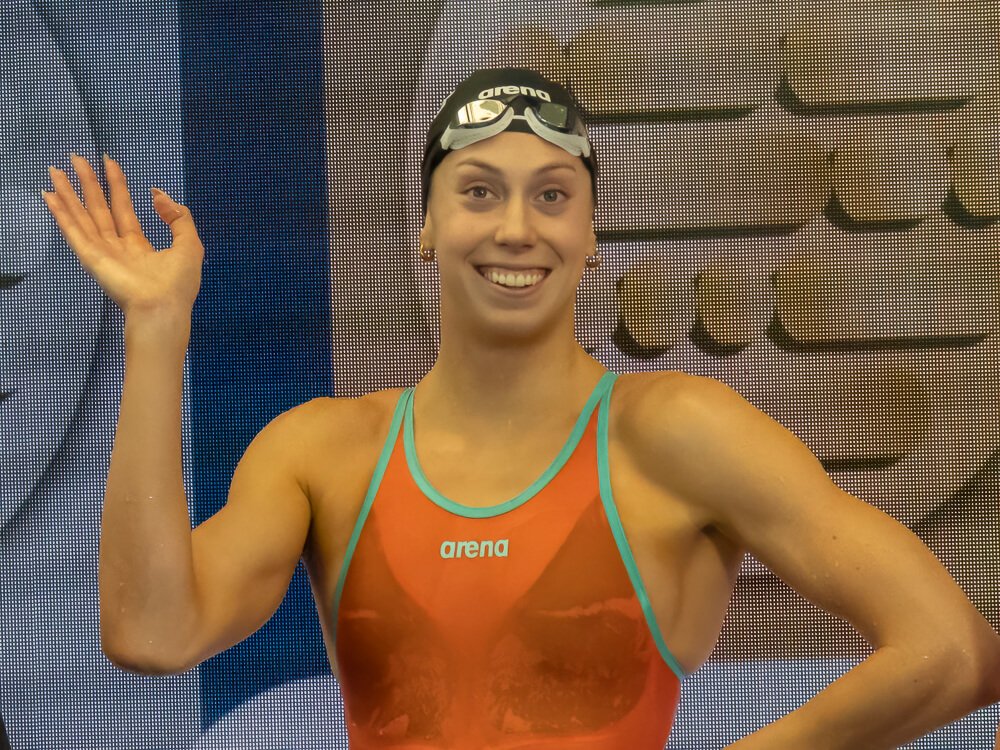
How Gretchen Walsh Has Crushed All Limits in 100 Butterfly
Three years ago, Gretchen Walsh opted to race the 100 backstroke instead of the 100 butterfly on the middle day of her sophomore-year NCAA Championships. The decision surprised no one, and Walsh established the fastest time in history in the event at 48.26. About an hour earlier, Virginia teammate Kate Douglass won a showdown with Olympic champion Maggie Mac Neil in the 100 fly, with both swimmers crushing the previous NCAA and U.S. Open records. Douglass hit the wall at 48.46 to take the victory.
At that moment, the world records in the meters version of that event belonged to Sarah Sjostrom in long course at 55.48, a mark that dated back to the 2016 Olympics, and Mac Neil in short course, at 54.05. Months later, Walsh would make her first serious competitive foray into the 100 fly, qualifying to race the event at World Championships and finishing eighth. But since then, she has completely reimagined the limits of the event — in all three courses.
The jump happened during the Olympic season of 2024. By that point, she had finally developed the endurance required to maintain her speed and power down the length of the 50-meter pool. And at the U.S. Olympic Trials, she took down a world record that had lasted eight years, going 55.18 in the semifinal round. She backed up that performance a night later with a time of 55.31, also under the previous mark. At the Paris Games, Walsh set an Olympic record of 55.38 in the semifinal round, although she would end up falling in the final as Torri Huske surged ahead in the closing strokes.
By 2025, however, Walsh was unbeatable. There were a pair of out-of-nowhere world records at the Fort Lauderdale Pro Series in May, 55.09 in prelims and a jaw-dropping 54.60 in the final. A month later at U.S. Nationals, she won the event in 54.76. At the World Championships, Walsh battled through illness to claim gold in 54.73. It was less than 14 months since no one had touched 55.48, and now Walsh had been under 55 on three separate occasions.
All that was before her latest blast, again in Fort Lauderdale. Out in 25.09 and back in 29.24, Walsh broke the world record for a fourth time with an incredible mark of 54.33. That was more than a second faster than Sjostrom ever went, making her the most dominant performer in any long course event. In total, the 23-year-old now owns the 10 fastest performances ever in the event.
Gretchen Walsh at the 2025 World Championships — Photo Courtesy: Emily Cameron
But before Walsh moved her domination to the Olympic pool, she obliterated all historical precedent in short course yards. During the 2023-24 college season, Walsh unofficially broke the all-time record in the event at midseason as she raced butterfly in a freestyle event. In the spring, the magic began: 48.25 at the ACC Championships, then a stunning 47.42 at the NCAA meet. She was a full second ahead of the times Douglass and Mac Neil had posted one year earlier, times which had then seemed like such a huge jump.
Not content with that, Walsh blistered the mark by another half-second her senior season, with times of 47.21 in the NCAA prelims and 46.97 at night. After the finals swim, the scoreboard at the King County Aquatic Center had gone out, so Walsh could only smile and shrug for a few moments until she learned she had reached the 46s far sooner than anyone could have imagined. Such is her dominance in short course that she won by two full seconds over Huske, just months after Huske had taken down Walsh in the Olympic final of the long course event.
Don’t forget about short course meters, the last of the formats to fall to Walsh’s butterfly mastery. Most Americans scarcely race in the format, at least until they have opportunities to compete globally, and Walsh took advantage right away. Mac Neil’s 54.05 was gone as soon as Walsh arrived at the 2024 Short Course World Championships in Budapest. In fact, she broke the world record in all three rounds, going 53.24 in prelims, 52.87 in semifinals and 52.71 in the final. The latter swim resulted in a gold medal by almost two seconds. A year later, Walsh swam times in the 53-second range on four occasions during the World Cup circuit, giving her history’s seven best efforts.
Not bad for a swimmer who spent the first two years of her college career specializing in sprint freestyle and backstroke. Of course, Walsh remains an elite freestyler as well, with legitimate chances of earning international medals (perhaps even gold) in the 50 and 100 free in coming years. She won the world title in the 50 fly last year, but her dominance in that race could come under fire with Sjostrom’s return to racing.
As for the 100 fly, though, Walsh has figured out the perfect combination of power, speed and the ability to hang on down the stretch. She is likely finished racing short course yards, at least for championship meets, but the meters records could continue to tumble in coming years. She has one world title in each course already, and with more than a full second advantage on anyone else in history, more titles will surely follow.

