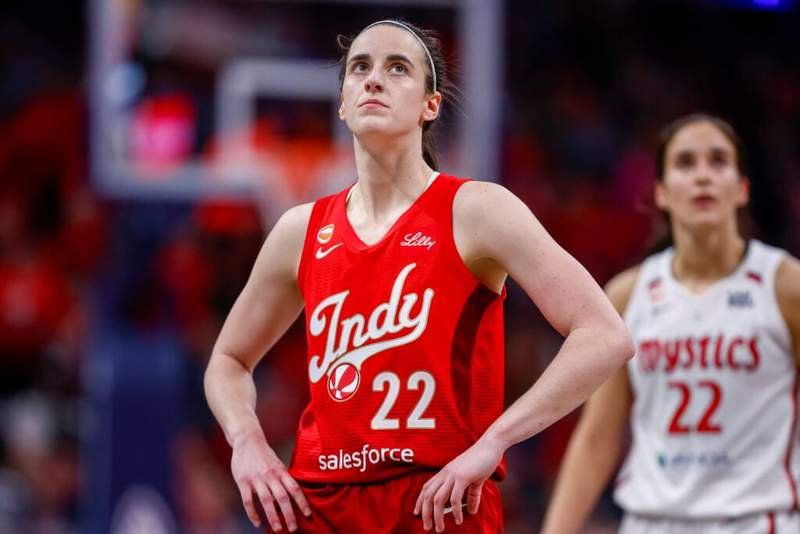
Jason Whitlock has accused the Indiana Fever and WNBA of “hate” against Caitlin Clark, following a promotional controversy around Indiana’s May 17 game against the Seattle Storm and a sideline exchange involving Fever assistant coach Briann January.
The issue is not that Whitlock noticed nothing. It is that his strongest language goes beyond what the evidence supports.
Advertisement
Clark’s market value makes any decision to leave her out of major Fever promotion hard to justify. But questionable marketing is not the same thing as proven hostility.
Jason Whitlock is right to question how Caitlin Clark was promoted
Photo by Bobby Goddin/Getty Images
Whitlock’s criticism came after he argued that the WNBA used A’ja Wilson and Angel Reese to promote Atlanta Dream against Las Vegas Aces, but did not do the obvious thing with Clark and the Fever.
He said Clark is the “biggest thing in women’s sports” and argued that the league chose to avoid her instead. That is the part of the argument the WNBA cannot simply wave away.
Advertisement
“You look at the Atlanta Dream vs. the Las Vegas Aces game, and they use A’ja Wilson and Angel Reese to promote the game. But when it comes to the Indiana Fever, we can’t promote Caitlin Clark, the biggest thing in women’s sports and the biggest thing in women’s basketball. Let’s avoid her.”
The controversy centred on a WNBA promotional graphic that reportedly left Caitlin Clark off the Fever side of a national doubleheader. That same May 17 schedule involved Las Vegas Aces against Atlanta Dream and Indiana Fever against Seattle Storm.
For a league trying to grow its audience, that is a strange choice. Clark does not have to be the only player promoted, but she cannot sensibly be treated as just another name when Indiana are involved.
Caitlin Clark’s value makes that decision harder to explain
This is why Whitlock’s wider marketing criticism has weight. Clark has already been tied to a record-setting 2024 season for the WNBA and record fan engagement for the Indiana Fever.
Advertisement
The Fever’s 2026 schedule also underlines her pull. Indiana were part of the league’s prominent national broadcast plans, with NBC Sports highlighting Fever games among the major WNBA broadcast properties.
That does not mean every social post has to become a Clark poster. It does mean the league should understand the difference between sharing the spotlight and hiding the player most casual fans recognise first.
Promotion is not just about fairness inside a locker room. It is also about audience behaviour. Clark is one of the few WNBA players who pulls people into conversations they otherwise might ignore.
The word “hate” is where the argument stretches
Whitlock’s strongest claim is also his weakest evidentially. Saying the WNBA made a poor marketing decision is one thing. Saying the Fever and WNBA “hate” Clark is another.
Advertisement
He also used the phrase “Caitlin derangement syndrome” while discussing the issue. That is sharp commentary, but it is not proof of motive.
“Look at this video of her arguing with the assistant coach on the sidelines,” he said. “How does this happen when she’s playing the most efficient, most mature game and getting her teammates involved? And she’s arguing with the assistant coach on the sidelines? These people hate Caitlin Clark. They have Caitlin derangement syndrome.”
The available evidence points more cleanly to a questionable promotional choice than to an institutional campaign against Clark. It also matters that Indiana have continued to use Clark prominently in their own wider media environment.
That distinction is important. If the WNBA left Clark off a major Fever graphic, it deserves criticism. But criticism works best when it stays tied to what can be shown.
Advertisement
The sideline exchange should not carry more weight than the game itself
Whitlock also pointed to video of Clark having an animated sideline exchange with Fever assistant coach Briann January. That moment became part of the wider debate because everything around Clark now gets magnified.
Reports linked the exchange to a tactical or defensive discussion during Indiana’s 89-78 win over Seattle. There was no confirmed formal reprimand or official statement that turned it into something larger.
The basketball context matters more. Clark finished that game with 21 points, 10 assists and seven rebounds.
Advertisement
A competitive player arguing a point with a coach is not automatically evidence of dysfunction. It can be exactly what happens when a high-level player is locked into the details of a game.
Whitlock found a real Caitlin Clark issue because the WNBA should know better than to make its biggest attention driver feel optional in major promotion. But his conclusion goes further than the facts allow.
The fairer view is simple. The league made a bad marketing choice, and Clark’s value makes that choice look worse. Calling it “hate” turns a legitimate criticism into a claim the evidence does not yet prove.
Read more:

