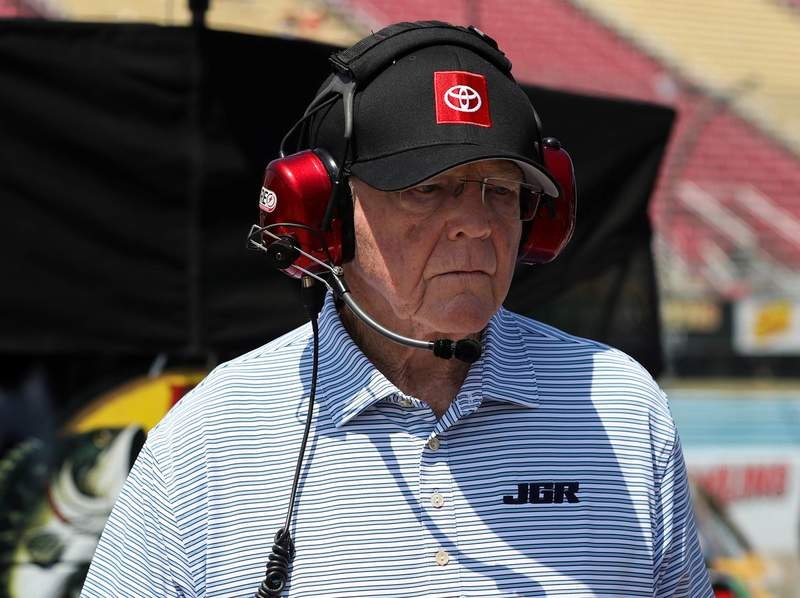
The toothpaste is out of the tube. How to put it back now? This was the situation NASCAR found itself in ahead of the Cup race at Talladega. Fuel-saving strategies have overshadowed much of the superspeedway racing in the Next Gen era. To combat that, the governing body introduced a major change, a shake-up of the stage lengths. But it didn’t work. And as per James Small, crew chief at Joe Gibbs Racing, other attempts to combat or eradicate fuel savings strategies won’t work either for a simple reason.
Speaking to SiriusXM NASCAR Radio, Small claimed that race cars simply cannot get out of line on superspeedways because of the nature of the Next Gen car. “It has a lot of drag. And we’re trying all these other ways to get around, maybe what’s not the greatest package on a superspeedway when it comes to racing,” he stated.
Advertisement
Moreover, Small wondered if it is an aero element (drag) that is preventing passing, perhaps NASCAR would be open to turning up the notch on the speed side of the car. However, he wasn’t sure if the sport would be taken back to the days of cars going over 210 mph at superspeedways.
Despite that, the Joe Gibbs Racing crew chief was hopeful of coming up with a solution to the problem through a collaboration between NASCAR and the teams. But until then, Small admitted that fuel-saving tactics would continue.
“I just think the fuel saving thing until you have the ability to maybe drive through the field or move around and make runs at people, it’s going to be hard to get rid of that because it just comes down to a track position race,” he described. “And we can’t unlearn what we’ve learned in a sense.”
The Next Gen car being drag-heavy and that being a factor in the lack of passing and leading to fuel saving is something Denny Hamlin also pointed out after Talladega. The newly elongated 98-lap stage 1 saw cars running close to 70% throttle to save time on pit road.
Advertisement
“The air that gets punched by this car is so massive, and they’re so draggy that all it takes is a little bit of a sniff and you can just run half throttle right behind someone that’s running all out,” he said on Actions Detrimental.
Then there’s the fact that drivers cannot pull out of line during the race. Because if they do that, they get swallowed by the pack and find themselves several positions down.
This proved that NASCAR’s attempts at preventing fuel savings were in vain. They made the first stage longer and the second and third stages shorter in hopes of more full-throttle action. But things turned out differently.
So what now?
Advertisement
Denny Hamlin urges NASCAR to make a major sacrifice on the Next Gen car
Denny Hamlin, one of the most accomplished and experienced drivers in the sport, suggested that instead of shortening the stage, NASCAR should shorten an aspect of the car. In fact, Hamlin suggested a complete removal of a key part of the Next Gen car.
“I hope next time they try something different. My first recommendation is please cut the spoiler off this car. Please. Do whatever it takes. If we’ve got to run 210 (miles per hour), we’ll run 210. It’s fine. Just please get some drag out of this car,” he claimed on Actions Detrimental.
He remarked that compared to the Gen 6 car, the Next Gen car has ‘hundreds of counts more drag.’
Advertisement
If the drag issue is addressed, it would naturally reduce the need for fuel saving, allowing drivers to pull out of line more freely, pit from outside the top five, and still rejoin the race with a realistic shot at the win.
The post Joe Gibbs Racing Insider Flags Superspeedway Challenge as NASCAR’s Fuel Saving Tactics Continue Dictating Race Outcomes appeared first on EssentiallySports. Add EssentiallySports as a Preferred Source by clicking here.

