Over the past few weeks, both the point guard and shooting guard Mt. Rushmore have sparked a lot of great conversation and insight. Shifting our attention to the small forwards, I expect this rendition of the mountain to do the same.
For the Knicks, the three-spot is not just another position. It is a goldmine of pure scorers, gritty enforcers, and players who seamlessly match New York City’s energy. The top two spots on this rock were quite simple to chisel in. They are franchise legends, making significant impacts on their era of basketball. Spots three and four, on the other hand, provided a bit more of a challenge.
Advertisement
Let’s head back to the mountain and get this all settled.
Carmelo Anthony
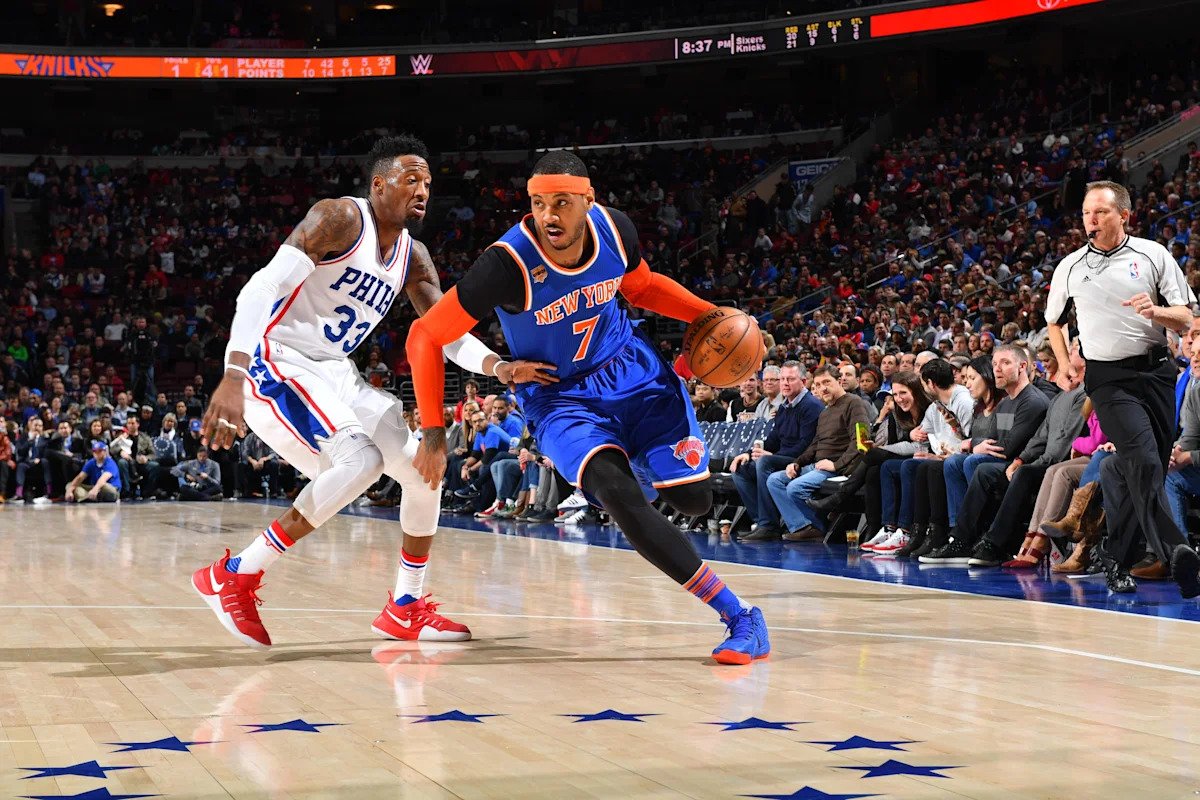
Okay haters, let’s get the counterargument out of the way. Yes, his overall playoff resume during his Knicks tenure is far from perfect. But Carmelo Anthony took New York basketball out of the dungeon and made it matter again. After years of inhabiting the NBA’s desert, one of basketball’s greatest scorers willingly took on the pressure of Madison Square Garden to get the Knicks back to relevance.
A complete offensive force, Anthony possessed the physical strength to punish smaller defenders in the post and combined it with a soft shooting touch from the perimeter. He was the focal point of 2012-2013’s 54-win season, capturing the scoring title by scoring 28.7 points per game. Whether it was his 62-point explosion or the clutch threes on Easter Sunday, Melo delivered moments that defined a generation of Knicks basketball. Earning seven All-Star selections as a Knick, he sits at seventh on the franchise’s all-time scoring list despite only playing six and a half seasons in New York. There is no denying that Carmelo Anthony’s face belongs on the mountain.
Bernard King
If we are talking about peak performance, Bernard King might have had the highest ceiling of any Knicks player. Before a devastating knee injury changed his career trajectory, King was arguably the most unstoppable player in the NBA not named Magic Johnson or Larry Bird.
Advertisement
An expert of the mid-range and one-person fast break, King completely overwhelmed defenders with speed, power, and an unblockable release. Capturing the 1984-85 scoring title, he averaged a mind-boggling 32.9 points per game. On Christmas Day against the Nets, he dropped 60 points, the highest single-game total on Christmas. During the 1984 playoffs, King put the team on his back, averaging close to 35 points per contest against the Pistons and Celtics.
To put it simply, one cannot tell the story of the New York Knicks without showing Bernard King the love he deserves. Like Melo, King is a total lock to make our Mt. Rushmore.
Bill Bradley
You cannot carve an accurate mountain without honoring the figures that helped bring home the Larry O’Brien Trophy. Starting at small forward for both the 1970 and 1973 championship teams, Bill Bradley was the epitome of a team-first basketball player. A perfect contrast to the isolation play of Anthony and King, Bradley was not flashy or the primary offensive engine. Instead, he was an incredibly intelligent, unselfish player capable of executing Red Holzman’s system perfectly. Understanding spacing better than most, he moved without the ball flawlessly. He consistently hit open jump shots, serving as the perfect connector alongside Willis Reed, Walt Frazier, and Earl Monroe.
Advertisement
Not possessing the scoring titles, Bradley is still a two-time champion and Hall of Famer whose number 24 hangs in the Garden rafters. That is enough to put him as the third face on our small forward Mt. Rushmore.
Latrell Sprewell
With the first three spots of the mountain inhabited by Melo, King, and Bradley, spot number four needed a specific brand of energy to round out the group. Latrell Sprewell provided that exact energy.
The 1999 NBA Finals run is sacred ground for Knicks fans. New York was an eighth seed with absolutely no business competing for a title. Yet, Sprewell put the franchise on his back and willed the Knicks forward. Not just a productive player, he was a cultural phenomenon, perfectly capturing the gritty, underdog mentality of the city. When the offense completely shut off in the postseason, Spree served as the engine keeping the team alive. Completely carrying the offensive load against the Spurs in the ’99 Finals, Sprewell thrived under pressure and made fans in the Garden roar like no other.
Advertisement
He was the ultimate wildcard. For that, he takes our final spot.
The Snubs
Before we officially close the book on this debate, we have to give a shoutout to the players that missed the cut. Though they fell on the wrong end of the selection, we cannot ignore how much these players meant and continue to mean to the franchise.
Fully understanding the recency bias, leaving OG Anunoby off the mountain hurts. The definitive perimeter of our championship team, we also do not win the title without him dismantling the opposition’s best wing every game. Of course, his “Hand of God” tip-in sits as one of the greatest moments in NBA history. However, when comparing his relatively short tenure to the massive footprint left by Sprewell in the late 90s, Spree edges him slightly, for now.
Advertisement
Then there is Anthony Mason. Mase served as the heart, soul, and muscle of Knicks basketball in the 90s. Playing point-forward, he was completely ahead of his time. But because he split so much of his time playing power forward, it felt right to leave him off the pure small forward list.
Finally, we need to show respect to Larry Johnson and RJ Barrett. Providing unmatched leadership, LJ gave us the legendary 4-point play. On the other hand, RJ was the polarizing prodigy that helped rebuild New York’s broken culture and serve as the bridge to the current championship era.
Okay, so the rock is set. The official New York Knicks Small Forward Mt. Rushmore features Carmelo Anthony, Bernard King, Bill Bradley, and Latrell Sprewell. We get two of the greatest scorers in franchise history, the historic glue guy of the 70s championships, and the chaotic energy of the 1999 Finals run.
Now, it’s your turn. Where did I go wrong? Who did I disrespect? Am I completely out of my mind for leaving Anunoby off after this title run? Let me know who makes you mountain below.

